How to remove brown algae, thread algae, green spot algae, black beard algae, staghorn algae and blue-green algae
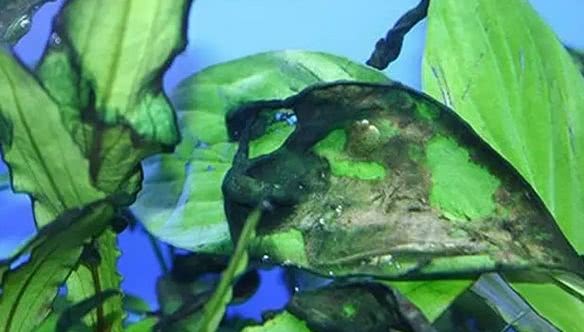
Blue-green algae
Blue-green algae can be green, black or brown in color, covering the surface of the substrate like snot, with a foul-smelling odor, and often appears on the substrate and at the contact surface between the substrate and the tank wall.
Causes: water hardness too high, substrate too fine.
Treatment: use a gravel cleaner to siphon it out.
Staghorn algae
Staghorn algae: its appearance is easily mistaken for black beard algae; the difference is that black beard algae grows like a chrysanthemum, radiating outward from the center, with an obvious center, while staghorn algae grows in a more irregular pattern, is longer than black beard algae, and looks similar to a stag's antlers.
Causes: staghorn algae generally appears when ammonia nitrogen in the water exceeds the standard and PH is on the high side.
Treatment: remove as many of the algae-bearing leaves as possible, stop feeding, and based on the PH and hardness test results, increase CO2 supply and add some purified water when changing the water.
Black beard algae
Black beard algae: the great enemy of the planted tank, severely affecting the visual effect, severely affecting plant growth, and extremely stubborn, because not a few people have torn down their tanks due to a black beard algae outbreak.
Characteristics: black chrysanthemum-shaped, short and hard hairs, cannot be pulled off with tweezers, often appears on stones, driftwood, leaves in poor condition, filter intake and outflow openings, and the substrate.
Causes: opinions differ on the causes of black beard algae; it is generally believed to be water on the hard side and PH on the high side, as well as eutrophic water caused by too many fish, overfeeding and infrequent water changes, unreasonable liquid fertilizer composition, imbalanced trace elements and other reasons.
Solutions: since black beard algae is the BOSS among algae, it must be tackled case by case:
1. If black beard algae grows on the substrate, just wash it out and throw it away;
2. For black beard algae on stones, take them out and scrub it off with a steel wool ball;
3. For leaves with black beard algae, if possible, cut them off as much as you can;
4. A toothbrush or tweezers cannot remove black beard algae; only a steel wool ball can;
5. Increase water changes; if there are too many fish, remove some of them and stop feeding;
6. Check the filtration system, mainly considering the size and capacity of the filter canister, as well as the filter media; if black beard algae keeps appearing, it is recommended to increase the filtration capacity;
7. Improve water quality: use test strips and a test pen to test the PH and hardness of the water in the tank, then test the corresponding values of the tap water; if the PH is on the high side, it is recommended to increase CO2 supply and remove some of the stones; if the hardness is on the high side, it is recommended to mix in 1/2 or 2/3 bottled purified water when changing the water;
8. Biological control: the Siamese algae eater is the only choice; pick ones that have been in the fish store for about 1 week, are relatively small and lively, and put them in the tank; according to the algae outbreak situation, add 1-2 of them; Amano shrimp and Neocaridina shrimp, as conventional algae-eating organisms, also have some effect.
Green spot algae
Green spot algae: often appears on large-leaf aquatic plants, such as Anubias, etc.; when there are only a few, it looks like the plant is malnourished.
Characteristics: dark green spots, often appearing on the tank wall and the leaf surface of broadleaf shade-tolerant aquatic plants.
Causes: shade-tolerant aquatic plants generally do not need overly strong lighting, and overly strong lighting often leads to the appearance of green spot algae.
Solutions: arrange the position of shade-tolerant aquatic plants reasonably, and try not to let light shine directly on them; for leaves with only a small amount of green spot algae, you can gently brush with an old toothbrush to try to remove it; if there is a large amount, just cut them off. Add some algae-eating organisms: Otocinclus, Chinese algae eaters, various snails.
Thread algae
Thread algae: this algae is also an extremely common one, a thin green filamentous algae that is very unsightly.
Characteristics: green filamentous, can be very long, sometimes clumps together and traps small fish and shrimp, often appearing on the leaf surface of needle-leaf aquatic plants and moss, as well as at the outflow opening.
Causes: thread algae is generally considered a sign of stable water quality. Excessive lighting, excessive liquid fertilizer and poor plant condition are the main causes.
Treatment: it is recommended to first use physical removal, rolling an old toothbrush along the direction of the thread algae until the toothbrush starts to pull up leaves; next, reduce the lighting time by 1-2 hours and halve the liquid fertilizer; after the thread algae disappears, keep the lighting time unchanged and gradually increase the liquid fertilizer to the standard dosage.
If the thread algae recurs, lower the standard dosage of liquid fertilizer.
Brown algae
Brown algae: a relatively common algae in planted tanks, usually appearing in the initial stage of tank setup.
Characteristics: yellowish-brown patches, appearing on stones, the tank wall, driftwood and leaves.
Causes: brown algae is generally considered a sign that the nitrifying system has not been fully established; if in the early stage of tank setup, before the plants have adapted to the water quality and the nitrifying system has been fully established, you prematurely add so-called starter fish, then the excess ammonia nitrogen brought by these fish cannot be promptly processed by the nitrifying system, which leads to eutrophic water; at this time brown algae often breaks out and fish and shrimp die inexplicably.
Solutions: first, speed up the establishment of the nitrifying system, adding nitrifying bacteria capsules or nitrifying bacteria liquid after each water change; second, add grass shrimp 2 weeks after tank setup and fish 3 weeks after, gradually letting the water body adapt from fewer to more fish. Third, if the brown algae outbreak has affected the development of the plants, then it is best to remove it manually: take out the stones and driftwood covered with brown algae, scrub them with a steel wool ball, and then put them back in the tank.
Prevention and treatment of various algae in planted tanks
The key to treating algae lies in the plants; aquatic plants and algae need the same nutrients to grow, so when plants thrive algae are suppressed. Proper lighting, PH, hardness, CO2, fertilizer, nitrifying system and regular water changes: doing these well not only keeps the plants in good condition but also suppresses algae very well. As for what lighting, PH, etc. are proper, only through careful daily observation, appropriate adjustment and summarization can you master the habits of the plants in your own tank and grow perfect aquatic plants.
There is also a surprise here