This tree covered in copper coins is as precious as the giant panda
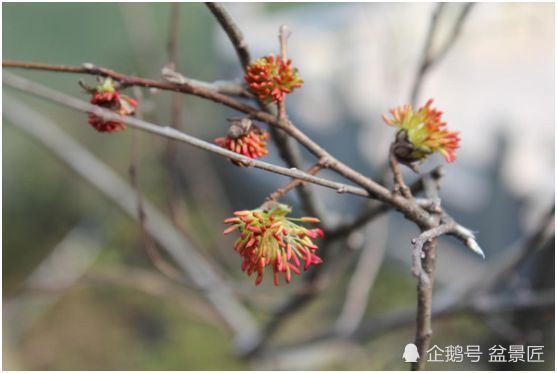
Parrotia subaequalis: a very rare plant in China, endemic to China.
It is rated as a rare plant because of its small numbers, and it has important research significance in economic, scientific, cultural, educational and other respects.
Parrotia subaequalis is also called "Shan's wood". It is a wild plant under national Class I key protection. It is a deciduous tree, and people describe its tree shape as dancing, and when grown, Parrotia subaequalis has luxuriant branches and leaves.
The flowering period of Parrotia subaequalis is in mid-March, and its flowering is very interesting. This plant flowers before it leafs out, and then after flowering the flowers are pale green, then the flower color changes from pale green to white. Its anthers are yellow with a bit of red. After Parrotia subaequalis blooms, the flowers first face upward and then droop after the flowering period. Seen from a distance it is very beautiful, golden bright.
Parrotia subaequalis was discovered in 1992 in Yixing City, Jiangsu Province, China, and dates back 67 million years. Like the dawn redwood used as a bonsai tree species, it is also called a living fossil by people.
Gymnosperms have lived on Earth for 200 million years, roughly in the middle Paleozoic. In the Cretaceous of the Mesozoic, angiosperms appeared. This fully shows how important its research value is.
In fact, the discovery of Parrotia subaequalis was already made by people in 1935, but at that time the War of Resistance Against Japan was underway, so scientific research was interrupted for a time. And the discovered specimen was kept in the laboratory all along, and with the victory of the War of Resistance Against Japan and the victory of the War of Liberation. In 1987, scientists restudied this species. And in 1992 it was formally named.
From the above it can be seen that Parrotia subaequalis has very great value in all respects. Its tree shape is quaint and vigorous. Indoors it is very good as a foliage and flowering plant, its leaves turn yellow in autumn, and the shape of its flowers is like strands of silver thread, so it is a very good material for making bonsai. It can not only be a good material for bonsai, but can also be made into home furnishings; its wood is hard, and the wood grain is straight, fine and dense with very good gloss.
As an endangered plant, slow reproduction and a low survival rate are common problems for them. So, if you encounter it in the wild, protect it well and do not harm them.