Fertilize succulents like this for more pups and a succulent ocean
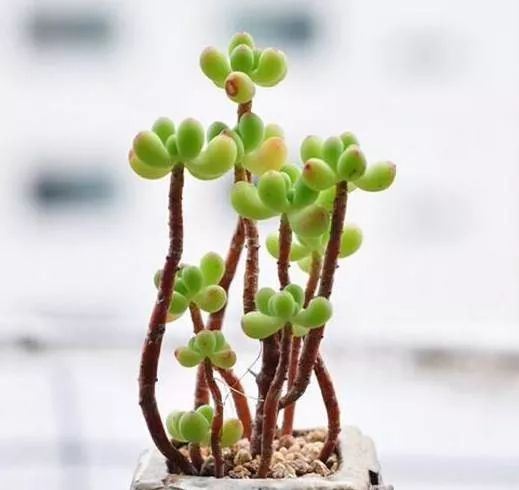
Many succulent lovers are confused about fertilizing succulents, not knowing whether they should be fertilized at all, or when to fertilize. They wonder if more fertilizer means better growth and more vivid colors. Succulent growth basically comes down to a few points: sunlight, temperature, and humidity, and of course fertilizing really is useful too.
1. Granular slow-release fertilizer: This is the most common fertilizer we see today. This granular slow-release fertilizer is made specifically for succulents. Uncle uses granular slow-release fertilizer, and the effect is very good, with the fertilizer releasing gradually. Uncle once talked with friends who grow succulents in South Korea, and they said fertilizing succulents is not very important. With a slow-release fertilizer like this, you generally put in a few granules and then do not need to fertilize the succulents for a long time. It should count as a kind of compound fertilizer.
2. Potassium fertilizer: promotes photosynthesis, increases stem hardness, and promotes the growth of succulent stems and roots. Uncle uses this kind of fertilizer on some old plants, but in very small amounts, since Uncle still prefers old plants in their natural state. If succulent lovers want to grow old plants, they can use a fertilizer mainly containing potassium.
3. Phosphorus fertilizer: promotes earlier flowering and fruiting in succulents, and is a kind of growth-promoting fertilizer. It improves the drought resistance and drought resistance of succulents. If you want succulents to bloom earlier or to supplement nutrients when they are blooming, this kind of fertilizer is quite good. Uncle does not often use this kind of fertilizer; it is commonly seen in growing greenhouses.
4. Nitrogen fertilizer: its effect is to make succulent leaves larger and healthier, slow down leaf aging, and increase yield. Succulent lovers who want their succulents' leaves to grow larger can try using this kind of nitrogen fertilizer, but the amount must be controlled well.
The editor loves growing succulents. At first there were only about ten pots at home, and they were not grown well either, but as long as they could survive it counted as success. By accident, some leftover fruit juice was given to the succulents to drink, and unexpectedly the pot that drank the fruit juice produced more pups than the others, and the succulents were crystal clear and stunningly beautiful.
It turns out that after fermentation, fruit juice is a very good organic fertilizer, and it can also ferment into fruit enzyme, which has a very good beautifying and nourishing effect on succulents. At first I did not know succulents liked drinking fruit juice. It was just that every time I drank orange juice there would be a little bit of residue left, and when washing the cup I would pour some into the succulent pot. Unexpectedly, the unexpected thing happened.
To improve the resistance of succulents, pay attention to maintaining fertility at ordinary times. Do not think that succulents are lazy-person plants, so you skip watering and fertilizing. Organic nutrient solution fermented from sugarcane stalks is rich and balanced in nitrogen, phosphorus, and potassium, promotes well-developed succulent roots, strong plants, more sprouting, strong resistance, and more fleshy growth.
After the succulents produced many pups and it felt like the pots could no longer hold them, I started taking off leaves and putting them into new pots for leaf propagation. At the beginning, I just kept the potting soil dry, sprayed a little water on the surface of the potting soil once in a while, and did not let them see light, and the leaves slowly grew roots. There was no other method either. I put them out on the balcony to get some sun, and when drinking fruit juice I gave the succulents a few drops.
Gradually the succulents produced more and more pups. In 2 years, from about 10 pots of succulents, I grew to 50 pots of succulents. The house could no longer hold them all, and looking at it, the home was simply a succulent ocean. I could not just give them fruit juice either.
Go to a park or green belt and cut some tender grass to bring home, then smash it soft with a mallet, just like the medicinal herbs collected from the mountains in rural areas, smashed into a pulp, then pour in 10 times the amount of water, and use a watering can to pour it into the succulent pots. We all know that rural areas use rice straw to compost organic fertilizer, and watering succulents with tender grass juice follows the same principle.
Once winter comes, the grass outside withers and the leaves fall, and the natural fertilizer is gone, so I bought some decomposed sheep manure online to bring home. Because sheep eat grass, the manure they excrete is of course very good organic fertilizer, and after decomposition there is no bad smell at all. Each time I water, I soak the sheep manure in the water and water with it together, so absorption is better. If you find it troublesome, you can also mix some into the soil when repotting the succulents.
Caring for succulents is not a matter of one morning or one evening. Besides using the right materials, a very important point is getting sun, so the succulents will not just grow tall without growing fleshy. In winter, when the temperature is low, you can put the succulents outside in the midday hours where it is not freezing to get some sun. If it is freezing, then they can only be placed by the edge of the balcony.
However, one good feature of winter is that temperature differences form easily. This is a good time for succulents to change color, and also a good time for them to become beautiful, so be sure to seize the opportunity. In southern regions, the temperature difference between morning and evening is at least 10-plus degrees. In the north, with heating, you can only choose a room without heating to artificially create a temperature difference.
Source: Internet, delete if infringing, apologies