Buddha Belly Bamboo has an auspicious meaning and looks beautiful too. Keeping a pot of it perfectly echoes the saying that one cannot live without bamboo.
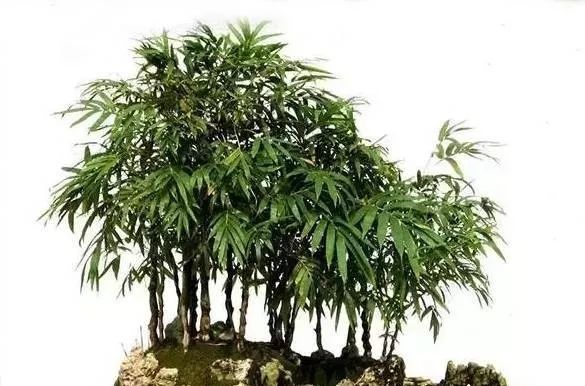
What makes Buddha Belly Bamboo so unusual is that the upper end of every node grows into a little bamboo gourd, like a pot-bellied Buddha, which is why it is called Buddha Belly Bamboo. The whole stalk of bamboo looks like a row of beads on an abacus. In the old days, during folk lantern parades, some people would clutch a stalk of Buddha Belly Bamboo in their hands as a club to ward off demons and evil spirits.
The plant is short and elegant, with swollen internodes shaped like a Buddha's belly. Its form is unusual, its bearing graceful, and it stays green all year round. It is an excellent material for pot culture and bonsai, and also an ideal choice for courtyard planting in the south.
For the care of Buddha Belly Bamboo bonsai, the main things to pay attention to are environmental control, watering, and shaping techniques:
(1) Environment.
For a newly potted Buddha Belly Bamboo bonsai, water it thoroughly, then place it in a shaded spot for about 10 days, then in a spot with half shade and half sun for 5 days, and then place it in a sunny, well-ventilated, warm and humid environment for careful care. Because the pot is shallow and holds little soil, exposure to the scorching sun in summer can easily damage the root system, so it should be shaded appropriately. In late autumn and early winter, when the minimum nighttime temperature drops to about 5°C, it should be moved indoors, and a room temperature of about 8°C is sufficient; too high a room temperature is unfavorable for the next year's growth. In the south, simply burying the pot in soil in a sunny, wind-sheltered spot is enough for it to overwinter safely.(2) Watering.
Buddha Belly Bamboo likes moisture and should be watered frequently to keep the soil moist, but water must not accumulate in the pot. Summer is its vigorous growth period, and the temperature is high, so it should be watered once in the morning and once in the evening. After it is moved indoors in winter, dust tends to collect on the leaves, so the leaves should be misted appropriately to keep them green and attractive.(3) Fertilizing.
Buddha Belly Bamboo bonsai should not be fertilized too much; excessive fertilizer and water will make the branches and leaves grow leggy and spoil its appearance. From March to September, applying a diluted dose of decomposed liquid fertilizer once a month is sufficient.
(4) Shaping.
Buddha Belly Bamboo grows quickly, so branches not needed for the desired shape should be pruned promptly to avoid consuming nutrients. For new bamboo, whether to keep or remove it can be decided according to its form: if the internodes are short and the belly is large, it should be kept even if it affects the shape somewhat, and replanted separately when divided in September; if the new bamboo culm is thin and the internodes are long, and it also affects the shape, then it should be pruned promptly.(5) Prevention and control of pests and diseases.
Buddha Belly Bamboo has relatively few pests and diseases, mainly bamboo borers, aphids, and scale insects, which should be removed promptly.How can you grow Buddha Belly Bamboo so its internodes are short and its belly is large, making it especially beautiful?
1. Prune off the autumn shoots
Buddha Belly Bamboo sprouts twice a year, the first time in early summer and the second time in early autumn. With proper care, the new bamboo that grows in early summer generally has short internodes and a large belly, while the new bamboo that sprouts in early autumn has long, thin internodes and is best pruned off.
2. Apply alum fertilizer water
Buddha Belly Bamboo originates from the south and likes slightly acidic soil, but soil in the north is slightly alkaline. Therefore, alum fertilizer water should be applied a few times as appropriate to make the soil slightly acidic.
3. Control watering
When the bamboo shoots emerge from the potting soil, control watering and keep the potting soil dry. When the bamboo leaves show signs of water shortage, place the bamboo in a cool spot for a while, then mist the leaves, and after 1 hour water it thoroughly. The next day, place it in a sunny spot for 5-6 days of care. Repeat this several times, and once the new bamboo has grown to the desired height, resume normal watering.
4. Pinch the tips at the right time
When the new bamboo has grown to about 80% of the desired height, cut off 5-8 cm from the top of the bamboo shoot to encourage side branch growth. After the first pinching, the side branches grow very quickly, so a second pinching should be carried out. According to the height requirements of the overall plant shape, cut off the upper part at the 2nd or 4th node to encourage secondary side branches to grow.
5. Peel off the shoot sheaths
Each node of a bamboo shoot has a rather thin outer skin that is pointed at the top and broad at the bottom, called the shoot sheath. Inside the shoot sheath are the buds of the side branches. When the bamboo shoot has grown to a certain height, 1 or 2 sheaths at the base of the shoot can be peeled off, and after 7-10 days another one can be peeled off.
Source: Internet. Infringement removed, apologies.