Add a little something to these 4 flowers every month, and in half a year you'll grow a flower wall - I wish I'd known this sooner
There are many kinds of potted flowers, but the ones grown at home are just those few, such as the common clivia (Clivia miniata), camellia (Camellia japonica), gardenia (Gardenia jasminoides), geranium (Pelargonium), and so on. Actually, besides these flowers commonly seen in the flower market, there is another kind of flower that is well worth growing on a home balcony. Or simply planted directly in the ground in the yard. This kind of flower is the "climbing plant", also known as the wall-climbing flower.
Bougainvillea, trumpet vine (Campsis), morning glory (Ipomoea), flame vine (Pyrostegia venusta), and so on are all flowers that can climb. Growing them into a "flower wall" really is beautiful, but to grow them well you still need to master some techniques. Next, we'll share some little care tips.
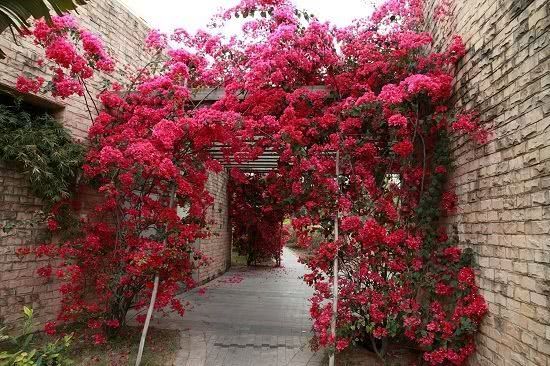
Once bougainvillea forms a flower wall, its ornamental value is very high.
To grow wall-climbing flowers well, you first need to understand their individual growth characteristics. For example, bougainvillea loves a sunny environment most, so even at hot noon there is no need to shade it. It is highly adaptable itself; after all, in the south this flower grows everywhere in the wild. But when growing bougainvillea in the north, you need to pay more attention: watering it with rice water from time to time can help its growth.
As shown in the picture, this is trumpet vine (Campsis), also one of the very beautiful wall-climbing flowers.
Whether it is bougainvillea or trumpet vine, as long as you apply a bit of "ingredient" to the pot once a month, you can ensure healthy growth, making them grow more vigorously and bloom profusely. This "ingredient" is decomposed soybeans.
After fermentation and decomposition, soybeans are a genuine organic nitrogen fertilizer. Nitrogen promotes the growth of plant stems and leaves, keeps the leaves glossy green, and extends the flowering period. Just bury the fermented soybeans under the pots of these flowers.
Can you tell which flower this is above? That's right, it is morning glory (Ipomoea). In the past, people always thought of it as a wildflower, not classy. When grown into a "flower wall", its value goes up.
Continuing from above, the method for making decomposed soybeans was shared with you in a previous article, and it is very simple to do. Soak the soybeans in water, boil them, put them into a sealed mineral water bottle, fill it with water, and leave it in the sun for one to two weeks.
Flame vine (Pyrostegia venusta) is a very common wall-climbing flower. Its adaptability is also strong. Ordinary soil is enough to grow it. Because this flower blooms a lot and has a long flowering cycle, it needs more fertilizer. In the early flowering stage, apply more nitrogen fertilizer, and you can use the decomposed soybeans mentioned above. During the flowering period, reduce nitrogen fertilizer, or stop applying it, to avoid causing excessive leaf growth. Apply only phosphorus and potassium fertilizer, which can promote flowering and extend the flowering period.
The "4 kinds" of flowers shared above are all very easy to grow, and very easy to train into a "flower wall". To help them climb and take shape quickly, you can set up a few small bamboo poles near the flowers and fix them with wire, so they can follow the bamboo poles to form the shape of a flower wall.
That's all for the knowledge about wall-climbing flowers. Thank you for reading!
Remember to like and share~