Succulent Care: The 6 Most Common Problems Beginners Encounter and How to Solve Them
In recent years, succulents have won over many people with their adorable looks, and more and more friends are joining the ranks of succulent growers. However, many beginners run into a lot of problems while growing succulents. Today, Xiao Jingzhi Life will go over the most common succulent problems and their solutions together with beginner friends.
1. Should newly bought succulents be repotted?
Most succulents bought from the flower market come with a pot and soil, and some friends think this is just fine, since it saves the process of letting the plant settle into the pot. However, these succulents that come out of commercial greenhouses may have uncertain factors such as insect eggs or ant nests in the potting soil, so it is best to remove the soil first after buying them, then repot them in fresh soil. If conditions allow, the old soil can be sterilized by heating it in a microwave before reuse.
2. Why do succulents show no signs of growth?
If a succulent shows no growth for a long time, it is very likely "stunted" (root-bound stagnation). The main cause of stunted growth is that the root system has not developed well. Generally, before potting a succulent, you need to trim and wash the roots first, removing bad and dead roots, to stimulate new root growth. If your succulent shows no growth during its settling-in period, you can pull it out, trim the roots, and repot it. Of course, there are other factors too, such as insufficient light. Also, some succulent varieties like those in the genus Sempervivum (houseleeks) are naturally slow-growing, so you should respond accordingly based on the actual situation.
3. How should succulents be watered?
Watering succulents is an eternal topic: you cannot water frequently, nor can you cut off water for long periods. Some friends will say once a week or once a month, but actually, because the care environments for succulents vary greatly and the varieties differ, judging the watering cycle simply by time is not a scientific method. The simplest method is to wait until the leaves in the bottom two rings of the succulent start to soften and wrinkle, then you can water it. The suitable time to water is on a clear, windy evening.
4. The succulent has become thin, tender, and elongated?
Leggy growth in succulents is also a problem beginners often encounter. Many friends' succulents, as they grow, become tall, thin, tender, and elongated; this phenomenon is succulent etiolation (leggy growth). The biggest cause of leggy growth is insufficient light, so you must try every means to give your succulent as much natural light as possible. If it is behind glass, the effect will be greatly reduced. But you must understand that ample light does not equal high-intensity exposure in summer; be sure to pay attention to this. In addition, overwatering and soggy potting soil are also causes of leggy growth, but the most fundamental cause is still light, so some succulents kept long-term in offices or next to computers will definitely become leggy.
5. The succulents online all have vivid colors and compact shapes, but mine do not?
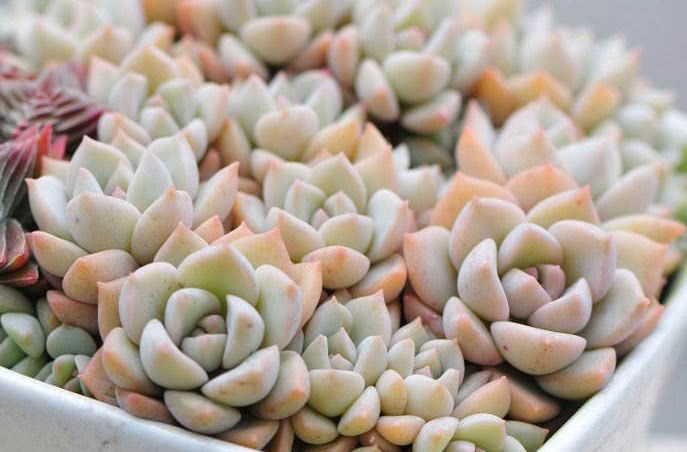
Under suitable care conditions, succulents will develop vivid colors, compact shapes, and thick leaves, and may even take on a jelly-like color; this is what is commonly called succulents "showing their colors" (coloring up). So what care conditions are most suitable for succulents to color up? There are mainly 4 factors: ample light, good ventilation, controlled watering, and a large temperature difference. Of course, there is also one biggest prerequisite: a well-developed root system. Only succulents that meet these conditions will color up, so succulents require careful, attentive care.
6. The succulent disappeared as it was growing?
If this happens, your succulent has probably "turned to water" (mushy rot). There are many causes of mushy rot: overwatering, an extremely hot and humid environment, sunburn, frostbite, and other reasons can all cause a succulent to turn to water. If you find that only one or two leaves have turned to water, hurry and remove the affected leaves, place the succulent in a ventilated, shady environment, and stop watering; then the succulent may still recover. If the whole plant has turned to water, start over from scratch.
Some beginners may feel after reading the above that succulents are very hard to grow and lose confidence in growing them, but that is not the case. Growing succulents comes down to nothing more than three key elements: good ventilation, ample light, and strict water control. Many expert growers also accumulated experience step by step over the corpses of succulents, starting out as total beginners, so as long as you keep the right mindset and have enough patience, you can definitely do it too!
Thank you for following Xiao Jingzhi Life. Due to limited ability, if there are any errors, please leave a comment to point them out; I would be extremely grateful!