What are the reasons for yellowing leaves in potted Phalaenopsis orchids?
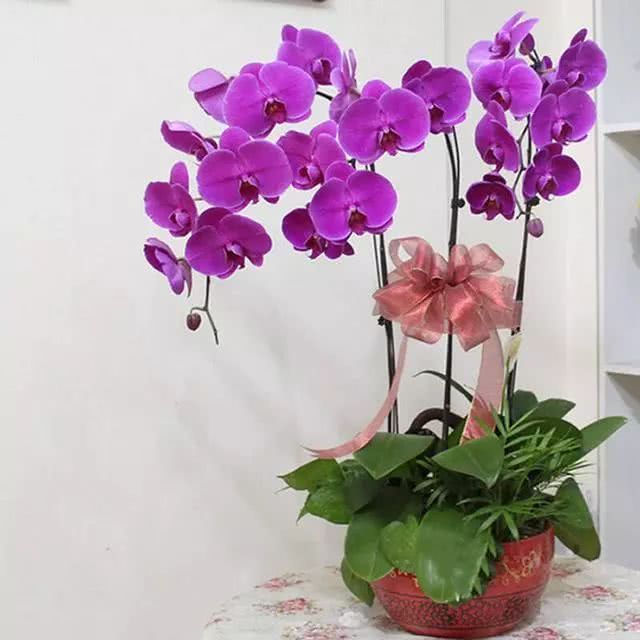
Phalaenopsis is no stranger to many flower lovers. Its colors are rich, with many varieties ranging from pink, pure white to yellow and deep purple. Because of its high ornamental value, Phalaenopsis can be seen at many flower shows around the world, and it has the reputation of "Queen of Orchids." So why do its leaves often turn yellow during cultivation? What exactly are the reasons?
1. Improper water control
Phalaenopsis is a tropical plant. It grows more suitably in a humid environment, but it also has another weakness - it is afraid of waterlogging. If water accumulates in the soil of Phalaenopsis, it often causes root rot at the rhizome. This often cannot be seen in a short time; in fact, yellowing leaves only appear when the situation is relatively serious.
This situation often occurs after the rainy season, when the condition of the potted plant or soil is not checked in time and the pot is not moved to a suitable place. At this time, the potting soil needs to be cleaned up in time, and the leaves that have already become diseased should be cut off. If the root system is severely rotted, consider replanting the plant.
2. Improper fertilization
In addition to waterlogging in the soil, improper fertilization is another relatively common cause. If the leaves are found to be thicker and fleshier than usual and the leaf stripes have degraded noticeably, this is often yellowing caused by excessive fertilization. At this time, fertilization should be stopped immediately, and appropriate watering should be done. Place the potted plant in a suitable outdoor environment to ensure the plant consumes nutrients faster.
If the situation is too serious, consider replacing the potting soil. When replacing it, it is not necessary to replace all the potting soil; keep the growing medium around the plant's roots to ensure that the Phalaenopsis can adapt quickly in the new soil.
3. Improper light control
Phalaenopsis cannot grow in strong light. If the plant's leaves are found to be softened and yellowing, this is very likely leaf yellowing caused by overly strong light. If discovered in time, the leaves that have already turned yellow need to be cut off, then appropriate watering and fertilization should be carried out, and it is best to grow it in a semi-shady environment for 3-5 days. After the plant returns to its normal form, place it in an environment with suitable light to grow. Especially from June to September each year, appropriate shading can be provided to avoid direct strong light, while in winter it can grow under full light conditions.
4. Diseases caused by pests and insects
If there are no major problems in your daily management, then you should consider pest and insect damage. For example, common insects such as beetles, red spiders and aphids are common enemies of most flowers. If they grow in dark, damp places, the plants are very likely to suffer from insect damage. Therefore, in ordinary care, the humidity and light conditions of the plant's environment need to be well controlled. If the insect damage is relatively serious, certain insecticides can also be used to eliminate them.