What are the considerations for creating a flower wall on a tenth-floor open-air balcony?
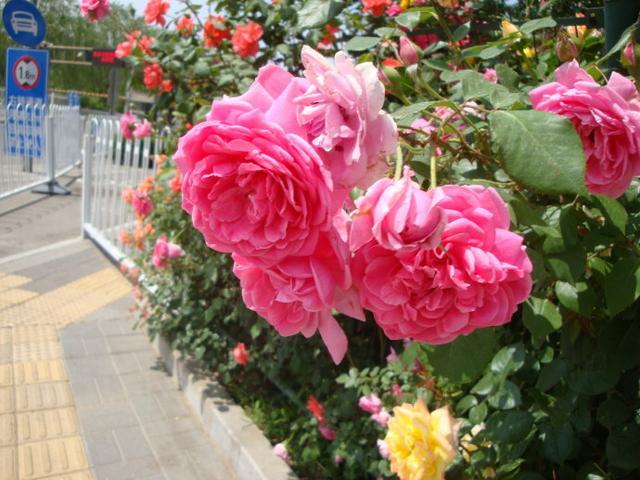
On the tenth floor, safety comes first. If you really want to make a flower wall, trailing plants can easily block the windows of the floors below - unless the whole building is yours, which is a different matter. There are many flowering plants suitable for a flower wall, and common ones include Rosa multiflora, redbud (Cercis chinensis), bougainvillea (Bougainvillea spectabilis), morning glory (Ipomoea) and so on. In fact, climbing roses are probably a very good choice.
For roses, forming a flower wall takes at least a year, and you have to buy large plants; buy them in spring and you can see them the following spring, while small plants take at least three years. Or if the nursery has ready-made plants, you can just buy them fully grown. Each plant can cover 1-2 m without a problem, and the longer the time, the larger the coverage area. I have not grown Rosa multiflora, but it is probably faster. It is best to ask someone who knows about it to help, otherwise the time spent figuring it out yourself is quite long.
If you want to grow a flower wall, is Rosa multiflora better, or are climbing roses better? Rosa multiflora is wild in nature and relatively easy to manage, with small flowers in large numbers. Roses are human-cultivated varieties, with large flowers in relatively smaller numbers. So you should choose according to your personal preference and conditions. For Rosa multiflora, plant one every 30 cm; plant more and the wall forms earlier. At 50 cm it can also form a wall, but it takes two years. The corner supports must be fairly sturdy to prevent the wall from being blown down by strong winds once it has formed. The key to growing Rosa multiflora is pruning; generally keep the main trunk no higher than 1.5 m, and leave three buds on each branch. The number of flowers depends on time and personal preference. For the same kind of flower, if you want larger blooms, you need to thin the flowers; if you want more flowers, do not prune, and the flower shape will be relatively smaller. It is also related to your fertilizing and pruning, and to the variety.
Every flower has its own preferences; some like sunlight, and some like shade, so we should choose suitable types according to the environment. In addition, the quality of the plants is also very important. For a plant wall or flower wall, later maintenance is also very important. Pay attention to pruning dead and spent flowers so that the plant's nutrients can be supplied to the newly grown flowers, which ensures the flowering period and the ornamental effect.
There is also a plant called firecracker vine (Pyrostegia venusta), which can also be used to make a flower wall. Firecracker vine likes moist soil, so during the growing season it is best to keep the potting soil moist. In dry seasons and hot summers, you also need to spray water on the branches and leaves 2-3 times a day and sprinkle water on the ground around the flower pot to increase air humidity. In autumn, when it enters the flower bud differentiation stage, watering should be reduced, and it is better to keep the potting soil slightly moist. In the peak growing season, apply dilute cake fertilizer water about once every half a month. After the beginning of autumn, fertilization should be mainly phosphorus fertilizer, and compound fertilizer can also be applied as a top dressing.
Finally, let us talk about what flowers are good to grow on a high-rise balcony. High-rise balconies are mostly on the sunny side, with characteristics such as long sunshine hours, strong wind and dry air, so you should choose varieties that like sun and tolerate drought as much as possible. Succulents, cactus-family flowers, roses and so on should take priority. Especially white, yellow or very fragrant varieties, such as Ziwu, Moonlight, Xuehai Xiangzong and so on. You can also choose woody flowers such as potted pine, potted bamboo, jasmine and begonia; among herbaceous flowers, tuberose, narcissus, fuchsia, carnation, cyclamen and so on.
This is a gathering place for succulent lovers, sharing succulent care tips. You are welcome to follow and exchange ideas.