Plant this on a one-square-meter balcony and enjoy flowers all year round
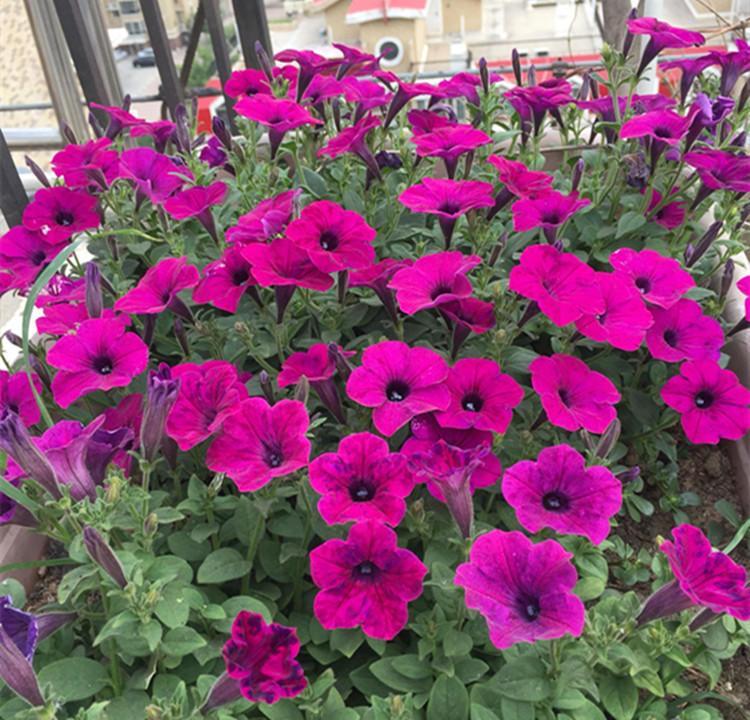
Petunia is a flowering plant that is especially easy to grow and very quick to bloom in abundance. If you have a small balcony, even if it is only 1 sq m, you should plant it; as long as you care for it well, your balcony can achieve "no shortage of flowers" all year round, and you can enjoy flowers every day.
So how do you grow petunias on a balcony so they bloom continuously through all four seasons?
First, gardening friends should know that petunia has strong adaptability to temperature. Its optimum growing temperature is 13°C-18°C; in winter the temperature should be 4°C-10°C. If it drops below 4°C, the plant stops growing, and it can withstand a low of -2°C. But at a high summer temperature of 35°C, petunia can still grow normally. In addition, petunia likes dryness and fears dampness. During growth it needs sufficient water, especially in the hot summer season, when it should be watered in the morning and evening to keep the potting soil moist.
Petunia is a long-day plant. During the growing period it requires ample sunlight. Most petunia varieties take about 100 days from sowing to flowering under normal sunlight. If light is insufficient or there are too many overcast and rainy days, flowering is often delayed by 10-15 days, and there are fewer flowers. Therefore, when petunias are cultivated in a greenhouse in winter, under low-temperature and short-day conditions, the stems and leaves grow luxuriantly. When long-day conditions arrive in spring, flowers quickly form at the tips of the stems and leaves.
Under protected cultivation conditions in the middle and lower reaches of the Yangtze River, petunia can be sown and raised year-round. The sowing times are October-November for autumn sowing and June-July for spring sowing. Before sowing, fill the container with medium and water it thoroughly. After sowing, mist lightly to moisten the seeds. The seeds must not be covered with any medium, otherwise germination will be affected.
After sowing, keep the medium temperature at 22°C-24°C, and seedlings emerge in 4-7 days. After the first pair of true leaves appears, pay attention to ventilation, and the seedlings can gradually be exposed to light. When the seedlings have 2-3 pairs of true leaves, the medium temperature can be lowered to 18°C-20°C, and once every 7-10 days apply a diluted 500-fold organic liquid flower fertilizer.
Petunia is fairly tolerant of high temperatures when growing in summer. Generally, shading is only needed for a few days after transplanting to help the seedlings recover, and no shading is needed throughout the rest of the growing period. In addition, after transplanting petunia, keep the temperature at around 20°C, not below 15°C; if the temperature is too low, flowering will be delayed or the plant may not flower at all.
When caring for petunia, always follow the principle of not watering until the soil is dry, and watering thoroughly when you do. For potted flowers grown in summer, apply light fertilizer frequently during the early growth of young seedlings. Choose an organic liquid flower fertilizer with high nitrogen and potassium content and appropriately low phosphorus. For potted flowers grown in winter, apply liquid fertilizer frequently in March-April, and according to growth conditions, appropriately apply additional nitrogen fertilizer.