Detailed Explanation of Rapid Styling Methods for Five-needle Pine Bonsai
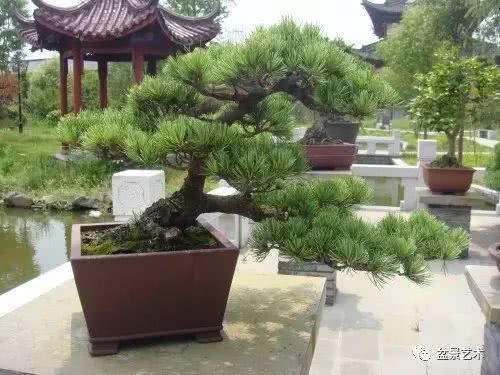
1. Five-needle pine bud grafting and branch high grafting
Five-needle pine bud grafting and branch high grafting are two different forms, but their methods and effects are the same; the only difference is the scion. The method is as follows:
Selection of rootstock: choose a potted black pine old stump that has begun to take the preliminary shape of a bonsai. For the branches on the rootstock that receive the graft, generally those below six or seven years of age that have not yet grown scales are best.
Grafting time: generally the best period is from mid-February to early March, before the buds sprout but when they are about to sprout.
Scion selection: the primary condition is that the buds and branches must be robust. Main buds are best for buds, and branches with 3 branchlets are best for branches.
Determining the number of scions: how many buds and branches to graft onto one black pine rootstock depends on the size of the crown and the length of the rootstock branches. Generally, long rootstock branches can take 3-5 scions, while 1 is enough for short ones.
Grafting method: basically the same as side grafting, except that the grafting position is not at the base of the main trunk but on the branches.
Post-grafting care and management
A. After bud grafting, the care and management are very simple: place it in the open air and there is no need to shade it. During spring drought, spray water appropriately onto the crown. Other management is the same as for ordinary potted plants.
B. After branch grafting, move the pot into a greenhouse or plastic shed, and spray frequently to maintain a high humidity of about 80%.
With these two methods, after the graft survives, the growth of the rootstock branches must be controlled and gradually reduced to favor the growth of the five-needle pine branches. When the five-needle pine branches are about to grow to a size corresponding to the main trunk of the rootstock, cut off all the rootstock branches. This takes about three to five years.
2. Multi-head grafting of Osaka pine (golden-leaf five-needle pine)
Rootstock selection:Choose one that has been cultivated for many years, has a beautiful selected form, and grows robustly; tree age from ten to one hundred years is acceptable.
Scion selection:From a robust Osaka pine free of pests and diseases, select well-growing two-year-old branches as scions; those in a sunny position are best.
Branch thinning:Prune and thin the branches of the black pine while maintaining its original form.
The scion cut must be equal in length to the rootstock cut; the cut is about 1 cm long, with one side long and the other side short.
On the main branches and parts of the black pine, use a sharp knife to make a cut, cutting one third into the xylem, insert the scion into the cut, and the cambium layers of both must match each other exactly.
Bind firmly with plastic tape, with appropriate tightness.
1. Placement location:
Crabapple bonsai should be placed in a location with ample light and good air circulation. During the high temperatures of midsummer, shade appropriately to prevent sunscald and scorched leaves. In winter it is relatively cold-tolerant; the pot can be buried in soil or placed indoors at a window.
2. Watering:
Usually just keep the pot soil moist, but be careful to prevent water accumulation in the pot, otherwise the roots are prone to rot. During the spring and summer growing period, the pot soil should not be too dry either, especially during the flowering period, when the pot soil must retain sufficient moisture.
3. Fertilizing:
In winter, crabapple bonsai should be given sufficient base fertilizer, with dry cake fertilizer or decomposed barnyard manure plus bone meal being best. During the growing period, except for the plum rain season, frequently apply dilute fertilizer water as a top dressing.
4. Repotting:
For mature crabapple bonsai, repot once every 2-3 years. It is best done after flowering in spring, and autumn is also acceptable. When repotting, combine it with root pruning and place base fertilizer at the bottom of the pot.
5. Pest and disease control:
Crabapple has relatively many pests and diseases: the main diseases include scab, leaf spot, and sooty mold, which can be controlled by spraying 0.5 degree Beaume lime sulfur mixture; the main pests include aphids, scale insects, red spiders, and longhorn beetles. 80% dichlorvos 1200-times solution can be used to spray and control aphids, longhorn beetle eggs, and scale insects; use 0.5 degree Beaume lime sulfur mixture plus a small amount of tetradifon to spray and control red spiders.