A vine with small pinkish-white flowers in bloom and strange-looking fruits
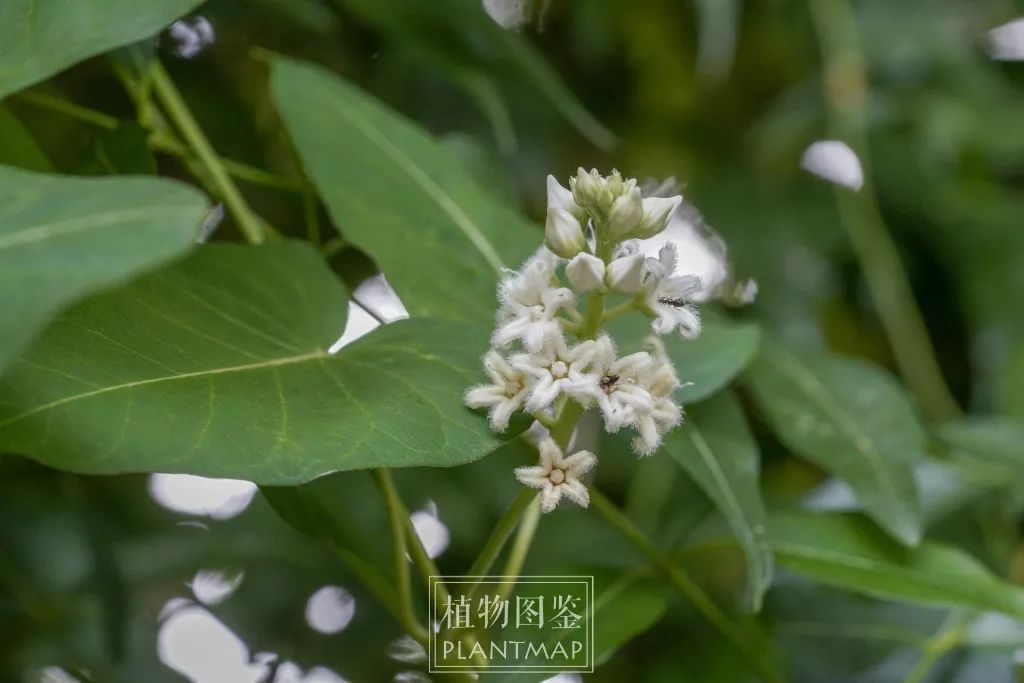
Metaplexis japonica is a vine with a very strong twining ability. Recently this vine has been in full bloom, with clusters of small pinkish-white flowers opening all along the vine.
[Metaplexis japonica] Asclepiadaceae >> Metaplexis
Metaplexis japonica is widely distributed. It may be uncommon in South China and the tropical provinces and regions, but it can basically be seen in all other provinces. Metaplexis japonica has very strong survival ability, like a weed, twining everywhere, and it is easy to spot even in cities.
Therefore Metaplexis japonica also has a great many aliases. A few that I have heard of are yuanlan, milk vine, grandma's sewing kit, magua, and sparrow gourd.
Metaplexis japonica
The name yuanlan (pronounced wanlan) comes from the Book of Songs. In ancient times "yuan" was pronounced the same as "man," and "lan" refers to fragrant herbs, so yuanlan means "a kind of trailing fragrant herb" [2]. Although the ancients considered Metaplexis japonica to be a fragrant herb, I do not think it is fragrant at all...
As far as my sense of smell can tell, the flowers of Metaplexis japonica have no scent, but their nectar may be very tasty; during full bloom they attract all kinds of insects to feed, making quite a lively scene. The flowers are white and pink, covered in dense fine hairs. When they first open, the small flowers are arranged in an umbel, and later the umbel gradually stretches out and comes to look like a raceme.
The name milk vine points out a major characteristic of Metaplexis japonica and of plants in the Asclepiadaceae: they have milky sap. The leaves of Metaplexis japonica are heart-shaped and thick and fleshy in texture. If you pinch or break its stems and leaves, rich white milky sap immediately flows out, sometimes dripping out in quantity.
Speaking of the leaves, the leaf veins of Metaplexis japonica are also somewhat interesting. At first glance they look like a turtle shell or ribs, arranged on both sides of the midrib, but on closer inspection you find that the leaf veins of Metaplexis japonica are staggered rather than paired opposite each other like ribs. Its leaves also host a special little insect, the Metaplexis leaf beetle, whose blue-gold metallic sheen is very charming. [3]
Metaplexis leaf beetle, image from Animal Specimens - Institute of Zoology, Chinese Academy of Sciences
Aliases such as grandma's sewing kit, magua, and sparrow gourd all refer to the fruit of Metaplexis japonica. The fruit of Metaplexis japonica looks bizarre, roughly spindle-shaped, really just like a "magua," and its surface, like a toad's, is covered in unsettling bumps.
But people actually eat this fruit. It is said that if it is picked and eaten in the first few days after the fruit sets, the texture is tender and fresh, with a light fragrance like that of cucurbit plants.
Young fruit
Ripe, split-open fruit
I would not dare eat it, not because I am frightened by its strange appearance, but because plants in the Asclepiadaceae are more or less toxic.
After the fruit ripens it splits open into two valves, and the seeds inside resemble dandelion seeds, with flat seeds bearing long white hairs. This differs from the dandelion: the dandelion is a plant in the Asteraceae, and its "seed" is actually an achene, which is a fruit; whereas that of Metaplexis japonica is a genuine seed.
In the end, what does the formal name Metaplexis japonica refer to? I do not know, and I could not find it online either.
But I think luomo is a homophone of "lonely and desolate." The fruit of Metaplexis japonica in autumn and winter really is quite lonely and desolate. In winter, when all things wither, the fruit of Metaplexis japonica opens, and the seeds that once filled its belly gradually scatter and fly away. In the end, only the two central axes remain inside the fruit, and apart from that nothing is left at all.
[1] Bencao Tupu
[2] Notes on the Interpretation of Plant Names, Xia Weiying
[3] Animal Specimens - Institute of Zoology, Chinese Academy of Sciences
http://museum.ioz.ac.cn/upload/zhuanti/hebeidiaochaheshibie/big/403701.jpg
Author: Jiang Mouren
Images: Jiang Mouren
This work is licensed under the (CC BY-NC-ND 4.0) license agreement
Please retain the above statement when reposting