To grow a plump, round succulent Peach Egg, do these 7 things well, and patience is the most important
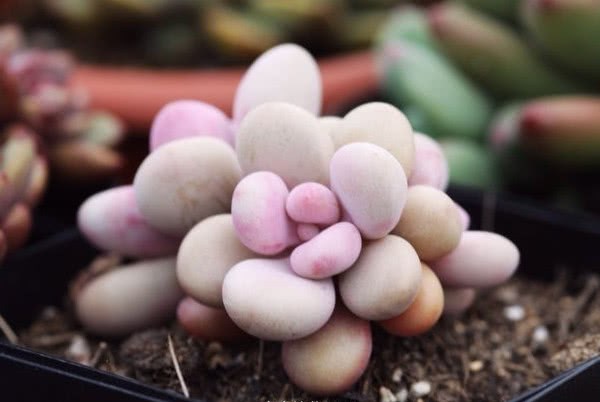
Peach Egg, everyone loves it: pink, round, chubby, cute, and adorable. If you don't grow a Peach Egg, you'd be embarrassed to tell people you grow succulents.
But many beginners find that as they grow it, it turns into the one in the picture below, and as they grow it they lose confidence and patience. So how exactly can you grow a round, chubby Peach Egg? Below, Little Exquisite Life learns together with everyone.
1. Flower pot
For a Peach Egg's flower pot, generally choose one with a round mouth and a big belly, as this matches a plump, round Peach Egg better, and the pot size can be determined by the size of the plant. As for the depth of the pot, the advantage of a deep pot is that it holds more soil, which is better for the Peach Egg to take root, but it is prone to leggy growth; a shallow pot also has advantages, as a shallow pot is better for maintaining the Peach Egg's plant shape and offers higher ornamental value.
2. Soil mix
Peach Egg's requirements for soil mix are not especially high; maifan stone and granular soil are both fine. If you are lazy or really don't know how to mix it, you can also just buy ready-made soil online; the main requirement is simply good drainage and air permeability.
3. Potting
Before potting a Peach Egg, the roots need to be trimmed. Root trimming is mainly to remove bad roots and dead roots and to stimulate the sprouting of new roots. If you are as lazy as Little Exquisite Life, you can just tear them off by hand; the standard is to tear gently, throw away all that can be torn off, and keep only what cannot be torn off. After trimming the roots, let them dry, then pot the plant and place it in a ventilated environment with scattered light to wait for the Peach Egg to establish itself. After a week, gently shake the Peach Egg by hand; if it feels very stable and does not loosen or wobble, it basically means new roots have grown, and it can gradually receive full sun and be watered and cared for normally.
4. Watering
To grow succulents, first grow the roots, and Peach Egg is no exception. The plump, round state is all achieved through tough love, but the premise is that the root system is well developed, giving it the right to be treated that way. How well developed a Peach Egg's root system is mainly depends on watering. On the 3rd to 5th day after potting, you can water just a small circle along the pot wall to entice the Peach Egg to work on sending out roots in all directions to find water. After that, you can water thoroughly once a week; combined with good ventilation, its roots will grow wildly in the potting soil. At this time, the Peach Egg may show slight leggy growth, so don't worry.
After that, you need to water according to its condition, which is what we often call "water control." Usually, watering is done when the bottom two layers of leaves of the succulent wrinkle and soften, but if you want the Peach Egg to reach a plump, round state, you can hold off a bit longer and water thoroughly only when the whole Peach Egg has slightly shrunk and looks listless. Once this becomes a habit, the goal of controlling its shape is achieved.
5. Light
The above watering method has two prerequisites: good ventilation and sufficient light. Without sufficient light, no matter how you control water, the Peach Egg will grow leggy; conversely, if the light is sufficient, even if you sometimes water a little too much, there is not much of a problem. Some friends may say that their balcony has very good light, so why does it still not work? That is because sunlight filtered through glass loses a large amount of ultraviolet rays, so it is best to grow it outdoors. If conditions really do not allow that, then watering must still be strictly controlled.
6. Ventilation
As said above, good ventilation is also one of the key factors in Peach Egg's growth. Good ventilation can quickly let the excess water in the potting soil evaporate and transpire after watering the Peach Egg, and at the same time good ventilation will also suppress the probability of pests and diseases to the greatest extent.
7. Other
Shading in summer goes without saying, but there is actually another important thing: rain protection. Although rainwater is a good thing for succulents, in summer it easily causes mold spots, and if there is a sun shower, the Peach Egg may die miserably. So rain protection is just as important as sun protection.
Having said so much, there is actually one most critical factor that has not yet been mentioned, and that is enough patience. Whether it is a Peach Egg or other succulents, from birth to growth, to reaching its prime state, and then maintaining it, it is a very long process. In this process, only a Peach Egg cultivated with enough patience and careful care is your own unique and most beautiful one.
Compiled and published by Little Exquisite Life, hoping everyone can grow their own plump, round Peach Egg!