The soil for succulents needs a certain water-holding capacity, which is good for root growth.
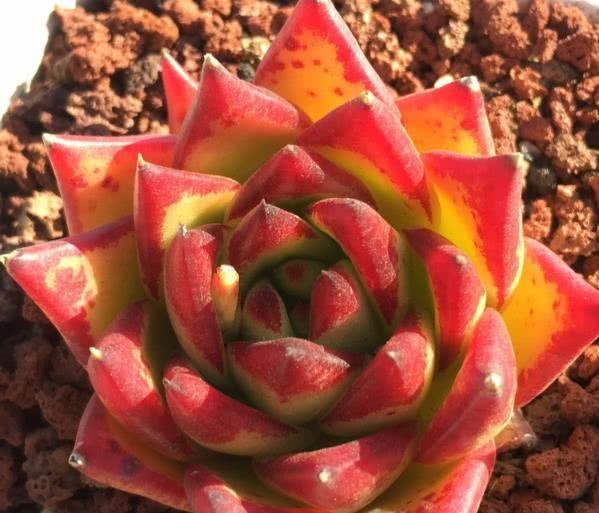
Succulents are higher plants with enlarged vegetative organs. Because succulents are drought-tolerant, simple to plant and care for, diverse in varieties, strong in propagation capacity, and beautiful and lovely in form, and can be enjoyed all year round, they are widely popular as potted plants around the world. Because the native habitats of succulents are mainly Mexico and South Africa, their root systems have a low demand for water and fertilizer. When planting, the substrate is required to be loose and breathable, well-draining, with good water-holding capacity, containing a certain amount of humus, and neutral or slightly acidic (a few species can be slightly alkaline).
Only when the root system of a succulent grows well can the succulent be kept alive and become beautiful, and the soil is closely connected to the root system, so you can imagine how important soil mixing is. Flower lovers say that when it comes to mixing soil, you still have to look at the condition of the succulent. If it is a newly bought small seedling with a very weak root system, then soil with a lot of granular material is not suitable at this time, as it is not good for root growth; the soil should have some water-holding capacity. If it is a mature succulent, the proportion of granular material in the soil can be larger. Akadama soil and maifan stone are both relatively easy-to-use granular materials, with very good breathability and drainage, and can make up about 70 percent. If it is an old specimen, 90 percent granular material can be used, and after a long time, full granular material can also be used for planting.
When we generally mix soil, we divide it into two parts: organic planting material and inorganic planting material. The main function of inorganic planting material is to increase the soil's breathability, drainage, water-holding capacity, and so on; at present, akadama soil, volcanic rock, perlite, kanuma soil, furnace ash slag, and even large-particle river sand are all relatively excellent in improving soil breathability and drainage. The main function of organic planting material is to provide the necessary nutrients needed for plant growth, and increasing organic planting material will also increase the soil's water-holding capacity. Common organic planting materials include peat soil, leaf mold, coconut coir, shengtu, garden soil, and so on.
Different growth stages also have different soil requirements. For example, during the seedling stage, the root system is not well developed, the organic matter content should be slightly lower, and the soil should mainly be light materials mixed with some fine sand, after which the organic matter content can gradually be increased. Succulents from different regions also have different soil requirements. For example, the climate in the north is dry, so the soil's moisture-retention capacity should be slightly higher; the south has abundant rain and high air humidity, so there are higher requirements for the soil's drainage and aeration.
Succulents of different families and genera have different soil requirements. For example, epiphytic species need a certain amount of humus, while some terrestrial species whose native soil is poor and whose root systems are not well developed have lower humus requirements than the former. Not only do species of different families need different soils, even species of different genera in the same family have different soil requirements. Take Aloe vera and Gasteria of the Liliaceae family: the former belongs to the genus Aloe, is robust in habit, and grows quickly, so sufficient base fertilizer can be added at the bottom of the pot. The latter is a plant of the genus Gasteria, grows slowly, and basically does not need base fertilizer.
The main function of vermiculite is to increase the aeration and water-holding capacity of the soil (medium). Because it is easily broken, as the period of use lengthens it easily makes the medium dense and causes it to lose aeration and water-holding capacity, so coarse vermiculite lasts longer than fine vermiculite and has better effects. Hyuga soil: it is a kind of volcanic pumice, a porous and lightweight horticultural soil produced in the place of Hyuga City, Japan. It looks somewhat like kanuma soil, and like other pumice it is very dry. It is a lightweight stone that has been sterilized at high temperature and can improve the drainage of the soil. It is suitable for plant varieties that do not like repotting and do not need repotting. Besides being used for bonsai and cactus-type plants, it can also be used as a surface decorative soil for potted plants, and is also quite suitable as part of a cutting soil. It is an additive soil; using too much or using it entirely will affect the stability of the plant. Generally, it is better when mixed with akadama soil and kanuma soil.
This is a gathering place for succulent lovers, sharing succulent care tips. You are welcome to follow and exchange ideas.