How do you water succulents? Get the watering amount right and the roots won't rot
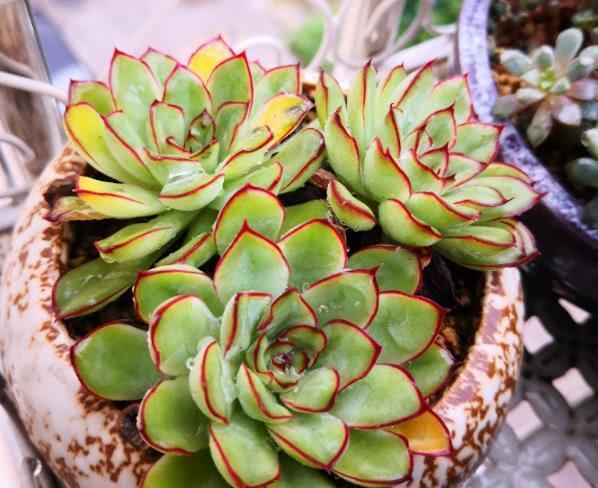
It's summer now, so don't water your succulents often at this time. When you do water, do it at night when it's cool, and don't pour water on the leaves, lest the leaves turn to water and black rot. Ventilate promptly after watering. Watering succulents is a very difficult thing. We often say that watering takes three years of skill. When you first start caring for them, you always water your succulents to death. Succulents don't need much water. Each time you water, you can wait until the soil has dried out completely before watering again. That way the soil won't be too wet and the roots won't rot. If you want your succulents to become beautiful, the watering and ventilation environment is very important. As we care for our succulents, we should also observe them often and deal with any problems promptly.
When cultivating cacti and other succulents, you must pay attention to the watering issue. Since most succulents originate from tropical and subtropical regions and were forced to adapt to arid desert climates, they developed the trait of liking dryness and disliking moisture. Although they like dryness, that doesn't mean they don't need watering. In fact, they can't truly go without water; you have to adjust flexibly according to the climate changes of the four seasons. In spring, the air in the south is generally more humid, while the weather in the north is still cold, so in principle you should either not water or water sparingly. When succulents are in their dormant period, if you keep following your usual practice and water heavily, not only will they fail to grow plump, they may also become leggy or develop root rot! So if you want your succulents to grow plump during the dormant period, we can't follow our usual practice of giving plenty of water. On the contrary, only by controlling water can succulents grow plump.
The climate is different in every place. To grow a succulent well, you first need a basic understanding of the climate where you are, such as when the high temperatures begin, when the plum rain season comes, when it snows, and then combine that with your own succulent's condition and habits. As long as you're careful and good at summarizing and observing, after a year you'll roughly be able to grasp the basic rules of watering. Water more in dry regions, less in humid regions. The climate in the north is dry and windy, so you should water more; the south is the opposite, and the watering frequency should be a bit lower than in the north. If you run into the plum rain season, you can skip watering.
Greenhouses often control light and temperature according to the plants' growth characteristics in order to achieve the optimal growing environment for the plants. In this kind of environment, plants grow quickly, the higher temperature creates a greater demand for water, and because of mass production, the growing medium used is mostly a substrate with very good air and water permeability, so the watering frequency is also higher. Generally, greenhouses use automatic irrigation systems, watering at set times and in set amounts. The biggest feature of a temperature-controlled greenhouse is high humidity, which fosters higher air humidity and can make up for insufficient water in the potting soil.
Water more for flower pots with good air permeability, and less for those with poor air permeability. Flower pots with good air permeability include red clay pots, purple clay pots, and earthenware pots; those with poor air permeability include plastic pots and glazed pots. Depending on whether the pot's air permeability is good or not, watering should also be adjusted. The air permeability of ceramic pots falls between the two. Succulents like continuous and even light. When the light conditions are good, they grow well. During the growing season, you should appropriately supply more water at this time to promote growth. In principle, good light is defined as: within a day, the succulent receives more than four hours of light.
A fellow plant lover asked: several of my succulents have turned yellow and scorched, and I'd like to know why my Guanyin Lotus (Sempervivum) has now become a bit transparent? In summer, you must water at night, and just water so it's dry-wet alternating. In summer I grow my Guanyin Lotus wild, with full sun all day, and there's no problem. Your medium may retain too much water; water less, and just keep it dry-wet alternating. If it's in full sun all day, the medium dries out quite fast. Another most important point is whether the holes at the bottom of the pot were blocked during planting; poor air permeability is also a big problem. I think the yellow leaves are a root problem. If it doesn't improve, it's best to dig it out, dry the roots, and replant.
This is a gathering place for succulent lovers, sharing succulent care tips. You're welcome to follow and exchange ideas.