Over more than twenty years, he built 150 treehouses, all to fulfill one dream
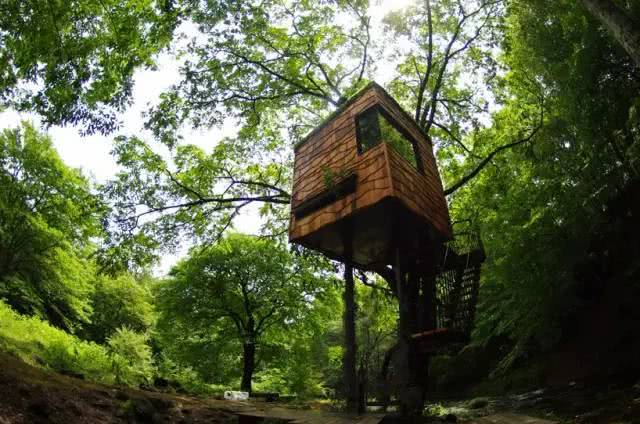
Woken by birds in the morning,
watching the stars from up in a tree at night,
a treehouse like this,
would you want to live in it?
……
- Treehouse Uncle -
In the morning,
accompanied by a ray of sunlight slipping through the gaps in the leaves,
and the chirping of birds and the murmuring of a stream,
"Treehouse Uncle" Takashi Kobayashi climbs down from his treehouse to the ground.
Over more than twenty years, he has built 150 treehouses,
and is known as "Japan's number one treehouse builder."
But more often than not,
he still likes children to affectionately call him - Treehouse Uncle.
No profound design,
no luxurious decoration.
"A good treehouse is one that makes you want to climb up into it,
and look at the world anew."
He grins, with a childlike smile.
In the morning,
listen to the birds sing,
watch the squirrels leap,
at night,
watch the setting sun at dusk,
watch the starry sky,
we, who have long lived in the city,
how long has it been since we saw a scene like this?
He feels that treehouses belong to nature,
"A treehouse in the true sense,
looking out from the window,
you can see a forest sea that gladdens the heart and refreshes the mind."
Treehouse Uncle's hometown is Izu, the land of hot springs,
he originally had a job at a Tokyo television station,
but "the crowded streets of Tokyo put me under pressure,
and I missed the mountains and sea of my hometown very much."
This is the reason he built treehouses in the mountain forests.
15 years ago, Kobayashi Takashi's first treehouse appeared in Jingumae, Shibuya ward, Tokyo, China, costing only 500,000 yen (about 30,000 yuan), and 15 years later, he still runs the cafe Hideaway here, selling organic coffee, green lifestyle magazines and self-designed eco-friendly T-shirts.
From then on,
he found something worth doing for a lifetime,
from rough surreal huts to square volumes,
they all share one common concept:
a fantasy space of gratitude to nature.
He never studied any professional design,
relying entirely on passion,
and a love of nature,
he built dream huts for people in the woods, one after another.
Why do you want to build a treehouse?
He always asks this.
For a writer's wish for a "self-sufficient" life,
Kobayashi Takashi built a treehouse in Nakijin Village, Okinawa;
a mother wanted to fulfill an unfulfilled wish for her deceased daughter,
so he built a treehouse in her private garden in Karuizawa;
there were also clients like this,
who asked him to build "a gift for my grandchild."
He always builds treehouses for children,
incorporating more child-friendly elements.
He designed a wooden slide,
and even deliberately cut slender hollows into every step,
to make it easier for children to grip while climbing,
and he is even more willing to build treehouses for public welfare organizations.
After the 2011 tsunami,
he specially built treehouses for children who had lost family members,
to soothe the wounds in their hearts.
He believes that treehouses can not only dissolve the boundary between people and nature,
but also have the power to warm people's hearts.
His most ideal treehouse
is built in Angkor Wat in Siem Reap, Cambodia,
reaching 26 m high,
and it has now become a dating spot for lovers:
"In this treehouse,
the bird calls come from beneath your feet."
In March 2014, in Atami, southern Japan, he built the world's most luxurious treehouse, "Kusukusu".
"Perched" in a 300-year-old camphor tree, the treehouse structure is independent and does not rely on the trunk to bear the load.
The design team used 3D laser scanning to locate the positions of all the trunks and even the branches, then designed a metal frame that cleverly avoided these trunks and completed the purpose of supporting the treehouse.
Around the treehouse
some supporting facilities were also built for tourists and children to play in,
at the top of the treehouse is a space similar to a tea room,
with a spacious terrace, which must be extremely pleasant.
And this way of letting people return to nature
and feel nature's way of life,
is exactly what he advocates.
For him, trees are friends for life,
he is familiar with more than 400 species of trees,
before building each treehouse,
he carefully surveys around the big tree,
so as not to affect the tree's growth.
Using local materials,
for a treehouse he built in Guangzhou,
he used local nanmu,
building it among banyan trees.
A "tree god worship ceremony" is also held
"Building a structure on a tree
undoubtedly affects the tree's growth,
and perhaps they are not willing to be treated this way."
He has his own persistence,
from design drawings to the completion of the work,
whether it is climate, temperature or humidity,
every step beneath his feet
is a decision made after careful deliberation.
Why build a house in a tree?
He always asks people who come to him to make treehouses this.
For him, a treehouse is not architecture,
but a dream of making friends with nature.
Takashi Kobayashi, a master treehouse builder born in 1957 in Shizuoka, Japan, graduated from the Department of Art at Nihon University.
After encountering the world's number one treehouse builder Peter Nelson in 1994, he decided to build treehouses in Japan, and he is also the only Japanese person invited every year to attend WTC (World Treehouse Conference), the international treehouse event held in Oregon, USA. In 2000 he launched the Japan Treehouse Network, and in 2005 he founded Tree House Creation.
—— THE END ——