Chinese trumpet creeper has an auspicious meaning; keeping one pot brings prosperity to people and home, and the method is very simple
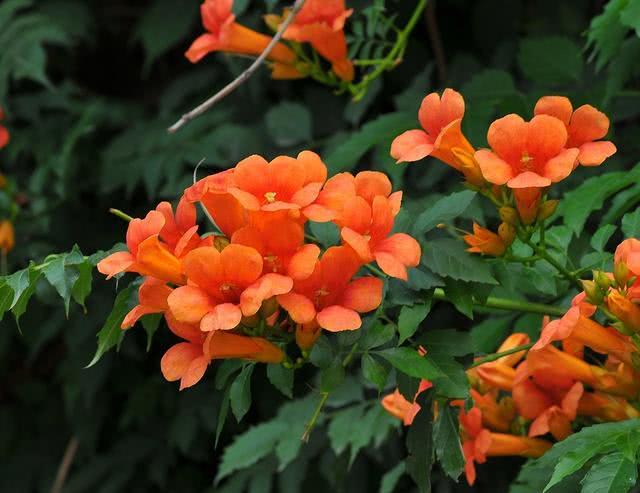
Chinese trumpet creeper (Campsis grandiflora) is a plant symbolizing admiration and reputation, and it also carries the meaning of a loving mother's love. Nowadays we mostly use it to express deep love for our mothers. In ancient times there was a saying that in a certain mountain village, a landlord had a very beautiful daughter who could recite poetry and paint, and her name was Lingxiao. When this young lady reached marriageable age, she deeply loved a long-term hired laborer in her own household, and the two even made a solemn oath to stay together in life and death. The landlord was very unhappy, desperately seeking a socially matched person for his own daughter, and in addition angrily beat that hired laborer to death. So the villagers kindly buried the hired laborer by the small river outside the village. One day, after Lingxiao learned of it, she came to the hired laborer's grave and struck her head against a willow tree, then transformed into a woody vine covered with blooming flowers, and so those flowers were called Chinese trumpet creeper. Chinese trumpet creeper is very beautiful and suitable for us to grow.
To grow potted Chinese trumpet creeper at home, we should choose soil with good air permeability, and it is best to choose a deep and large clay pot or wooden barrel for growing it. We can appropriately put some fertile, loose soil with strong drainage capacity and slightly acidic pH into the pot. We can use the soil from our vegetable garden for planting; the simplest way is to dig some soil on the street, take it home and sun-expose it for a period of time, then add some base fertilizer to the soil, and it can also be used.
Chinese trumpet creeper likes to grow in an environment with relatively good sunlight. Growing in a semi-shady environment is not so good for Chinese trumpet creeper; the Chinese trumpet creeper will grow less vigorously, and the flowers will be relatively fewer and the color will be relatively pale. We had best place the potted Chinese trumpet creeper on a balcony to grow it. If we have a courtyard, then that is best; place it in the courtyard to grow it, and the ventilation effect is also good. When we place it on a balcony, we should not place it in a relatively closed indoor balcony to grow it.
Regarding the water and fertilizer requirements of Chinese trumpet creeper, Chinese trumpet creeper still relatively likes to grow in a moist environment, and can appropriately adapt to a relatively dry environment, but it is very afraid of waterlogging. For us, during the growth period we should frequently water the Chinese trumpet creeper, as long as the surface layer of the potting soil is kept slightly moist, but do not let water accumulate. Chinese trumpet creeper is basically in a dormant period in winter, so at this time we only need to keep the potting soil on the dry side and slightly moist.
Chinese trumpet creeper relatively likes fertile soil. In addition to having base fertilizer in the potting soil, we should also fertilize it when the Chinese trumpet creeper sprouts, about once every half a month. At this time, the main fertilizer chosen is nitrogen fertilizer, which will effectively promote the growth of the branches and leaves of the Chinese trumpet creeper.
Starting in May, we mainly use phosphorus and potassium fertilizer to promote the flower bud differentiation and bud formation of the Chinese trumpet creeper. Occasionally we can spray monopotassium phosphate on the Chinese trumpet creeper, which can ensure that the Chinese trumpet creeper blooms very brilliantly. In winter, we should not fertilize the Chinese trumpet creeper, because at this time the Chinese trumpet creeper is in a dormant state.
After the Chinese trumpet creeper passes through the short dormant period of winter, it will welcome a season of very vigorous growth, which is spring. At this time we should promptly cut off all the dead branches and rotten leaves of the Chinese trumpet creeper, and also cut off all the relatively weak branches, especially leggy branches, which will very much waste the nutrients of the Chinese trumpet creeper. Doing this is all to promote the Chinese trumpet creeper to sprout new and more robust branches.