Caring for flowers after the Start of Autumn: what should you pay attention to when it comes to watering, fertilizing, disease prevention and repotting?
After the Start of Autumn, the weather gradually turns cooler, marking the beginning of the autumn season. Although the heat of summer is hard to shake off for a while after the Start of Autumn, and the "autumn tiger" still lingers, the temperature difference between morning and evening and midday will grow larger, and mornings and evenings will be relatively cool. So let's take a look at what to pay attention to when caring for flowers after the Start of Autumn.
As summer goes and autumn comes, flower lovers also need to adjust their plant care methods appropriately. Here we introduce 6 aspects: light, watering, fertilizing, pest and disease control, repotting, and cutting propagation.
1. Give light-loving plants more light
After the Start of Autumn, daylight hours grow shorter, mornings and evenings turn cooler, and the sunlight is no longer as intense as in midsummer. Light-loving green plants such as jasmine, orange jessamine, Chinese hibiscus, Bougainvillea, Christmas cactus, osmanthus and chrysanthemum should have their shade netting removed and be placed in direct sunlight. Sufficient light helps the plants grow stronger and more robust.
After the Start of Autumn, if plants do not get enough sunlight, photosynthesis is insufficient, which severely reduces the plant's ability to absorb nutrients and directly affects the plant's health as well as the number and quality of its flowers.
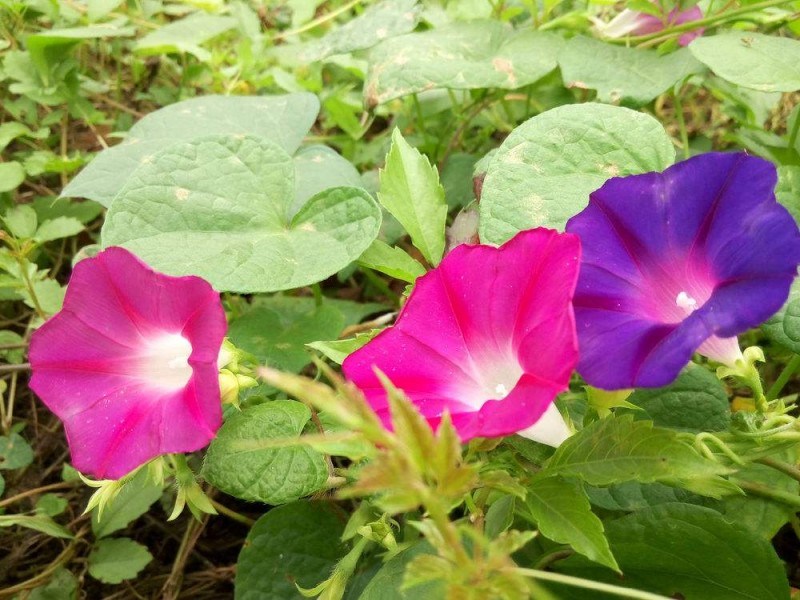
Morning glories blooming in the mountains
Sunlight hours, for example: jasmine more than 4 hours, osmanthus more than 6 hours, Christmas cactus more than 6 hours, chrysanthemum more than 7 hours, Chinese rose more than 4 hours. For flowers not listed here, leave a comment if you want to know their sunlight hours, and I will reply within 48 hours.
2. Watering amount should be gradually reduced
In midsummer the temperature is high, the air evaporates quickly, and plants need a lot of water, so they must be watered once in the morning and once in the evening. After the Start of Autumn, the temperature drops, evaporation decreases, and the potting soil of plants does not dry out as quickly, so the watering amount for some flowers changes from twice a day to once a day.
The best time to water after the Start of Autumn should be chosen on a sunny morning, because after the Start of Autumn the temperature difference between day and night is large and the nights are cool, which is not suitable for watering.
Some flowers are in their growing season after the Start of Autumn and need enough water every day to ensure their growth. Examples include azalea, camellia, osmanthus, Chinese rose and other flowers that grow in both spring and autumn. For flowers not listed here, leave a comment if you want to know whether they are in their growing season, and I will reply within 48 hours.
For some flowers that bloom in autumn, such as osmanthus, clivia and chrysanthemum, some have already begun to sprout flower buds and flower buds, and at this time water must be controlled; do not water too much, to prevent the buds from dropping. For flowers not listed here, leave a comment if you want to know whether they are in their growing season, and I will reply within 48 hours.
3. For flowers in their growing season, increase the amount of fertilizer
Flowers that are dormant or semi-dormant in summer revive after the Start of Autumn and begin to grow. To help the plants grow better, fertilizer must be applied to supplement nutrients, so the plants grow healthily and produce more beautiful flowers.
Premium orchids
Flowers that begin to grow after the Start of Autumn and need fertilizing include: chrysanthemum, osmanthus, Chinese rose, camellia, geranium, asparagus fern and others, as well as succulents. For flowering plants, phosphorus fertilizer is the main type; for foliage plants, nitrogen and potassium fertilizers are the main types. Depending on the size of the plant, you can apply liquid fertilizer or solid fertilizer. For flowers not listed here, leave a comment if you want to know whether they are in their growing season, and I will reply within 48 hours.
4. Autumn is a time of high incidence of pests and diseases
After the Start of Autumn comes a season of high incidence of plant pests and diseases. If plants are kept in a dark place with poor ventilation and insufficient light, then you must be prepared in advance.
Pests and diseases that flowers are prone to after the Start of Autumn include: leaf spot disease, black spot disease, anthracnose, fusarium wilt, powdery mildew, scale insects, aphids, thrips, longhorn beetles, whiteflies, red spider mites and others. If you find the above conditions appearing, deal with them promptly to prevent them from infecting other healthy flowers. Healthy plants are better able to survive the winter.
Even when no disease has occurred, you must not let your guard down. You can spray carbendazim to do preventive work. For flowers not listed here, leave a comment if you want to know whether they are in their growing season, and I will reply within 48 hours.
5. Repotting in autumn
Repotting plants in time can effectively improve the soil structure and conditions, increase the organic matter in the soil, and provide the nutrients necessary for the plant to continue growing. For orchids, clivia and spider plants, repotting allows you to clean the roots in time so they become healthier and more spread out.
If you do not repot in time, the soil nutrients are exhausted and the plant roots cannot spread out, so growth cannot be guaranteed, and the plant will become weak, with yellow leaves and few flowers.
Husband-and-wife flower
After the Start of Autumn is one of the most suitable times for repotting. If your potted flowers have problems such as pests and diseases (earthworms, ants, root-eating insects in the soil, etc.) or root rot, then get ready quickly.
Potted flowers suitable for repotting in autumn: cyclamen, clivia, orchids, spider plants, calla lily, Chinese rose and others. For flowers not listed here, leave a comment if you want to know whether they are in their growing season, and I will reply within 48 hours.
6. Prepare early for timely propagation and cuttings
After the Start of Autumn is the best time to sow many flowering herbaceous plants, for example: petunia, snapdragon, oxalis, cineraria, coleus, pot marigold and others.
Woody plants that can be propagated by cuttings after the Start of Autumn include: money tree, serissa, Chinese hibiscus, Buddhist pine, rubber tree, crape myrtle and others. For flowers not listed here, leave a comment if you want to know whether they are in their growing season, and I will reply within 48 hours.
Following + sharing + liking is the best support; I share flower care knowledge with you.