Ding! Your Desert Rose care and habits manual is now live
We almost missed each other!
Interesting, useful, and full of attitude - flowers make life more passionate!
---------------------------
Desert Rose Introduction
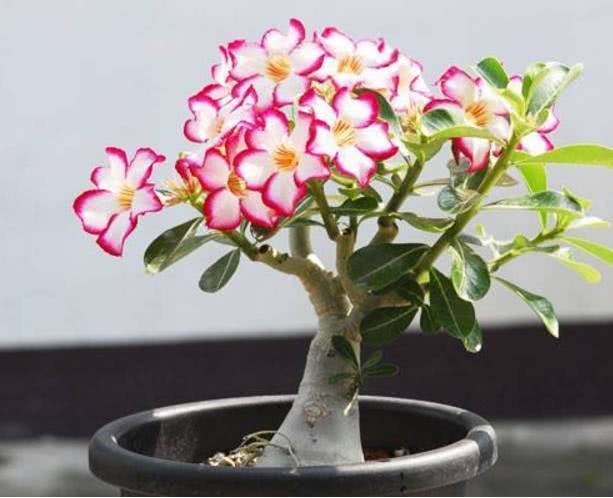
Desert Rose (scientific name: Adenium obesum) is also known as Tianbao flower, wealth flower, Shahongji flower, Adam's flower, dwarf frangipani, and others. It belongs to the Apocynaceae family, genus Adenium, and is often called "Desert Rose" or "Desert Azalea" in Europe and America. Desert Rose is a perennial succulent plant, native to the desert regions from Kenya and Senegal in Africa to the Arabian region of the Middle East. Many friends hear the name Desert Rose and think it is a rose that grows in the desert, but that is not actually the case! It is called Desert Rose because its place of origin is close to the desert and it is red like a rose.
Desert Rose is a small tree and can grow up to 2 m tall in its place of origin. The base of Desert Rose is swollen, with a short and thick succulent stem. Its needle-shaped leaves are alternate at the tips of the branches on the stem. The upper surface of the leaves is dark green, while the underside is light green and rather rough. The flowering period is from late spring to autumn. The flowers are pink to red, borne in umbel-like clusters, with 2 to 10 flowers in a five-pointed funnel shape gathered at the branch tips.
Desert Rose is native to dry desert areas and can withstand extremely hot weather. When the temperature is too low or water is lacking, Desert Rose will drop its leaves and go dormant. Proper pruning can promote branching and flowering. When the branches of Desert Rose grow longer than thirty cm, they can be pruned, usually once every two years. Desert Rose needs sufficient sunlight. Insufficient sunlight will cause the plant to grow leggy, weak and prone to disease, and it will be difficult for it to flower. However, seedlings or plants that have just been repotted should not be exposed to strong sun. At noon in the dry, scorching heat of midsummer, slight shading is needed (25-30% shade).
The flowering temperature for Desert Rose is 20-35°C, and in tropical regions it can flower all year round. The optimum growth temperature is 22°C-30°C. It stops flowering above 38°C and can tolerate high temperatures of 40°C. Below 12°C it enters dormancy, and the overwintering temperature is 10°C.
The whole plant of Desert Rose is toxic. When Desert Rose is injured, the wound exudes toxic sap. If livestock or young children accidentally eat the stems, leaves, or milky sap, it can cause heart-related problems such as accelerated heartbeat and arrhythmia. When planting, avoid touching the exuded sap. If your hands touch it, immediately wash them with soap and clean water. If it touches the eyes or mouth, immediately rinse with clean water and seek medical attention.
About Desert Rose
Temperature:The optimum growth temperature for Desert Rose is 20°C-30°C. It is a plant that tolerates heat but not cold, so Desert Rose is mostly grown in tropical and subtropical regions.
Light:Desert Rose prefers a climate environment with high temperatures, drought, and ample sunlight. During the growing period of Desert Rose, receiving more light can help it flower. In winter, receiving sufficient light can help it overwinter.
Watering:Desert Rose is drought-tolerant, so it should not be watered too much. Too much water can easily cause root rot. In spring and autumn, it needs to be watered thoroughly, but each time wait until the potting soil is completely dry before watering. During the extreme heat of summer, you can water according to how dry or moist the soil is. Gently pinch the belly of the Desert Rose (the thick stem near the potting soil). If it is hard, you can hold off on watering for now; if it is soft, then you can water. When the temperature drops in winter, reduce the frequency of watering.
Fertilizing:Desert Rose prefers phosphorus and potassium fertilizers. Usually, supplementing once about a month is enough. In summer, Desert Rose grows more vigorously, and fertilizers are best as a combination of slow-release fertilizers, such as phosphorus and potassium fertilizers. In autumn and winter, generally you can stop fertilizing.
Soil:Desert Rose grows close to deserts, so it likes sandy soil with good drainage. When the plant is growing luxuriantly, you can add some river sand or small gravel to its medium to improve drainage. Among these, a mixed soil of fertile, loose sand and leaf mold is best.
Types of Desert Rose
Desert Rose
Desert Rose is the most widely cultivated type. It has a peculiar club-shaped succulent stem and beautifully colored flowers. The plant can reach up to 2 m tall. It is naturally distributed in the rocky desert areas of East Africa. In the wild it flowers in summer, while cultivated varieties flower almost all year round.
Multiflora Desert Rose
Multiflora Desert Rose looks very similar to Desert Rose in appearance, but has more flowers, and the petal edges are wavy and crinkled. It was originally distributed in the desert areas of Namibia. The flowering period is summer, and it flowers when leafless.
Narrow-leaf Desert Rose
Narrow-leaf Desert Rose is native to the deserts of southern Africa. It has narrower leaves and narrower petals. The flowers are purplish red with white stripes in the center. The flowering period is in summer.
Somali Desert Rose
This Desert Rose is native to the desert regions of Somalia. Its characteristics are broader leaves with hairs, purple flowers, and relatively broad petals with a dark purple center. The flowering period is from summer to autumn.
South African Desert Rose
As the name suggests, South African Desert Rose is native to the desert areas of South Africa. It has many-branched stems and narrowly lanceolate leaves, usually clustered at the ends of the stems. The flowers are clustered, pinkish purple, with a dark purple center and wavy petal edges. The flowering period is in summer.
Arabian Desert Rose
Arabian Desert Rose is native to the Arabian deserts of West Asia. The plant is low-growing and has oval leaves. The flowers are often borne singly at the top of the stem, orange-red, with a dark border along the petal edges. The flowering period is in summer.
About Watering and Fertilizing
Regarding watering, when Desert Rose is in its growing period, it should be watered sufficiently to keep the potting soil moist, but be sure not to overwater, because Desert Rose is drought-tolerant and does not like moisture. When watering, pay attention to watering when dry and letting it dry out between waterings, and water thoroughly when the soil is dry. When the temperature is high in summer, it needs to be watered once a day. At other times, watering once every two to three days is enough. When the weather is cold in winter, we should reduce watering and keep the potting soil dry. Only when the potting soil is too dry do we need to water.
Regarding fertilizing, Desert Rose actually does not have very high requirements for fertilizer and water. During the peak growing season in summer, we can fertilize more to ensure lush branches and leaves and bright, full flowers. In winter, we can stop fertilizing it and let it enter its winter growth dormancy period. Desert Rose likes phosphorus fertilizer and potassium fertilizer, and during the growing period it can be supplemented once every one or two months.
In addition, when repotting Desert Rose every spring, we can also appropriately apply some long-acting base fertilizer in the pot, such as decomposed soybean cake and bone meal.
What should you do if Desert Rose does not bloom?
After adjusting the existing conditions, we should first consider whether the Desert Rose is still not old enough to bloom. In other words, before your Desert Rose has fully matured, it is very normal for it not to bloom. In this case, we can only wait for it to grow up and then see whether it can bloom.
If the possibility of insufficient age is ruled out and Desert Rose still does not bloom, we can consider other reasons. If Desert Rose has flower buds but does not bloom, then it may be caused by insufficient fertilizing, lack of nutrients, or too low an ambient growing temperature, insufficient light, and other reasons. If that is the case, we need to actively carry out daily care. During daily care, note that for water and fertilizer, you can use diluted fertilizer water instead of clean water, but be aware that when the plant has flower buds, fertilizing needs to stop, so as to ensure the flowers do not drop their buds. Light and temperature must meet the needs of Desert Rose so that it grows well.
The best growing temperature for Desert Rose is between 15°C and 25°C. If our cultivation temperature is not within this range, it may also cause Desert Rose not to bloom. Desert Rose is not cold-tolerant. The indoor temperature in winter is also best kept above 10°C, as this is conducive to Desert Rose flowering.
In addition to daily care issues, we also need to be careful when buying Desert Rose not to buy a fake. Some unethical sellers pass off other relatively similar plants as Desert Rose, but once you buy it and care for it, you may find that this plant does not bloom or that the flowers are not what they should be at all. The editor suggests that we do enough research before buying, so as not to be deceived.
About Yellow Leaves
Yellow leaves caused by not adapting to a new environment
After Desert Rose is first brought home or taken to a new environment, it needs a period of adaptation. In this case, a small number of yellow leaves is a very normal phenomenon. We just need to wait for Desert Rose to adapt to the new environment on its own.
Yellow leaves caused by overwatering
Desert Rose is a relatively drought-tolerant plant. If watered too much, it can easily cause water accumulation around the roots, leading to root and stem rot, and yellow leaves are an inevitable result. For yellow leaves caused by this situation, we can solve it by cutting off the rotten roots and then controlling watering.
Yellow leaves caused by too-low temperature
When the temperature is too low in winter, Desert Rose will enter dormancy. The leaves turning yellow, drying up, and even dropping are all to reduce water evaporation and nutrient consumption. This is a self-protective mechanism, so we do not need to worry too much. If a friend hopes that Desert Rose can remain evergreen and full of life in winter, it can be moved indoors for cultivation and kept at a relatively warm temperature.
Yellow leaves caused by insufficient light
Desert Rose is a light-loving plant. No matter the season, it needs sufficient light to help it grow. If the light it receives is insufficient, it will cause yellow leaves in Desert Rose. At this time, we can move Desert Rose out of the shade and place it in a spot with light, ensuring it can get enough sunlight every day.
Yellow leaves caused by overfertilizing
If too much fertilizer is applied to Desert Rose, the soil will become poorly aerated, and the concentration of the solution outside the cells will be too high, making root cells prone to losing water and dying. The result of both is root rot, leading to death. The way to solve this problem is to fertilize appropriately and absolutely avoid overfertilizing.
About Root Rot
First, when we find that Desert Rose has developed root rot, we should promptly and carefully pull it out of the growing medium. We can first loosen the growing medium by patting it to help us remove the plant more easily. After pulling it out, shake off the remaining soil.
Next, use a sterilized sharp pair of scissors to quickly cut off the rotten roots and stems, and by the way also cut off old roots and excess roots and stems.
Immediately after that, use a potassium permanganate solution diluted with water that was prepared in advance to disinfect the cut surfaces of the roots, in order to prevent bacterial growth. The concentration of the potassium permanganate solution is best controlled at about 0.1%. Then apply clean plant ash to the cut surfaces.
After the above steps, plant the plant into new potting soil. When potting, the wounds and the seriously damaged parts of the root system should be surrounded and filled with clean wet sand, then covered with clean growing soil, to promote the sprouting of new roots at the wounds.
While repotting, we also need to heavily prune the branches and leaves. Sometimes, to ensure survival, we need to cut off 80%-90% of the branches and leaves. During the process of the plant recovering growth, try to keep the potting soil moist, frequently spray water on dry branches, absolutely avoid fertilizing, and do not let the potting soil be exposed to rain, in order to prevent root rot from happening again.
==========
The Gardener Says - Decorate Life with Flowers
Sharing practical tips for growing and caring for flowers, let the Gardener accompany you in decorating a colorful home world!