The "snowflakes" seen on trees are actually precious insect wax, 150 yuan per jin
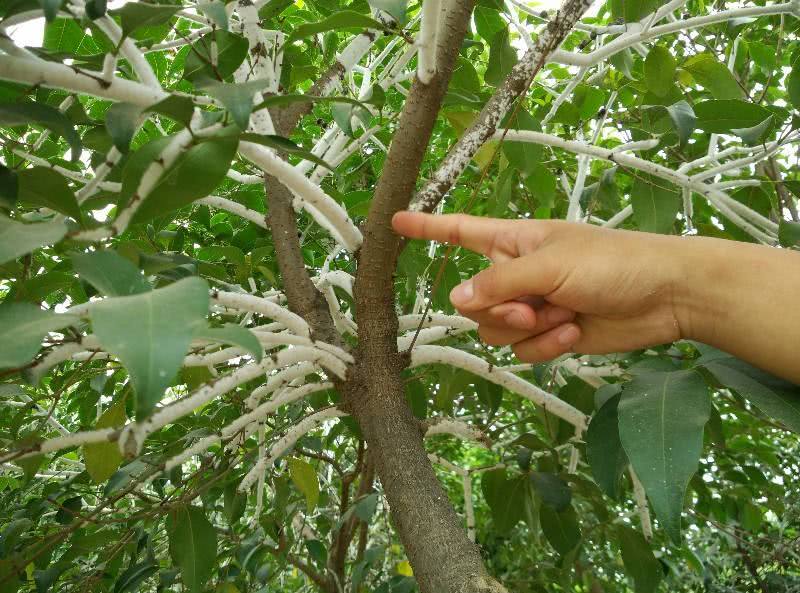
My favorite thing every day is to take a walk by the fields in the village after a meal, looking at the lush green trees, the air is especially fresh, and my mood becomes especially cheerful. On summer evenings the breeze is cool, and watching the trees in the woods, the closer I walked, the more I saw some white dots under the tree leaves, wrapped under the leaves like floccules, covering everything beneath.
They look just like snowflakes. My first thought was that the tree had bugs, and really disgusting bugs at that. It felt like the moment the wind blew, everything turned bad, as if countless white dots were floating before my eyes. This was terrible, a perfectly good tree ruined. When I went back and asked, I learned that the tree had "white wax insects." These insects are quite remarkable, a medicinal insect species unique to our country.
The white wax we use is the substance secreted by these insects. They are picky about trees and only live on privet (Ligustrum) trees and Chinese wax trees (Fraxinus chinensis). They lay eggs and reproduce on privet trees, and after the eggs hatch, the young go to live on Chinese wax trees, alternating between the two trees. The female insects are mainly responsible for raising the young, while the male insects are responsible for supporting the family by secreting insect wax.
The way the underside of the leaves gets wrapped in color-changing cotton-like fluff is called "hanging wax." Because it exists only in China, it is also called "Chinese wax." In our country, the use of insect wax has a long history, recorded for more than 3,000 years. The earliest clear records date back to the Wei and Jin dynasties, and later Li Shizhen's "Compendium of Materia Medica" also recorded it.
In the 19th century it began to spread to Europe. Afterward, "Chinese wax," as a representative specialty product, entered the world trading market. After reaching Japan, it was called "plant wax" and became deeply popular. As an insect with extremely high economic value, insect wax has a very wide range of uses, mainly in the pharmaceutical field and the industrial field. Its price today is also very high. It is understood that in some foreign countries it sells for 150 yuan per jin.
Chinese wax is a traditional export product of our country. First, in the pharmaceutical field, it has the properties of stopping bleeding and relieving pain, promoting tissue regeneration and replenishing blood, and promoting wound healing. Its therapeutic effect on bruises and injuries is quite good. In addition, because it is a natural wax, it is also often used as a polishing agent for medicines and for outer sugar coatings.
With the development of modern science, new research findings on insect wax indicate that white wax can be used to treat bronchitis, and it has already shown therapeutic efficacy.
In addition, in industry, white wax is used for protective films on precision instruments and metal instruments, can prevent moisture and rust, and is also used as a machine lubricant. It is also used in various polishing agents, floor care, and surface protection for precious metals. Because it is a pure natural plant substance, it is also often used as a cosmetic ingredient. In the textile industry, it is also used to increase the color and beauty of products. Whether eaten or used, white wax still holds many secrets waiting for humanity to discover.
So in rural areas and the wild, if you see something like "snowflakes" on a tree, then you have struck it lucky. Don't miss this precious "Chinese wax (insect wax)"!