5 kinds of flowers that will survive when you cut a root or branch and stick it in soil, easily filling a pot within 1 month
Many gardening friends tell Huahua that their cuttings just never take. Cuttings have a lot to do with temperature, humidity, timing and luck, but some flowers are easier to root from cuttings. Break off a branch, make a few cuts, stick it in soil and it easily survives. Let's take a look!
“
Plant cuttings"
-Pothos-
Pothos cuttings are fairly simple. Just cut off a section of vine and stick it in soil, and it will basically survive. However, some gardening friends say their pothos cuttings often fail. Here are a few common small problems to avoid.
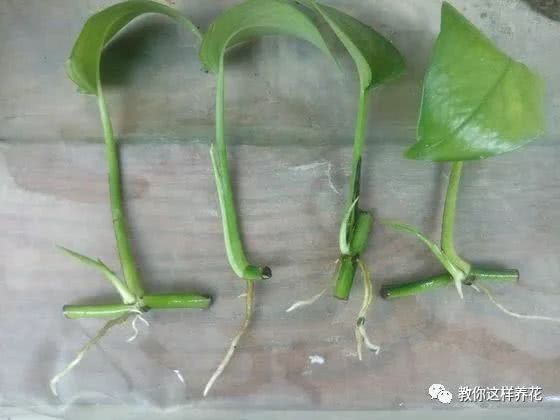
When taking cuttings, keep a leaf on them. Some gardening friends use the bare-stem cutting method, which has a certain chance of failure. Generally, for cuttings you can consider keeping 2 nodes, ideally with aerial roots, and 1-2 leaves, so pothos is more likely to survive.
Do not water too much. After finishing the cuttings, you generally water thoroughly once. Afterwards, you can wait until the soil is dry before watering again. There is no need to water every day, otherwise the cuttings easily rot.
The soil should not be too rich. Ordinary potting soil or peat soil is enough. You can also use plain sand or perlite for cuttings. No fertilizer is needed, and soil that is too rich is not good for rooting either.
Generally speaking, cut pothos into 10-15cm small sections, keep 1-2 nodes and 1-2 leaves, cut the bottom into a slanted surface, and it is best if there are aerial roots. Insert them into loose potting soil. You can insert a ring of them along the edge of the pot, water thoroughly, and wait for them to root.
If they still will not take, you can also first root them in water, then transfer them into potting soil. For water rooting, you can keep a 15-20cm section. After inserting it into water and waiting for roots to grow, bury it in a flower pot and it will survive.
-Spider Plant-
Spider plant care is fairly simple, and cuttings are also very easy and root readily. For spider plant cuttings, choose the small spider plants grown from a large spider plant. The small spider plant is a clustered stem and leaf on a stolon, already a relatively complete young new plant, especially once aerial roots have grown. You can directly place the small spider plant on the surface of the potting soil, and it will quickly take root. Be careful not to bury it too deep, otherwise the roots may rot.
Water culture of spider plants is also very easy. Place the small spider plant in a water culture container and it will root quickly.
-Hydrangea-
For hydrangea cuttings, generally use perlite or vermiculite. Choose tender branches of the current year, cut them into about 10cm, keep one pair of leaves, and cut the leaves in half to reduce evaporation.
After inserting them into a flower pot, place the pot on a tray, add some water to the tray, and put them together in a cool, ventilated place. Make sure the tray never runs out of water, and roots will grow in about one month.
There are two things to pay attention to with hydrangea cuttings. First, it is best to water thoroughly one day before taking cuttings, so the branches absorb enough water, then cut the branches the next morning. Do not wait until the leaves wilt before cutting. Also note that the cuttings should have half of their leaves cut off. Many gardening friends do not cut off some of the leaves, and the branches easily wilt, dehydrate and die.
-Plumbago-
Plumbago can be propagated by cuttings in summer. Cut 8-10cm branches, insert them into a plastic cup filled with vermiculite. Cut a cross in the bottom of the plastic cup, then place the plastic cup on a tray, fill the tray with water, and keep adding water if it runs out. Put it in a cool, ventilated place and wait for roots to grow.
You can place it in an air-conditioned room and cover it with a lid to retain moisture, and the survival rate will be even higher.
Plumbago can also be rooted in water. Insert the branches into a container and change the water once every 2-3 days. Roots can grow in about 25 days, and in summer they can root in about 2 weeks. After rooting, transfer them into loose potting soil.
-Jasmine-
Jasmine can be propagated by cuttings combined with pruning. Choose robust one-year-old branches, keep more than two nodes per section, cut off excess leaves, leave only one pair of leaves and cut them in half. Make the lower cut 0.5cm from the leaf node, which makes rooting easy. Insert them in plain sand, perlite or coarse vermiculite. During this period, you can spray water on the leaf surface, and roots can grow in about 30 days.
These 5 kinds of flowers can be propagated by cuttings in summer
They are also relatively easy to root
Just make 2 quick cuts and stick them in soil, and they will root quickly
You should try it too
Show this to gardening friends who need it!