How do you fatten up succulents on a balcony? Check root health first, then care for them
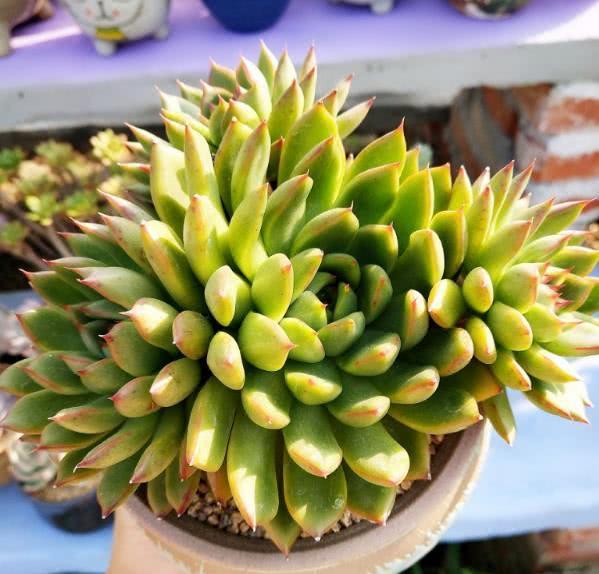
To fatten up succulents, you must first understand what "fat" means and why they need to be "fat." For succulents, getting fat is the process of storing water in preparation for drought. And to fatten up succulents, you must first grow good roots; a healthy, strong root system is the foundation of every aspect of a succulent's appearance. Granular soil of different particle sizes has different pore spaces and different ways humidity changes, and succulents grow roots at different speeds and in different root forms in different soils: sand and fine fiber, these two growing media, have the smallest porosity, and new roots grow slowly in them, so they are not worth considering. Granular soil is also the best medium for fattening, because water control is relatively much easier with granular soil.
Fattening up succulents is actually about storing water in preparation for drought. When caring for them, we need to make these plants feel as if they are in an environment that may become dry. The key is controlling how much water is given, and the principle is to create a low-water environment: not too wet, and not dry for too long. Then comes root growing. Before watering, there is an important prerequisite: the plant must have a functionally sound root system capable of absorbing water. So before fattening, you must first grow roots. Also, one more point: growing roots and settling into the pot are not the same thing. Settling into the pot refers to the process of the root system recovering from an abnormal state to a normal state, and it is the first stage of root growing. So having settled into the pot does not mean the roots have been grown well.
The root system is hidden work. We have very clear expectations for root growth, but we cannot see the growth state of the root system in real time. We can only guess based on the condition of the succulent and the bit of root sticking out of the drainage hole. The thick, strong root system that an old stem succulent spends many years growing is certainly not comparable to that of a succulent that has just rooted. So if your succulent is only a few months old, there is no need to think about some thick, strong root system; it definitely does not have one. What you should hope for is a more developed root system. The best state is when the roots look like a clump of messy whiskers.
Those succulents that tend to grow very tall, such as the various Aeonium varieties, naturally have roots that easily become woody. This is because their stems grow very tall, and in order to anchor themselves and not fall over, their root systems become very thick and strong. Some growers, when planting those tall-stemmed succulents, often bury the stems deep to make the planting more stable. This is not a very good habit. Burying the stems deep makes the root system lose that original pulling tension, and instead makes the succulent's root system weak and easily broken. The correct approach is to use an external force (such as copper wire) to secure the plant's main root to the bottom of the pot, and then use the secured root system to hold the tall stem. This pulling tension is very beneficial to root growth.
Generally speaking, for a stuffy, hot environment, place large granular drainage stones at the bottom of the pot, and cover the soil surface with breathable large granular akadama. For open environments such as a ventilated balcony or windowsill, it is best to put only a layer of paper towel at the bottom of the pot and not too much drainage material, otherwise the lower part of the pot will always be very dry (and it is precisely in the lower part of the pot that many root hairs are located). For the soil surface, choose a less breathable granular material, such as small stones. The core of this treatment is still to ensure a balance between moisture retention and breathability, and to extend the life of the root hairs.
Growing roots is a process, and you cannot expect a seedling to grow large, thick roots right from the start. Do not transplant or trim roots frequently. Try to plant it in place in one step, and keep one planting going for more than 1 year (some mature plants can be repotted once every 2~3 years). Too frequent transplanting affects the systematic development of the root system and shortens the life of the roots. Many people habitually think that the larger the pot, the better the root system develops. That is indeed so. But in our actual cultivation process, it often backfires: the larger the pot, the easier it is for roots to rot. The key still lies in an imbalance between moisture retention and breathability. At this point, in order to better meet our daily cultivation needs, we should choose a pot that matches the plant. The safest approach is to choose a pot 2~75px larger than the plant. For Haworthia cooperi and Haworthia truncata, a deep pot is a must. If cultivating in a stuffy, hot environment, it is best to use a pot with holes in the sides or choose a pot made of breathable material (such as a sand pot).
This is a gathering place for succulent lovers, sharing succulent care tips. Welcome to follow and exchange ideas.