Sichuan-style bonsai: mastery revealed within a foot of space, the three-peak imagery stands out even more
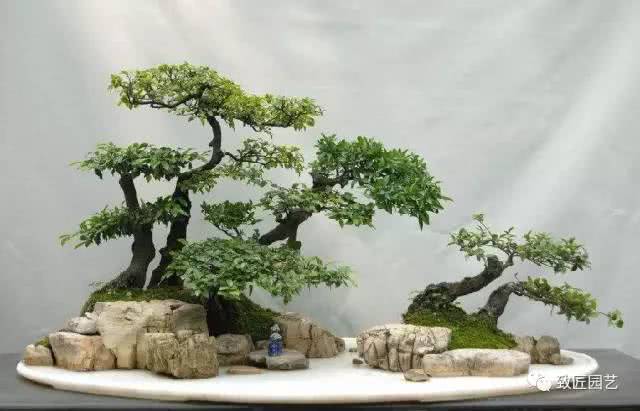
Bonsai, this comprehensive art that our ancestors created out of reverence for nature, blending Chinese philosophy, calligraphy and painting, embodies the Chinese ideal of indulging in mountains and waters, and reflects the tastes of Chinese literati. Wang Wei, Du Fu, Su Shi, Wang Shipeng, Lu You and others all wrote poems and prose praising bonsai and took part in making bonsai, greatly enriching the cultural connotations of bonsai.
Chengdu has deep ties with the development of Chinese bonsai: Liu Shan, the Later Ruler of Shu during the Three Kingdoms period, and Li Xian, Crown Prince Zhanghuai of the Tang Dynasty, both made bonsai in Chengdu, driving forward Chengdu's bonsai-making techniques and artistic level. Sichuan-style bonsai, one of the five major schools nationwide, is deeply rooted in the majestic yet beautiful landscapes of Bashan and Shushui; it is the crystallization of the wisdom of the hardworking Bashu people and an important part of Bashu culture.
Bonsai in China
Bonsai, as the name suggests, is the art of using plants and rocks as basic materials within a container to represent natural landscapes and thereby express the author's thoughts and feelings. It originates from our ancestors' awe and worship of nature, is closely connected with Chinese philosophy, calligraphy and painting, and organically fuses craft and art within a pot, and can be said to be a concentrated reflection of human creativity.
The term "bonsai" appeared relatively late; the textual record we can see today is a poem by Wang Shipeng of the Southern Song Dynasty, but in fact bonsai objects appeared very early. At the Hemudu site in Yuyao, Zhejiang (a Neolithic site more than 7,000 years ago), pottery shards painted with potted plants were found; in the Eastern Han tomb murals in Wangdu, Hebei (more than 1,700 years ago), there is a picture of potted flowers: six red flowers planted in a round pot, with several stands placed beneath the pot, forming an artistic composition integrating plant, pot and stand, regarded as the predecessor of modern bonsai.
But what is certain is that by the Tang Dynasty bonsai had developed to a relatively mature stage. The Palace Museum holds Yan Liben's "Portraits of Periodical Offering" from the Tang Dynasty, in which exquisitely carved rocks are placed in a shallow basin, very similar to today's landscape bonsai; on the east wall of the corridor in the tomb of Li Xian, Crown Prince Zhanghuai of the Tang Dynasty (son of Wu Zetian), excavated at Qianling in Shaanxi, there is a mural of a maid holding a bonsai in her hands. Feng Zhi of the Tang Dynasty records in "Jishi Zhu": "Wang Wei used a yellow porcelain vessel to hold orchids, cultivating them with patterned stones, and over the years they grew ever more luxuriant." Wang Wei (701-761), who resigned from office in 748, lived in seclusion at Wangchuan in Lantian, surveyed the site and built a garden, and arranged rocks together with secluded orchids to make bonsai.
In the Song Dynasty, the art of bonsai further developed, gradually splitting into two main categories, "tree bonsai" and "landscape bonsai." Specialized bonsai works appeared, such as Du Wan's "Yunlin Shipu" (Stone Manual of the Cloud Forest) in the Northern Song and Zhao Xihu's "Dongtian Qinglu" in the Southern Song, while the widespread participation of literati and scholar-officials further elevated the cultural significance of bonsai.
Wang Shipeng (1112-1171), a Southern Song jinshi who rose to the office of Academician of the Dragon Diagram Pavilion, was an important literatus in the history of Chinese bonsai development. He built a garden at home, planted flowers and trees, created bonsai, and had rich practical experience in bonsai making, composing nearly 40 poems and prose pieces specifically praising flowers, trees, bonsai, mountains and rocks: for example, his essay "Record of the Rock Pine" is the earliest classic document in China's bonsai history describing the tree-and-rock style of bonsai, possessing not only important academic research value but also the ideological value of appreciating and connoisseuring bonsai artworks. Wang Shipeng refuted the shallow notion held by some people of his time that bonsai art was a "plaything," greatly raising the status of bonsai and steering bonsai art toward the direction of literati poetic sentiment, light and elegant refinement.
In addition, Su Dongpo and Lu You also loved bonsai and left fine works to posterity. Su's poem "Two Rocks" says: "In dreams it was truly so, awake it is not; drawing water and burying a basin, one is foolish indeed. But seeing the jade peak lying across Taibai, one straightway cuts off Emei by the bird path. The autumn wind gives it the mood of mist and clouds, the morning sun makes it hold the bearing of plants and trees. A single point of empty brightness, where is it? The old man truly wishes to live at Chouchi." It is simply charmingly foolish. In "Gewu Chutan" it is recorded: "When the banana is first sprouting and divided for planting, pierce its root's eye horizontally with an oiled hairpin, and it will not grow large, and can be made into bonsai." This is a method of controlling banana growth to make bonsai; another example is Lu You's "Rockery, in the Style of Mr. Wanling": "Stack stones to make a small hill, bury a jar to make a small pool. At the side make a path for carrying firewood, in the middle open a fishing hut. The valley sound answers bells and drums, wave shadows invert pines and nanmu. May I ask where this is? I fear it is south of Mount Lu."
In the Yuan Dynasty, bonsai gradually developed toward "smallness," with attention to the quality of the bonsai. It mainly featured the "Three Friends of Winter" - pine, bamboo and plum - which were considered the highest grade in bonsai. The eminent monk Yun Shangren traveled in all directions, visiting famous mountains and great rivers, accumulating rich experience, and created "xiezi jing," or "small scenes," planting stones, trees, flowers and grasses together with small bridges, flowing water and thatched huts in a pot; though the pot was only a foot wide, its spirit could swallow the Bohai Sea, showing the great within the small, a world of its own, recorded in detail in Liu Luan's book "Yushi Hu."
During the Ming and Qing periods bonsai became even more prevalent. There were more bonsai works, and they influenced the world. Important bonsai works include a "Potted Plants" section in Tu Jiang's "Kaopan Yulu" of the Ming Dynasty; in the "Potted Plants" chapter of "Zhangwu Zhi" by the late Ming painter Wen Zhenheng, volumes one and two deal with garden design and landscape creation in considerable detail; the "Bonsai" section of Wang Xiangjin's "Qunfang Pu"; and Chen Haozi's "Methods of Planting in Pots to Capture Scenery" in "Huajing" of the Qing Dynasty. During the reign of the Kangxi Emperor of the Qing, the "Jieziyuan Huazhuan," compiled and illustrated by Zhu Sheng, Wang Zhi and Wang Gai, was translated, printed and published in Japan in the 13th year of Qianlong (1784), sweeping Japan and being revered by the painting world as a classic reader, influencing the development of Japanese bonsai.
In the late Qing and early Republic of China period, bonsai art, integrating art and technique, had through long development and practice seen the various schools distinguished roughly by region take on distinctive characteristics, among which the Sichuan school was an important one.
Sichuan-style bonsai is rooted in the landscapes of Bashan and Shushui
Sichuan-style bonsai is one of the five major schools of traditional Chinese bonsai, deeply rooted in the majestic and beautiful landscapes of Bashan and Shushui, with the bonsai-making techniques represented by the Chengdu area as the foundation and core of Sichuan-style bonsai-making techniques.
Sichuan-style bonsai has a long history, profound cultural deposits and exquisite craftsmanship, with strong local characteristics. As early as the Shu Han period, the Later Ruler Liu Shan built the Anle Palace in Chengdu, planting trees and grasses in the palace gardens and reproducing in pots the strange peaks, sheer cliffs, ancient trees and green pines of his memory. He also used stone and wooden boards to make pots of varying lengths, depths and shades, planting dwarf trees in them and pairing them with rocks, arranging them in a "V" shape in the palace gardens. Ministers and merchants followed suit one after another, and this form of landscape creation spread through Chengdu.
In the Tang Dynasty, Crown Prince Zhanghuai Li Xian, who had incurred Wu Zetian's suspicion, was demoted to Chengdu, and spent his days in the company of flowers, grasses and bonsai, taking pleasure in making bonsai; the mural of a tree-and-rock bonsai still exists in the corridor of his tomb. In the late Tang, during Li Deyu's tenure as military commissioner of Xichuan, he built the East Lake residence in Xinfan, Chengdu, where trees, rocks, flowers and grasses and bonsai set each other off beautifully. In the Northern Song, Du Wan in "Yunlin Shipu" highly praised "Western Shu stones"... In the Southern Song, Wang Shipeng wrote the poem "Jiannan Bonsai": "These two gentlemen have ancient hearts and lean, clear features; their delight lies in woods and springs, their zest is sparse. A thumb's breadth of blue has always been far from the Brocade River; the Nine Peaks are divided toward the western mountain dwelling. The hills and valleys in the mountains are like the Golden Valley; the waves beneath the brush put the Stone Canal to shame. I have a thousand peaks hidden at Yandang, a pillar holding up the sky thrust into the void." The author's original preface: "Mr. Jinhua has a marvelous blue rock, brought from afar from Chen Hongzhou of Shu. ... A single Yandang with its clustered peaks standing in disarray, all things among the desk." The author and the two friends who gave him bonsai were both connoisseurs who deeply understood the delight of bonsai, and highly praised the bonsai made from the marvelous rock from the distant Brocade River.
During the Ming and Qing periods, the body-training methods and techniques of wiring and shaping tree-stump bonsai in the Sichuan school had basically taken shape, and the annual Qingyang Palace flower and tree temple fair promoted the exchange and improvement of bonsai-making techniques. In the early years of the Republic of China, the wiring techniques were quite mature and complete, and tree-stump bonsai techniques were raised to a historic height.
Featured Content