Around 15 days of leave per year, many people are entitled to it, but most do not know about it and dare not request it.
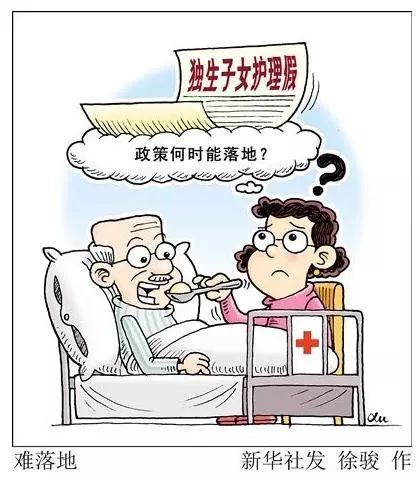
Recently, Sichuan and Henan provinces respectively introduced or revised "only-child care leave," a policy concerning only children and their families that is now being implemented in 9 provinces across the country. However, a reporter's investigation found thatthe implementation results of this leave are not entirely satisfactory, with prominent problems including people not knowing about it, not daring to request it, and being unable to get it approved.What exactly is causing this policy to remain up in the air? How many hurdles must be cleared before care leave can be truly implemented?
Photo/VCG
1
15 days of paid care leave per year
It looks wonderful
Although the era of the universal two-child policy has arrived, only children and their families remain a huge group in China. According to statistics from the Chinese Academy of Social Sciences, as of 2010, the total number of only children in China was about 145 million, and the population living in only-child families was nearly 450 million. The earliest cohort of parents of only children is now over 60 years old, and the caregiving pressure facing only-child families is growing by the day.
To better protect the rights and interests of the elderly, since Henan first introduced care leave in 2016, 9 provinces including Fujian, Guangxi and Hubei have now clarified care leave through local legislation or administrative regulations.
A review by the reporter found that care leave in various places is usually around 15 days. At the end of July this year, Henan revised the relevant regulations, changing the length of care leave to "no less than 20 days"; Sichuan, Hubei and Heilongjiang also grant non-only children no more than 7 days of care leave per year, with wages and benefits unchanged during the accompanying period.
In addition, the conditions for only children to take leave also vary from province to province.
In Henan, the prerequisite for an only child to take care leave is that the elderly person holds an only-child parent honor certificate;
Sichuan stipulates that an only child must meet the condition that "the elderly person is unable to care for themselves while ill and hospitalized" to take leave;
Guangzhou also stipulates that the parents of an only child must meet the conditions of being "aged 60 or above" and "during hospitalization for illness."
Although the rules and regulations differ from place to place, society generally gives a "thumbs up" to the introduction of care leave. Some aging affairs offices and elderly rights protection groups believe that this leave not only helps foster a social atmosphere of respecting and honoring the elderly, but also plays a positive role in raising young and middle-aged people's awareness of actively caring for the elderly.
To make care leave more operable, relevant regulations in Fujian Province set corresponding legal liabilities; in Hubei, related policies have also improved social security policies such as elderly social insurance, social welfare and social assistance.
2
A document was issued, but there was no follow-up
Leave is available but hard to take
Although this policy is widely recognized by society, a reporter's investigation found that its implementation results are not entirely satisfactory,with some companies and individuals clearly stating that they "do not know about care leave."The person in charge of human resources at a technology company in Hubei admitted frankly, "We really are not clear about this rule, and no one has applied for leave in the name of only-child care leave."
Some only children who meet the conditions said they "dare not request it."In the view of Ms. Xie, who works at a private enterprise in Fuzhou, this leave is "paid care leave for only children in government agencies and public institutions"; Liu Juanjuan, an employee of a private enterprise in Zhengzhou, said that even annual leave and some public holidays are not guaranteed now, let alone only-child care leave. If this kind of leave is only a principled requirement, it will probably come to nothing: "If the boss is unwilling, you won't dare take it even if you can."
Because it is not a nationwide policy, some only children also face the problem of being "unable to get it approved."Guo Zhanping, director of the Comprehensive Division of the Fujian Provincial Aging Affairs Office, said that care leave is currently implemented in only a few provinces, and there are not yet relevant provisions in national law. This means that some elderly people in provinces with such provisions, or only children working in provinces without such provisions, cannot enjoy the leave.
From the jubilation after care leave was introduced to the disappointment of hearing only thunder but seeing no rain, many only children complain that this leave is merely "paper welfare." However, the reporter learned that various places have repeatedly issued documents to promote policy implementation. For example, the Hubei Provincial Aging Work Committee has sent notices to the aging work departments of provincial-level agencies, higher education institutions, and large enterprises and institutions. Regarding why this policy has still not truly been implemented in many places, the people interviewed believe the main reasons are as follows:
-- Supervision is unclear.The civil affairs department of Guangdong Province said that the aging affairs office is responsible for refining the policy, while the specific enforcement and supervision should be handled by the labor inspection department. A reporter's investigation found that the Hubei Provincial People's Congress and the provincial government have made clear they will carry out law enforcement inspections; in addition, some provinces have not carried out law enforcement inspections on the implementation of this leave.
-- Penalties are unclear.Guo Zhanping said that this leave invisibly increases companies' labor costs, and some companies even refuse to implement it on the grounds that the relevant provisions have not been refined and clarified. Liu Junhai, a professor at the Renmin University of China Law School, believes that the absence of any penalties for companies violating the rules has, to a certain extent, encouraged illegal and non-compliant behavior by companies.
Photo/VCG
3
Promoting policy implementation:
Both incentives and penalties are needed
Experts interviewed believe that for more only children to enjoy the leave in accordance with laws and regulations, more safeguards are needed in terms of policy refinement, incentives and enforcement.
First, further refine the policy to ensure that care leave is implemented with a basis.Guo Zhanping suggested that unified and detailed rules should be made on issues such as confirmation of only-child status, parents' hospitalization, and how to calculate the travel time for only children from other places when requesting leave. Liu Junhai believes that after local regulations have been in effect for some time, their effectiveness can be evaluated, and legislation can be carried out at the national level.
Second, study and formulate relevant tax and subsidy policies.Yu Dandan, a lawyer at Beijing Dacheng Law Offices, believes that eliminating or reducing the problem of increased costs for companies caused by implementing care leave is crucial. Relevant departments can use methods such as tax adjustments to compensate companies for the additional labor costs.
Finally, regularly carry out supervision and inspection work.Yu Dandan said that to promote policy implementation, the specific responsible supervisory department should also be clarified. Trade unions or civil affairs departments, for example, can be responsible for supervising implementation by enterprises and institutions; once a company is found to have violated relevant regulations, the labor inspection department should step in and punish it.
Source: Xinhua News Agency
Chief editor: Chen Jingchun
Reporters: Hu Linguo, Mi Yingting, Liang Jianqiang
Contributing writers: Song Xiaodong, Zhu Lili
Editors: Dong Jingxue, Liu Xinyi (intern)
Proofreader: Gu Peng
Highlights