Are the leaves of your asparagus fern turning yellow? Dissolve this and water it once a week, and the yellow leaves never came back
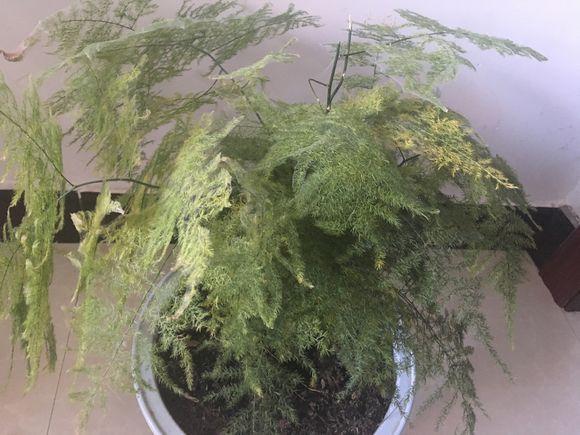
The asparagus fern (Asparagus setaceus) is a foliage plant with high ornamental value. Whether you keep it in the living room or the study, it brings a touch of greenery and vitality. At the same time, growing an asparagus fern symbolizes good fortune, meaning the owner of the house is refined and has the grace of a gentleman. Growing an asparagus fern takes care. Otherwise, yellow leaves and yellow tips easily appear.
It is very common for the leaf-like branches of the asparagus fern to dry up and the leaf tips to turn yellow. Many flower lovers who grow asparagus ferns are just not sure how to deal with it. Next, let us briefly share some care tips for after the asparagus fern's leaves turn yellow.
Below is an asparagus fern after its leaves turned yellow:
When the asparagus fern's leaves turn yellow, it does not look good at all. The one above is from the flower lover We Ai Ningmeng C. The reason the asparagus fern turned yellow is mainly that it was not grown according to its growth habits.
The asparagus fern likes a warm, humid, semi-shaded and well-ventilated environment. If the place where the asparagus fern is placed is not ventilated, yellow leaves easily appear. In addition, the asparagus fern should not be exposed to direct sunlight in summer, so it cannot be kept on a balcony either, as this easily scorches it and causes yellow leaves. Of course, there are also some other reasons, such as watering.
Image source: Asparagus Fern Tieba, flower lover: Wo Bu Shou
The flower lover above, at a glance, has placed the asparagus fern next to a window. The asparagus fern cannot be kept next to a window either; it is best placed 1 m away from the windowsill. All right, enough about the causes. Next, let us talk about what we should do when the asparagus fern's leaves turn yellow.
After the asparagus fern's leaves turn yellow, dissolve "it", then use it to water the asparagus fern once a week. Repeat this for two to three weeks to stop the yellow leaves from spreading, and it may even make the asparagus fern's leaves "turn green again".
It is "potassium dihydrogen phosphate". Many experienced flower lovers know that when a plant lacks phosphorus and potassium, its leaves cannot carry out photosynthesis smoothly under light, and therefore chlorophyll cannot be synthesized either. This easily leads to yellow leaves. In the past, I shared with everyone that fertilizing with potassium dihydrogen phosphate can keep leaves oily green and glossy and make stems and leaves thick and strong.
Since the potassium dihydrogen phosphate on the market is in powder or granular form, it needs to be dissolved before use. The specific dissolving method is: put 3-5 g of it into a mineral water bottle, fill it with water, shake well, let it stand for 2 minutes, and then it can be used to water the asparagus fern. With this method, you can alternate it with fermented rice washing water to water the asparagus fern; both can promote the healthy growth of the asparagus fern. Of course, potassium dihydrogen phosphate fertilizer can also be dissolved, diluted, and sprayed directly on the asparagus fern's leaf-like branches. This will also make the asparagus fern's leaves more and more oily green, with no more yellow leaves or yellow tips.
Image source: Asparagus Fern Tieba, flower lover: Qingfeng Zhuying
Although the asparagus fern is a very small potted plant, it is rather delicate. With proper care, it can be grown like the expert's above: not only are the leaves oily green and lush, but it can also bloom. It is fair to say that this cannot be achieved without several years of effort. Truly admirable! That is all for sharing about asparagus fern care. Thank you for reading!
Remember to like and share~