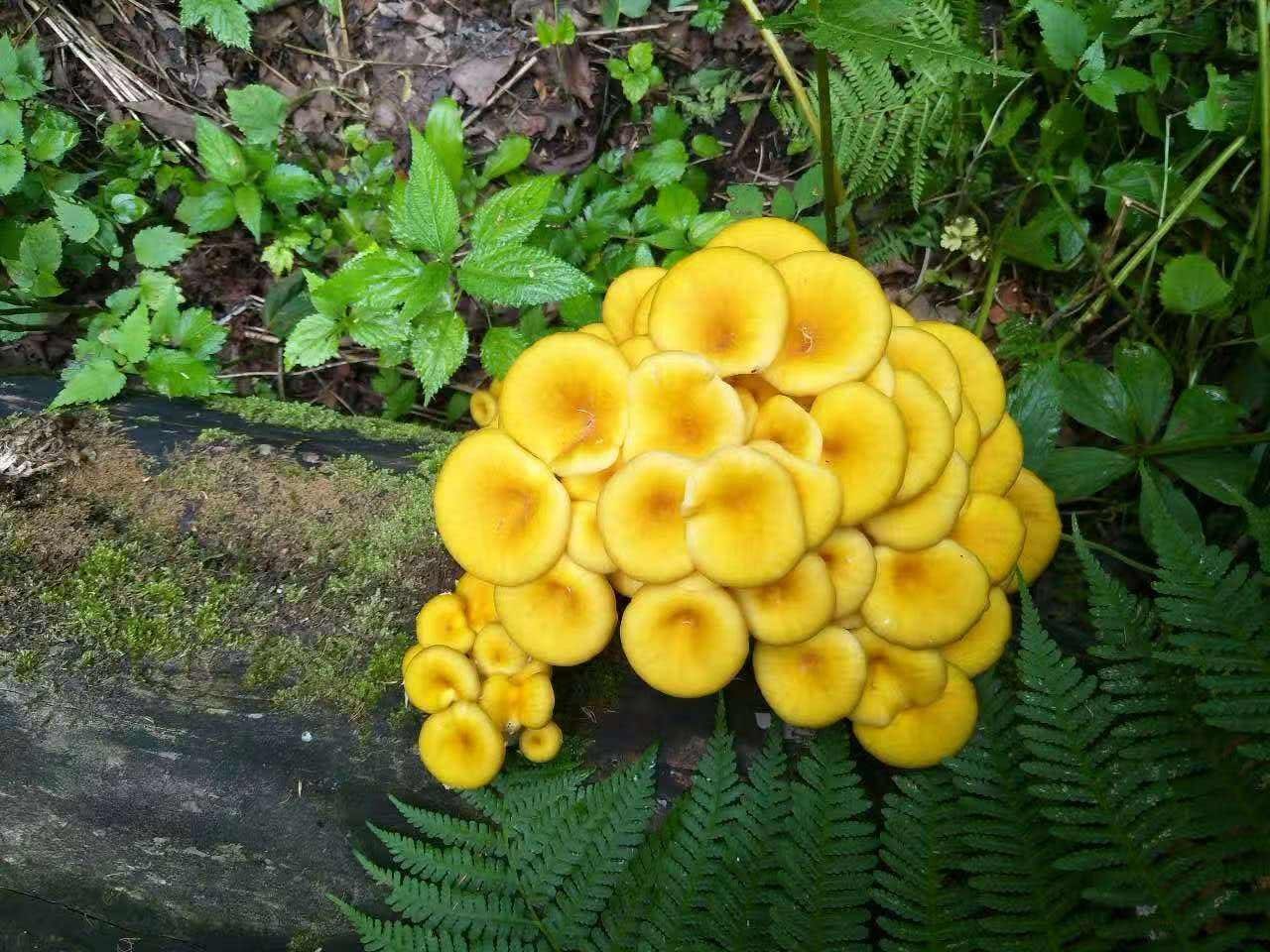
A cluster of "one-nest sheep" growing on a dead elm tree, once thought to be poisonous, now hard to buy even with money
They say farmers live off the mercy of the heavens - when to do spring plowing and when to harvest rice all depend on heaven's arrangement. As soon as spring begins, the adults hope for more rain, and once the water in the seedling fields has pooled enough, they plant the rice seedlings; in summer they can't wait for a few days of blazing sun so they can finish bringing in the corn and rice.
But we children often hoped for rain, especially when we were craving a treat. Once the rain passed and the sky cleared, delicious snacks could be found everywhere in the woods, on the hillsides and in the field ditches. Crayfish and loach were our favorites, not to mention wood ear mushrooms and wild mushrooms - everyone would scramble to find them.
03:12Speaking of mushrooms, I still remember that kind of small, exquisite, beautiful wild yellow mushroom that grew on dead trees. Every time, it grew in great big clusters on the roots of dead, rotten elm trees, especially eye-catching.
But the adults all said that the prettier a wild thing looks, the more poisonous it is, so even though we could see plenty of them every time, we all assumed that, like the temptingly red poisonous red mushroom, they absolutely could not be eaten. We would either glance at them or step on them, and sometimes we would smash them to pieces with sticks.
Later, when I saw an expert introduce this wild yellow mushroom on TV, I learned that it is actually called elm yellow mushroom, commonly known as "one-nest sheep", and is a precious wild fungus extremely rich in nutritional value. Thinking about it now, as a child I was really wasting something precious.
The elm yellow mushroom does not grow as individual stalks, but as many small yellow mushrooms fused together. When it first sprouts, it is only half a thumb long and pale yellow, and after about two days it turns a bright vivid yellow, in clusters that are especially beautiful - from a distance it looks as if the dead elm tree has bloomed again. Its cap feels slippery to the touch, and it tastes tender, smooth and refreshing, with an excellent flavor.
In autumn the elm yellow mushroom grows most abundantly and at its best. Farmers doing farm work always happen to come across a cluster or two. If there are few, they take them home and stew them with pig's trotters; if there are many, they take them to the market to sell. The elm yellow mushroom is most suitable for the elderly to eat - crisp, smooth and delicate, easy on the teeth when chewed, nourishing and kidney-tonifying, and able to prolong life. It is not only a hard-to-find natural delicacy, but also a health-preserving medicinal fungus!
Now everyone knows the value of the elm yellow mushroom, and more and more people are picking them. On the slopes you can hardly see any wild elm yellow mushrooms anymore, and even with money it is hard to buy purely natural wild ones. Moreover, the elm yellow mushroom is not only popular domestically, but is also a hot commodity abroad!
In recent years the export volume of elm yellow mushrooms has grown larger and larger. Many farmers have converted their idle single-story houses into mushroom sheds, or dug a dozen or so trenches for artificial cultivation. In rural areas, for such a hot high-grade export product, even spending money to build a few plastic sheds and buy a few sets of equipment is very worthwhile for farmers.
Dear friends, have you ever seen this kind of yellow mushroom in the countryside?