A drought-tolerant, easy-care flower that blooms for more than 300 days a year, even beginners can grow beautiful big flower balls
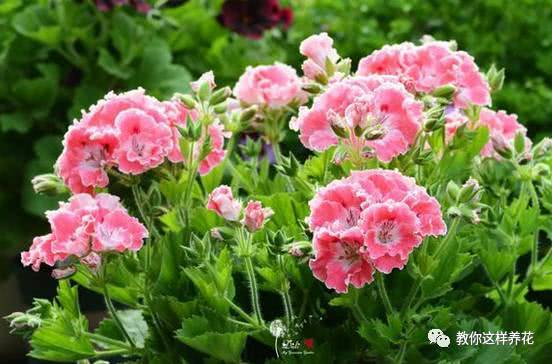
Geranium, also known as zonal geranium, is a perennial evergreen herbaceous or subshrub flowering plant in the family Geraniaceae, genus Pelargonium. Native to southern Africa, it is widely cultivated around the world. Geraniums have a long flowering period and strong adaptability to the environment, and their plant size suits home potting. They are easy to propagate and very popular, making them one of the common potted flowers in homes. The small flowers of the geranium cluster together, and the large inflorescence resembles a hydrangea ball, with vivid colors. If you love flowers and plants, you must get one!
“
Geranium
”
Beautiful varieties
Nantong Tian
Delli
Marjorie
King
Princess Carlton
Red Beauty
Lilac
Aztec
Red Witch
Lijiang Tian
Angel Tok Perfect
Bicolor Angel
Pink Angel
Pink Bowl
Candy Tian
Apple Bowl
Big Mountain Palace
Pandora
Flower Fairy White Splash
Chocolate
Lip Red
Empire
Orange
Tony
Pope Sophia
Belial
China Love
Images from Geranium Tieba flower friends didiwei, Maoduoer, Dali Bingtuotuo, xei312
-Soil Selection-
For potted geraniums, the growing medium can be a mix of 4 parts humus soil, 3 parts garden soil (or peat soil), 2 parts river sand (or perlite), and 1 part organic fertilizer, or it can be prepared by mixing fine sandy soil, humus soil, perlite, and organic fertilizer. Potted geraniums need to be repotted in autumn.
-Fertilization Method-
During the growing period, apply liquid fertilizer once every 10-15 days, and during the vigorous growth seasons of spring and autumn, apply liquid fertilizer once every 7-10 days; before bud formation, mainly use nitrogen fertilizer, and after bud formation, mainly use phosphorus and potassium fertilizer, with a concentration of 0.1%-0.2% being suitable. If the indoor temperature is relatively high in winter and growth has not stopped, fertilizer should also be applied. During the high-temperature period in summer, the plant is in a semi-dormant state and fertilization should be stopped. Because its stems and leaves have soft hairs, rinse immediately with clean water after fertilizing.
-Watering Method-
Geraniums have a relatively strong drought tolerance, so normally you can water after the soil dries slightly. During the peak growth seasons of spring and autumn, sufficient moisture should be provided to keep the potting soil consistently moist, but not waterlogged; on low-temperature cloudy days, generally do not water or fertilize; from June to July, when the plant is in a semi-dormant state, watering should be strictly controlled. In summer, spray water frequently to lower the temperature, keep the potting soil moist, and also pay attention to ventilation and light transmission.
-Temperature Requirements-
Geraniums like warmth, dislike high temperatures, and fear cold. The suitable temperature for geranium growth is 15-25°C, and indoors in winter a temperature of 10°C should be maintained. Below 3°C they are prone to cold damage, but some varieties can tolerate a low temperature of 0°C. In summer, after the temperature exceeds 35°C, they enter a semi-dormant state.
-Light Requirements-
Under direct sunlight, they grow robustly, with dark green leaves, short internodes, and a beautiful plant shape. In summer, pay attention to shading to prevent sunburn. In autumn, winter, and spring, they should all be placed in a spot with direct sunlight. When blooming, they can be moved indoors for appreciation, but after flowering they should still be placed in a bright spot. Rotate the pot once a week so the leaf surfaces receive light evenly. Keep the plant shape well-balanced.
When light is insufficient, they do not bloom; during the flowering period, avoid direct strong light, otherwise the petals will scorch and dry, and are likely to fall.
-Common Diseases-
The main diseases of geraniums include mosaic disease, crinkle disease, chlorosis, gray mold, root rot, and bacterial wilt. The main pests include white mosquitoes, caterpillars, small plume moths, and others. To control mosaic disease, it needs to be eliminated together with pests, especially aphids. To control small plume moths, a 1000-fold dilution of 90% trichlorfon can be sprayed.
-Propagation Method-
For cutting propagation, generally carried out in spring and autumn, the cuttings are best taken from mother plants that bloom frequently, are true to variety, and are free of pests and diseases. Both the tender shoot tips and the lower tender stems can be used as cuttings, but the tip portion is best, with strong growth vigor and fast rooting. After cutting the cuttings, soak them in 100 mg/kg indolebutyric acid for 5-10 seconds, then air-dry for half a day, and only after they have wilted can they be inserted into a sand bed or a substrate mixed with perlite and peat at 1:1. After watering thoroughly, cover with a small arch tunnel, and shade when sunlight is strong. Maintain the temperature at 15-20°C. They root 2-3 weeks after insertion, and when the roots are 3-4 cm long, transplant them.
For seed propagation, first soak the seeds in water for about 15 minutes and set aside. Fill a paper cup with 2/3 peat soil, spray water to moisten it, place the seeds into the peat soil, and cover with a thin layer of soil. Put it in a cool, shady place, keep the potting soil moist, and seedlings can sprout in 2-3 days. When the seedlings grow to the rim of the cup, they can be transplanted.
-How to Grow Flower Balls-
If you want geraniums to have many flowers and bloom into balls, pinching is indispensable. Generally, upright geraniums can be pinched when the seedlings are about 10 cm tall, keeping 5 or 6 leaves. After the first pinching, you can usually get 4 or 5 branches (for some varieties that do not easily produce side branches, pinch several more times).
Then pinch the side branches once more. After 2 rounds of pinching, there are often more than 10 side branches, and at peak bloom there can be around 20 flower stalks blooming. The shape will be quite full. For trailing geraniums, continue pinching 1 or 2 more rounds on the basis of upright geraniums.
(Geranium Tieba Feigelamu)
Geraniums like fertilizer. If you want the flowers to bloom into balls, fertilizer is certainly indispensable. 10 days after planting, you can begin fertilizing. But note that you should apply light fertilizer frequently, cooperate with topping during this period, and ensure sufficient light. During the stem and leaf growth period, fertilize once every half month, but nitrogen fertilizer should not be applied too much. If the stems and leaves grow too vigorously, stop fertilizing and appropriately remove some leaves, which helps flowering. During the flower bud formation period, add phosphorus fertilizer once every 2 weeks.
(Geranium Tieba sdf0809)
(Geranium Tieba Muzi Huapiaoxiang h)
Such a beautiful flower
Hurry up and start growing it!
Show it to flower friends who need it!