Aquatic plants are also very beautiful, yet few people know it
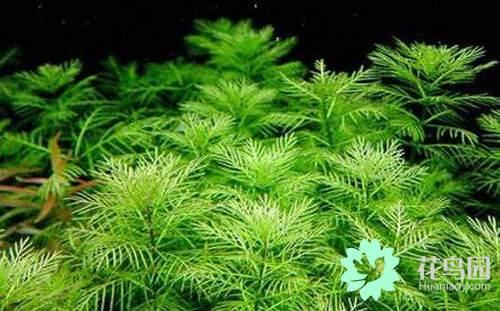
Myriophyllum aquaticum
MYRIOPHYLLUM AQUATICUM
Difficulty: Moderate
Light requirements: Moderate
Plant type: Stem plant
Family: Haloragaceae
Region: Central and South America, mainland China and ** also has distribution
Size: 125px -250px
Growth rate: Fast in the green variety, slower in the red
Whether CO2 needs to be added: YES
Native to Latin America, it is an amphibious plant belonging to the family Haloragaceae (water milfoil family?), and its other names include water milfoil, large milfoil, green foxtail or feather grass. The red form is also called red bottlebrush. Its leaves look very much like a fox's tail; the leaves are pinnately compound, arranged in whorls of five to seven. The submerged leaves are filamentous, and come in green, vermilion and pinkish-green. The stem is a hollow herbaceous stem that can grow creeping or upright, and is branched. On older stems, roots grow at the nodes, and these can be cut off and planted. Planted in groups in an aquarium, it is exceptionally beautiful.
Red Umbrella
PROSERPINACA PALUSTRIS
Difficulty: Moderate
Light requirements: Medium-High
Plant type: Stem plant
Family: Haloragaceae
Region: Americas
Size: Leaf width 3-125px
Growth rate: Average
Whether CO2 needs to be added: Yes
A dicotyledonous plant, an emergent aquatic plant. The emersed form and submersed form differ. The emersed plant has alternate lanceolate leaves with serrated margins and bright green leaves; it readily flowers and forms seeds in the leaf axils, and can overwinter by means of underground stems. When cultivated underwater, it shows many different variations. These include leaf shape changing from lanceolate to ovate, irregularly lobed leaves, and even pinnate leaves. The color can change from green to orange-red, and even deep red. There are not many red aquatic plants with serrated leaf surfaces, and among them the Red Umbrella is the most classic; when iron and trace elements are lacking, the leaf color turns bright green. At the same time, it varies with cultivation conditions. Its highly variable morphology stands out considerably compared with other aquatic plants, and in the United States it is called the swamp mermaid weed; it is a new favorite in planted tanks. It prefers strong light and lower water temperatures, and grows relatively slowly underwater. It does not branch easily, usually growing as a single upright stem, and several can be planted together to form a clump. To grow it beautifully, sufficient carbon dioxide must be supplied and a higher-quality liquid fertilizer used, so that the goal is easily achieved.
Four-leaf Clover
Scientific name: Marsilea quadrifolia Linn
Family: Marsileaceae
Distribution: Taiwan, China and mainland China, Japan
Light intensity: 1000 Lux
Water temperature: 15-28°C
Position: Foreground and midground plant
Hardness: 2-10 DH
pH value: 6.0-7.0
Difficulty level: Average
A fern, an emergent aquatic plant. The emersed form and submersed form are similar. The emersed plant has four green leaflets, which because they are arranged in the shape of the Chinese character "tian" (field) are why it is called "tianzi cao" (field-character grass). In nature, this aquatic plant rarely produces submerged leaves; it usually grows emersed leaves or floating leaves. It has slender petioles; when there is little water, the petioles can hold the leaves up in the air; when there is a lot of water, the petioles are softer, causing the leaves to float on the water surface. At night the leaves fold up, drooping as if asleep. In winter, sporocarps grow from the leaf axils, containing sori, and it can reproduce by spores. The rhizome creeps along the ground, and it can also reproduce by runners. It can be cultivated as a foreground plant, but under weak light the petioles may extend very long, so when used for foreground landscaping, the light intensity should be strong. In slightly acidic water quality, and under conditions with CO2 supply and normal fertilization, it can grow well.
Large Anubias
ANUBIAS BARTERI VAR. BARTERI
Difficulty: Very easy
Light requirements: Low
Plant type: Rhizome, underground stem
Family: Araceae, Anubias group
Region: Africa
Size: 625px -1125px
Growth rate: Slow
Whether CO2 needs to be added: NO
Small Anubias
Size: 125px -375px
Mini Anubias
ANUBIAS BARTERI VAR. NANA *PETITE*
Size: 75px -125px
Growth rate: Slow
Whether CO2 needs to be added: NO
Improved from the small Anubias, and the plant is even smaller than the small Anubias. The roots prefer well-drained conditions, and it is suitable for attaching to driftwood and rocks; because it grows very slowly, it easily attracts algae, so pay attention to the balance between lighting and fertilizer application.
Japanese Najas
BLYXA JAPonICA
Japanese Najas
Difficulty: Average
Light requirements: High
Plant type: Stem
Family: Hydrocharitaceae, genus Blyxa
Region: Mostly distributed in Southeast Asia, Korea, Japan, China and other places
Size: 175px -375px
Growth rate: Fast
Whether CO2 needs to be added: YES
When cultivated in an aquarium, it is often used as a midground plant. At present, due to environmental destruction, this plant is on the verge of extinction. Because this plant is relatively difficult to manage, it is not suitable for planting by those lacking experience.
Japanese Najas is not strict about water quality requirements; it is best cultivated in fresh water with lower hardness, and note that salinity should not be too high. The pH of the water body should preferably be controlled between 5.5 and 7.5, that is, ranging from slightly acidic to slightly alkaline. It has a relatively large demand for fertilizer, and during vigorous growth it can be top-dressed once every 2-3 weeks. If conditions permit, it is best to introduce carbon dioxide gas into the cultivation container as fertilizer to improve the plant's photosynthetic efficiency, and the supply rate should preferably be maintained at 2 bubbles per second. Japanese Najas likes places with ample light, and it can also be given 2-4 hours of scattered sunlight each day; when cultivated in an environment lacking light, a dedicated fluorescent lamp can be used, giving 8-10 hours of artificial light each day, so that the plant can also grow relatively normally. Be careful not to make the light too strong, otherwise algae will spread rapidly. Under intense sunlight, the leaf tips will turn reddish-brown.
Newton
DIDIPLIS DIANDRA
Difficulty: Relatively high
Light requirements: High (but avoid extremely high)
Plant type: Stem
Family: Lythraceae
Region: Southern North America, Mexico (in fact it also exists in China)
Size: 50px -100px
Its place of origin is North America, and it requires relatively strong light when growing, with temperature generally between 22--25°C, pH between 6.8--7.2, and carbon dioxide needs to be added when cultivating it; when it grows well, it is generally between 20--30CM. Newton grass has small leaves, opposite arrangement and short internodes, and the difficulty in cultivating it lies in its extreme sensitivity to changes in light and pH. The light source is best a warm-toned one, while strengthening the lighting; the top of Newton grass will turn red as it approaches the light, and after the lateral buds emerge from the underground stem, they can form dense clumps similar to moss.
Newton grass is a very distinctive aquatic plant, but it is relatively difficult to grow, and it is a midground-to-background plant in a planted tank. However, if grown well, it is a very eye-catching species of plant.
Cryptocoryne crispatula
Cryptocoryne undulata
Cryptocoryne crispatula comes from Sri Lanka, grows to a height of about 10-15CM, with a leaf width of about 10CM, and is a beautiful aquatic plant commonly seen when cultivated in aquariums. The leaf margins are wavy, dark red with diagonal stripes. When light is insufficient, the leaves appear green and the underground stem extends vertically, "baring its fangs and claws" in the water... so the light intensity must be sufficient to allow its dark red leaves to show. It likes old water and stable water quality. If the water quality, lighting or water temperature changes drastically within a short time, the leaves easily rot
Green Wendt's Cryptocoryne
Cryptocoryne wendtii *green*
It is an aquatic plant with quite strong adaptability, and its petioles are brown or red. In an aquarium the leaves become long and narrow, about 12-15CM, and bright green. Affected by water quality and light, the leaves change from bright green to reddish-brown [Note: different sources say different things; some say "Green Wendt's Cryptocoryne will not turn coffee-colored or brown under any water quality conditions"]. Green Wendt's Cryptocoryne is an aquatic plant that is easy to cultivate, and it prefers a substrate rich in nutrients (such as a substrate with a muddy quality), but too much iron will make the leaves fall off, and excessive CO2 will also cause the plant to soften.
On foreign websites there is also a Cryptocoryne called Cryptocoryne wendtii *green gecko*, which translated directly is "green gecko Wendt's Cryptocoryne"; it is unknown whether it is a new species or just a variety or specific form of our ordinary Green Wendt's Cryptocoryne.
Red Wendt's Cryptocoryne / Red Cryptocoryne
Cryptocoryne wendtii *mi oya* / Cryptocoryne wendtii *red*
In fact, what is generally called Wendt's Cryptocoryne on the market refers to Red Wendt's Cryptocoryne, that is, Cryptocoryne wendtii refers to Red Wendt's Cryptocoryne. This plant is distributed in Sri Lanka, and its leaves are lanceolate, 10-15 cm long and 2-3 cm wide. Its emersed leaves and submersed leaves are of the same type; the submersed leaves do not look red, but rather somewhat brownish-green or red-green, though the underside of the leaf is light green with some red. Because of its good adaptability underwater, it is widely used in planted aquariums. Relatively speaking, Green Wendt's Cryptocoryne is easier to plant than Red Wendt's; Red Wendt's is prone to withering if not cared for properly, and it has a particular preference for the calcium content in the water.