Fishing vessel unloading notice filed one day late results in a 1.3 million fine; Fisheries Agency says it has been advising for four consecutive years
A distant-water fishing vessel that failed to file an "unloading notice" was fined 1.3 million by the Fisheries Agency, sparking public concern. The Fisheries Agency held a press conference today (the 2nd) to explain, noting that the government had carried out thorough outreach before enforcing the law, and that the vessel owner had failed to complete the unloading notice in accordance with regulations for nearly three years, making this a "serious violation," leaving the Fisheries Agency no choice but to impose the fine.
In response, Chen Wen-chin, secretary-general of the Keelung Fishermen's Association, said that unloading notices and declarations must be done, and most fishermen support them. However, he believes that implementation of the unloading notice needs flexibility and should not mandate filing three days in advance, because offshore operations encounter many unexpected situations.
The Fisheries Agency responded that distant-water fishing vessels fish on the high seas, and the requirement for them to submit an "unloading notice form" at least three days before docking to unload is for the sake of coordinating our country's inspection personnel at foreign ports. As for special circumstances, it said these would be handled on a case-by-case basis, stressing that there is flexible room for adjudication.
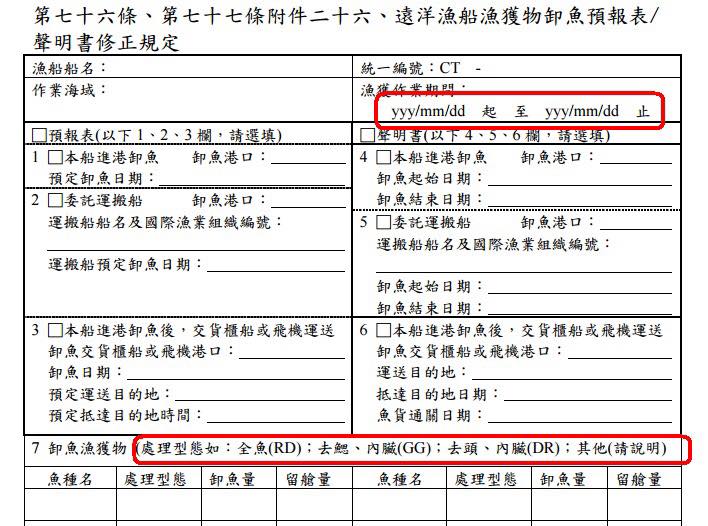
Did you know: Starting in 2014 (ROC year 103), Taiwan's distant-water fishing vessels must fill out a "notice form" before unloading fish, and also fill out a "declaration" after unloading. Starting in 2015 (ROC year 104), coastal and offshore fishing vessels were also required to fill out a post-unloading "declaration."
Fisheries Agency: the fined distant-water vessel owner failed to file an "unloading notice" for four consecutive years
Recently, media reported that a distant-water fishing vessel owner was heavily fined 1.3 million by the Fisheries Agency for submitting a form one day late, and complained that the government did not warn fishermen of their oversights first but instead imposed fines directly. Fisheries Agency Deputy Director-General Wang Cheng-fang said that since September 18, 2014 (ROC year 103), the Fisheries Agency has required distant-water fishing vessels to fill out a "notice form" and apply to the Fisheries Agency three days before unloading fish at domestic or foreign ports. The vessel owner in this case had failed to carry out the unloading notice since the regulations took effect in 2014. In November 2016 (ROC year 105), the Fisheries Agency reminded the owner of the violation and once again publicized the law's contents, and the owner afterward signed an affidavit acknowledging understanding of the regulations.
However, the vessel was operating in the Pacific between February and March last year and again failed to complete the notice three days before unloading as required, so the Fisheries Agency decided to impose a fine. Wang pointed out that the vessel completed unloading on March 20, 2017 (ROC year 106), but the form was only filled out on March 22, hence the fine for the violation. The Fisheries Agency said it carefully considers every individual violation case.
EU yellow card for Taiwan's illegal fishing not yet removed; failure to file a notice counts as a serious violation
Regarding the 1.3 million fine, he further explained that the vessel was fined 1 million for violating the unloading notice regulations, the captain was personally fined 200,000, and the fishing vessel had 74,831 yuan in fuel subsidy payments recovered due to the violation. On the other hand, the Fisheries Agency had originally offered installment payments for the fine, but the vessel owner recently needed to renew the fishing license, which required paying all fines in full first. Wang believed the owner was under excessive pressure at the moment, which led to the misunderstanding about the Fisheries Agency.
Our country has been on the EU's yellow card warning list for illegal fishing since 2015 (ROC year 104) and has not yet been removed. Wang stressed that implementing unloading notices and declarations is for effective management of fishery resources and also to show the international community Taiwan's determination to combat illegal fishing. "The pre-unloading notice is to allow the government to conduct unloading inspections, so failing to file a notice constitutes a serious violation." He explained that the Fisheries Agency has held many briefing sessions to publicize the policy, and called for fishermen's cooperation and support for the advancement of fishery regulations.
Keelung Fishermen's Association: unloading notices and declarations are the future trend, but there should be flexibility
Chen Wen-chin, secretary-general of the Keelung Fishermen's Association, said that unloading notices and declarations are the future trend and must be done to achieve sustainable fishery management, noting that 95% of fishermen are actually willing to comply.
However, he had something to say about the way unloading declarations and notices are implemented domestically. He believes distant-water fishing vessels encounter many unexpected situations at sea; unstable weather and course changes can both affect the date of arrival at port, and requiring a notice three days in advance does not match fishermen's working habits. "It's not that it can't be filed, it's that flexibility must be preserved." He suggested that if fishermen file a notice late but the final catch differs little from what was stated in the notice, they should not be fined, and a warning or light penalty would suffice, stressing that fishermen need flexibility in their operations.
Chen pointed to his own many years of fishing experience, saying there are too many force majeure factors at sea. For example, a typhoon or mechanical failure on the vessel may require an emergency docking. Moreover, many small fishing vessels in Taiwan have a "captain who is also crew," making it impossible to attend to every detail, and the government should consider convenience for the people when enforcing the law. "I agree that unloading reports must be done, it's just that the method of implementation should start more from fishermen's operational needs." He stressed this again.
Fisheries Agency: offshore and distant-water management differ; special circumstances will be given flexibility
Wang Mao-cheng, deputy director of the Fisheries Agency's Distant Water Fisheries Division, said offshore fishing vessels operate close to shore and are easier to manage, so they only need to fill out an "unloading declaration form" within five days after unloading. Distant-water fishing vessels fish on the high seas, and the requirement for them to submit an "unloading notice form" at least three days before docking to unload is for the sake of coordinating our country's inspection personnel at foreign ports; the three days are for dispatching personnel and facilitating management.
However, for special circumstances, such as onboard freezing equipment breaking down and requiring an emergency docking, making it impossible to complete the unloading notice within the required time, Wang said the Fisheries Agency will handle these on a case-by-case basis. "There is flexible room for adjudication; we will not fail to understand the emergency situations fishermen encounter." He also reiterated the purpose of unloading notices and declarations: to strengthen fishing management, such as checking for concealed catches of prohibited species or false reporting of catch volumes.
What if you can't read English? Fisheries Agency: bilingual Chinese-English
On the other hand, Chen Wen-chin further pointed out that the unloading report forms are all in English, which is difficult for middle-aged and older fishermen to read. "You even have to find someone to translate, which is very inconvenient!" In response, Wang Mao-cheng said fishermen had misunderstood, stressing that the forms are all bilingual Chinese-English and fishermen can definitely understand them.
A reporter actually obtained the unloading "notice form" and "declaration" and found they indeed contained more Chinese. However, on reviewing other fishing vessel operation reports, most were found to be bilingual Chinese-English. If the forms were all in Chinese, could that reduce the difficulty fishermen have in filling them out? Wang Mao-cheng explained that the reason for using both Chinese and English is to allow distant-water fishing vessels to communicate with vessels from other countries while sailing on the high seas.