They rented a junkyard and turned it into a 4,000 sq m garden. Are this couple crazy?
These past two days, the news of Kan Qingzi and Ji Lingchen's breakup flooded social media, and onlookers once again declared they no longer believe in love.
Why would anyone doubt love because of a celebrity's relationship changes? But in Shaoyao's view, the best love isn't found in books or movies, and certainly not in entertainment stars, but right around us.
Parents who have supported each other for decades, grandparents who still hold hands even as they totter along - they are what love truly looks like.
Around Shaoyao, there are many ordinary couples. They don't say pretentious things like "You loved the sea, and I loved you" - they simply love each other meticulously in real, everyday life. Fang Wei and Uma are just such a match made in heaven, and they built a 4,000 sq m garden house with their own hands, a place to hold their life and love.
At the foot of the mountain
Twelve
Fang Shi'er
00:00/04:46
{Shaoyao Girl Vol.829 }
x
Junkyard turned into a garden
Fang Wei and Uma went to build a garden not because they were wealthy people with nothing better to do, but precisely because they "had no money."
Fang Wei and Uma are an artist couple from Shanghai. Fang Wei paints, and Uma was once a dancer, now doing performance art. At the end of 2014, rent for studio space in downtown Shanghai went up, so they came to Chongming Island and rented a piece of abandoned land by the sea.
This land was originally an abandoned fishing station, nearly 4,000 sq m in size, and the center was used for burning garbage. Old plastic bags piled up into mountains, and around the open ground, there were abandoned old factory buildings to the north, south and west.
Although the buildings were dilapidated, the couple saw endless possibilities for transforming this place and quickly rented the land. Without changing the factory buildings' original structure, they gradually planned everything they needed for living and working into this space.
The two of them planted trees, flowers and raised fish with their own hands, slowly turning the former garbage heap and old factory buildings into a beautiful garden, a dining room, a bedroom, and separate studios for each of them.
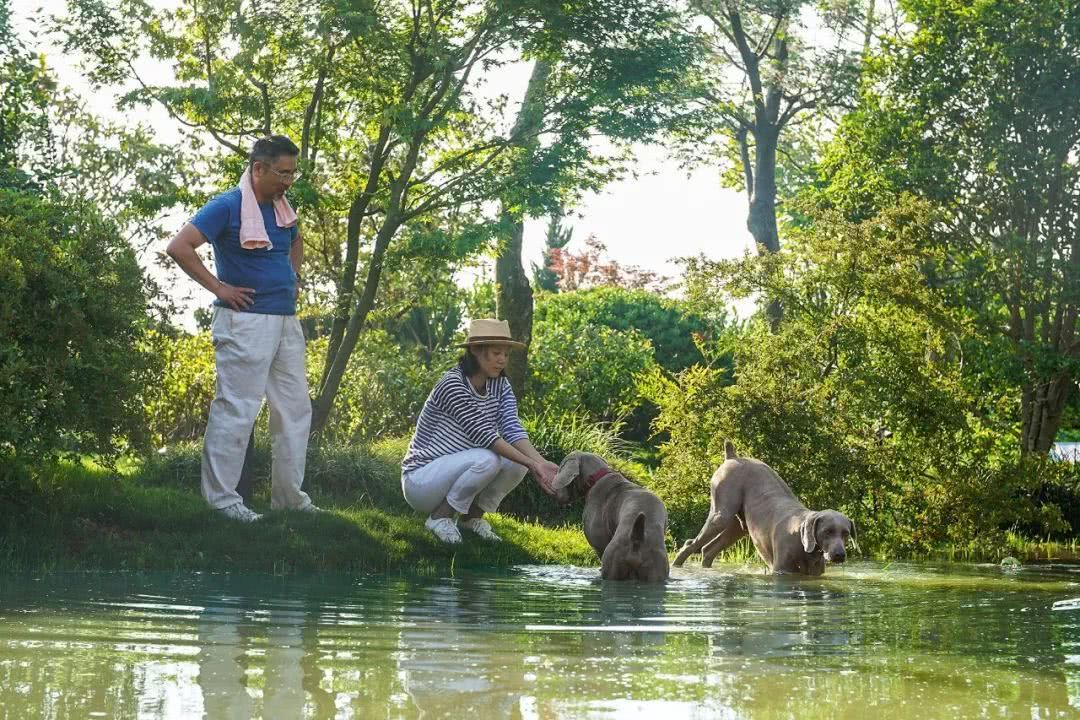
Now they live with their two-and-a-half-year-old daughter and a pair of Weimaraners, a father and son, continuing a life of renovating the house while creating art.
"Building a house here makes us happier than in the city,
it's no longer just renovation,
it's for the things we love."
"We didn't draw any blueprints,
the divisions between the different areas were measured with our feet,
grasping the size of the space with our bodies, very freely."
In the current home, open the courtyard gate and pass through the wooden fence,
a stone-slab path leads to two connected rooms.
One room is used as the dining room.
The plaque on the wall
bears the name Fang Wei's father wrote for their daughter - Yongqing.
The other serves as the living room, with two skylights opened in the roof.
This inspiration came from the couple's studio,
natural light pours down, making the whole space bright and airy,
and beneath the skylights two pieces of white cloth are hung,
to block the scorching summer sun from shining directly into the room,
and the light becomes softer too.
The floors at home are all old floorboards salvaged from demolished old houses in the city. "We paint, and our feet always carry pigment, or mud from the garden. Old floorboards let us be more casual, free, unrestrained - without the sense of constraint that new floors bring."
Fang Wei also picked up two cabinets from a secondhand dealer, Ming-style furniture made over a hundred years ago and still well preserved, for only five hundred yuan. "This excites me more than buying a 3,000-yuan toilet."
Three windows connect the dining room and the living room, so no matter which room you're in, you can see what family members in the next room are doing.
The couple also often go out "junk-picking" together, collecting furniture, doors and windows that farmers have thrown away. Three unwanted window frames that had been removed were set into the wall between the dining room and the living room.
Another door in the living room leads to a small bar space. When Uma was giving birth to their daughter, Fang Wei converted this into a space where the family of three could have breakfast.
"Looking out from the bar, you face the small pond we dug, with the most comfortable view."
The couple channeled water from the river outside the eastern wall into the courtyard, and the central open ground that was once piled with junk became a pond with circulating water. Hydrangeas were planted around the pond, and around the plum rain season is exactly when the hydrangeas bloom in lively profusion.
Push open the curved archway beside the bar,
and you can see the flower trellis built from discarded windows,
the rose planted two years ago has already climbed up along the frame.
"The surprises plants give you in a year,
are something you never realized before."
Uma's studio is behind the living room and dining room,
at the southernmost end of the whole site.
Fang Wei's studio is at the northernmost side of the whole site,
and across the entire garden, the two studios face each other from afar.
"This distance is very comfortable,
we work without disturbing each other, creating independently."
They don't see each other during the day, and at mealtimes,
the housekeeper gives a bell a shake,
and when everyone hears the bell, they head to the dining room from their different rooms.
When they first came to the countryside, besides building the house, the couple often drove around the village. When they saw villagers growing certain trees, they asked whether they could buy them, and slowly moved these large trees one by one into their small courtyard.
"There are ginkgo, chinaberry, silk tree, loquat, magnolia"
"Slowly we've learned a lot from these plants. At first it might have felt like being illiterate, but now we can name the trees we've planted."
One day while tidying the grove, Fang Wei even found a small bird's nest, with five or six newly hatched birds inside that hadn't yet opened their eyes.
Uma said another reason for coming to Chongming was to give one of their Weimaraners a larger range to move around. They had once paired it with a female Weimaraner of the same breed, and she gave birth to puppies.
Unfortunately, the female Weimaraner later passed away, and quite coincidentally they came across this bronze statue, so they placed it in the courtyard to remember the deceased female Weimaraner.
"Many friends ask us, are you used to living in the countryside? After we gradually finished renovating this studio, we felt for the first time how different it is from city life."
"We get up at five in the morning, we can see the sunrise every day, and we never tire of the colors of the sky."
"We go to bed early at night, there's no other entertainment, no coffee bars, and none of the petit-bourgeois atmosphere our previous life required."
"We're not living in seclusion here, nor are we escaping anything. This place lets us face ourselves quietly, and also keeps a very good sense of distance from the city."
Who says happiness means buying a mansion and driving a luxury car,
because of love, even a junkyard can become a garden,
a family of three, three meals through four seasons,
bird calls you never tire of hearing, morning glow you never tire of watching
- it's another kind of happiness.
END