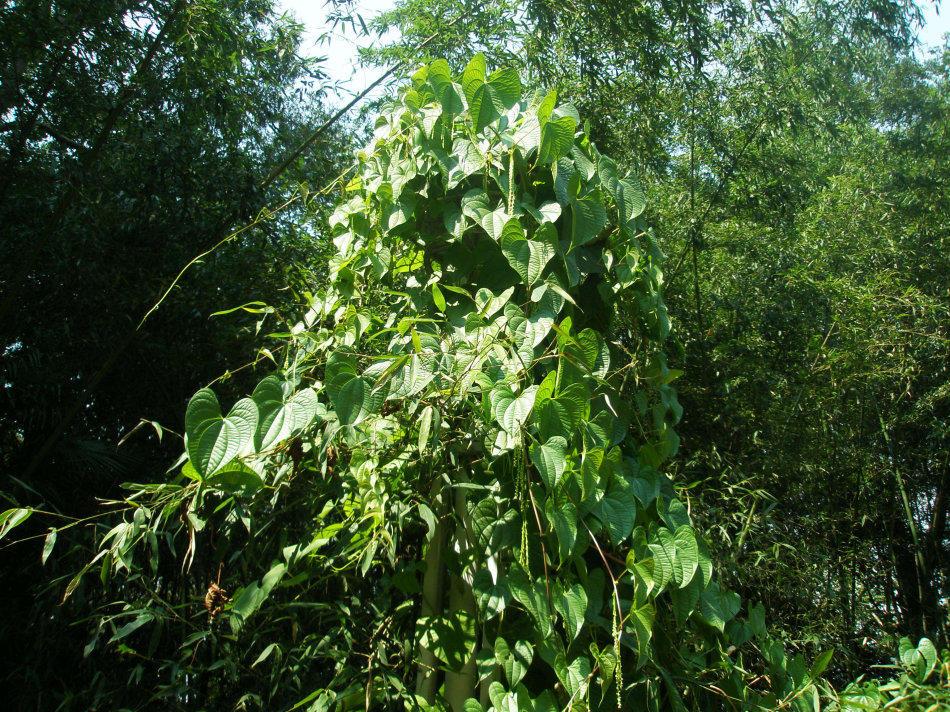
The precious Chinese yam bulbifera is often mistaken for Boston ivy, and it is a pity that farmers cut it down whenever they see it
Everything in the world, whether an object or a living thing, is a completely unique individual. Even products rolled off an assembly line in a factory cannot be guaranteed to be identical in every way; in the smallest details there is always something proving they are different.
This principle can be applied everywhere, including the plants and animals we commonly see, and especially some Chinese herbal medicines. Most people's understanding of Chinese herbal medicines is limited to a few precious ones, such as ginseng and reishi mushroom. Yet among Chinese herbal medicines, many look alike, but their medicinal properties are vastly different.
In some rural areas, similar-looking plants are often seen. The roots of this plant look no different from those of He Shou Wu (Polygonum multiflorum), but these are actually two different medicinal herbs. This often-misunderstood medicinal herb is Huang Du (Dioscorea bulbifera).
It is precisely because He Shou Wu is highly valuable and Huang Du closely resembles it that some unscrupulous traders often pass Huang Du off as wild He Shou Wu to deceive consumers, achieving the aim of passing fake goods off as genuine and putting on a real-life "real and fake Monkey King" drama. So people often use it to impersonate He Shou Wu, not realizing that it is itself a good medicine.
Because Huang Du's growing requirements are relatively simple and its adaptability is very strong, Huang Du is found all over the country; no matter which province it is, Huang Du can be seen there. Huang Du is just like Boston ivy, extremely similar in appearance; not only does it grow fast, but it can also thrive in any environment.
Therefore many farmers cut it down as a troublesome Boston ivy, not realizing that its root is a rare medicinal herb called "Huang Yao", also known as Huang Du.
It is precisely because Huang Du grows in a wide range of areas that people who do not know it often mistake it for He Shou Wu and think it is a precious Chinese herbal medicine, taking it home to use; and unscrupulous traders often pass Huang Du off as wild He Shou Wu and sell it at a high price.
Although Huang Du and He Shou Wu look very much alike, Huang Du and He Shou Wu are two different medicinal herbs, and their uses are also different. Huang Du itself contains toxic components. If taken in excess without proper use, it will produce many adverse effects, cause great harm to the body, and in more serious cases even cost lives. So if you see this Chinese herbal medicine that closely resembles He Shou Wu, you must be doubly careful and treat it seriously.
Although Huang Du contains toxic components, that does not mean it is a completely harmful poison. Like He Shou Wu, Huang Du is also a Chinese herbal medicine and has certain medicinal value; with proper use, it can likewise have therapeutic effects. No matter what medicinal herb it is, it must be taken reasonably under a doctor's supervision, for as the saying goes, "every medicine is three parts poison".
Friends, have you ever seen Huang Du? You are welcome to leave a message and share your thoughts!