Whether orchids are planted deep or shallow is all up to your mood? Then you are being far too naive.
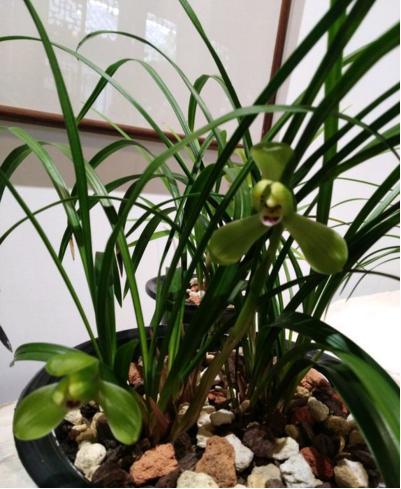
Many growers believe that planting orchids too deep will cause rot, and that it is better to leave the pseudobulb exposed or half-exposed, but what is the real situation? Based on my experience, this is actually not the case. Do growers perhaps have some misunderstanding about orchid planting?
Let me correct this. First of all, the pseudobulb is best not left exposed. As for whether to plant deeper or shallower, this is mainly decided by a combination of various factors. As for how deep or how shallow, getting it just right depends on the environment, the condition of the seedlings, and the potting medium.
I believe that first of all the variety should be a good one, so as to eliminate weak and diseased stock at the source and reduce the possibility of root rot. To put it more bluntly, if the variety is poor, then no matter whether it is planted deep or shallow, whatever is going to rot will still rot. In addition, the potting medium must also have good ventilation and air permeability; this prevents the possibility of rot from the external environment.
There are two situations in which shallow planting is not suitable and deep planting is suitable: one is dry regions, and the other is coarse granular potting medium. Therefore, in general, shallow planting may suit areas in the south with high humidity. When planting orchids, growers should open their eyes and look clearly at the region they are in, and then decide whether to plant the orchid deep or shallow. Fine, soft potting medium can be used for shallow planting, but the actual situation still has to be judged by the growers themselves.
Growers, take note! When first potting up, the pseudobulb should still be covered so that it is not left bare and exposed. Of course, nothing is absolute. If growers want a high sprouting rate, the pseudobulb is best kept hidden! Covering the pseudobulb gives a high sprouting rate, and the seedlings will also grow strong.
Everyone knows that new shoots generally sprout from near the bottom of the pseudobulb, about one third of the way up the pseudobulb. If an orchid is planted shallowly, the sprouting part of the pseudobulb is close to the pot surface, and the humidity at the pot surface is almost the lowest, so with low humidity it is not easy for shoots to grow. An orchid that has reached its sprouting period can only sprout from the very bottom of the pseudobulb, where the humidity is relatively higher; these are what everyone calls undersea shoots.
And it is an indisputable fact that undersea shoots rot easily. The reason is that undersea shoots grow in a lower position, take a long time to emerge from the medium, are stifled in the potting medium for a long time, and combined with carelessness when watering, they rot easily. This is the biggest drawback of planting orchids shallowly.
In summary, under normal circumstances deep planting is somewhat better for orchid sprouting. Exactly how deep? I suggest adding potting medium up to the point where the roots meet the stem, then covering it with a 1 cm thick layer of loose moss, and that will do. Of course, growers can also decide the depth according to certain conditions of the orchid.