What are the watering methods and precautions for the money tree?
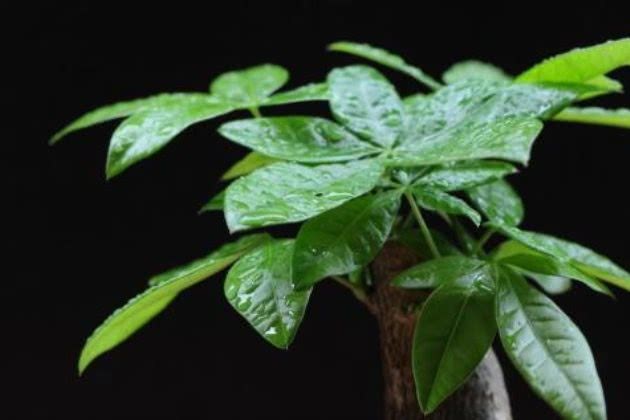
The money tree (botanical name: Pachira aquatica) is one of the indoor green plants that many people like to grow. Whether in company offices, lobbies, shopping malls or individual homes, the money tree can be said to be everywhere. The money tree is not only a plant with an auspicious meaning, but also an evergreen plant suitable for decorating home environments all year round.
Most people may know that the money tree should be watered sparingly, as it is a relatively drought-tolerant plant. Conversely, if it is watered too much, at best the leaves will become soft and turn yellow, and at worst the stems and roots will rot and the plant will die. Therefore, watering is a crucial step in growing the money tree, and also a fatal one! So how exactly should the money tree be watered to be most appropriate? Today Hua'er Gu will learn together with everyone how to water the money tree!
Watering the money tree can save its life, but it can also be fatal! First of all, clean water is best for watering, and you must absolutely avoid using untreated tap water or rice water, especially rice water. If used improperly, it can be fatal in one move, with no room for recovery!
Nowadays many families, especially those living in cities, basically use water from the tap water plant to water their flowers. So how should tap water used for watering the money tree be treated so that the money tree can grow better?
First, we need to place the water collected from the tap under the sun for more than a day before it can be used! Tap water is generally treated with disinfection, bleaching and sedimentation, and contains substances such as chlorine and bleaching agents. Tap water that has been exposed to sunlight or left outdoors to stand for more than 72 hours will have greatly reduced levels of chlorine and other harmful gases.
Using tap water that has been exposed to the sun to water the money tree can avoid harm from chlorine and other gases as much as possible. This is an important step in water treatment for growing the money tree!
Secondly, the money tree is a drought-tolerant but not waterlogging-tolerant plant. It is better to let it be in a dry environment than to let it experience even a little waterlogging, otherwise the money tree's weak roots will develop black rot and cause the whole plant to die.
In other words, the principle of "water when dry, dry when wet" that we usually exchange is not suitable for growing the money tree! "Water when dry, dry when wet" generally means that once the surface layer of the soil in the pot is observed to be dry, you can water thoroughly. For a plant like the money tree, this watering technique will obviously easily cause the soil to become too moist and lead to root rot.
Therefore, we need to, on top of the "water when dry, dry when wet" principle, delay watering by about a week or so to be more appropriate! That is to say, if in summer our other flowers are generally watered once every 5 to 7 days, the money tree should be watered at least once every half a month! For a money tree grown in a cool indoor spot, it is even not surprising to water it only once a month!
Of course, a more intuitive method is that we can also observe by inserting a chopstick into the potting soil. Insert the chopstick about 5 cm into the money tree's potting soil, pull it out after about half an hour to observe. If there is a very obvious water mark, do not water at this time; conversely, if there is no obvious water mark, then it needs watering.
When using the method of inserting a chopstick into the soil, you generally need to stay away from the money tree's stem to minimize harm to the money tree's roots. Generally, inserting it near the edge of the pot is enough for observation. If you accidentally harm its roots, we can observe a particularly obvious water mark on one side of the chopstick. In this case, even if it is time to water, we should wait a bit and water after 24 hours to let the wound heal. This prevents watering from causing infection of the injured roots.
Then, we need to pay attention to watering techniques. If we are using the lightweight soil that came with the plant when we bought it, we must not water too much at once, otherwise the soil absorbing too much water can also easily cause root rot. Many flower enthusiasts know that when watering flowers, you should not water if not dry and must water thoroughly when you do, but this also depends on the situation. Not all plants can be watered this way! For example, with a ball of cotton and a pile of compacted soil, the cotton naturally absorbs a great deal of water. Different substrates mean watering cannot be generalized.
A half-meter-tall money tree in general lightweight soil only needs about 100 ml of water, letting it slowly seep through inside. If ordinary garden soil or loess soil with not very strong water absorption is used, we can also water slowly with about 100 ml of water to let the moisture fully penetrate. If the flower pot has relatively good drainage performance, you can also water according to the principle of watering thoroughly, and as long as waterlogging does not occur, watering problems generally will not arise.
Finally, we need to explain some issues to note when watering the money tree with rice water. Freshly obtained rice water absolutely must not be used to water the money tree, otherwise every plant you water will die! If the rice water contains broken rice grains, it is even more likely to cause the money tree to die! When we use rice water to water flowers, it generally must be fermented for more than a month before being diluted with water for use.
Of course, some flower enthusiasts may say, "I use fresh rice water with small millet grains to water my pothos, so why doesn't this problem occur?" In fact, the vitality of pothos cannot be compared with that of the money tree, and we need to treat them separately. However, we also cannot water pothos with fresh rice water too frequently, otherwise problems will still arise!
The above is Hua'er Gu's introduction to the techniques for watering the money tree and some issues to note when using rice water to water flowers. If you also grow a money tree, share your unique growing insights with the friends of Hua'er Gu!