How is river sand used in soil mixes for growing flowers? I'll teach you the screening method, and even succulents can be grown well
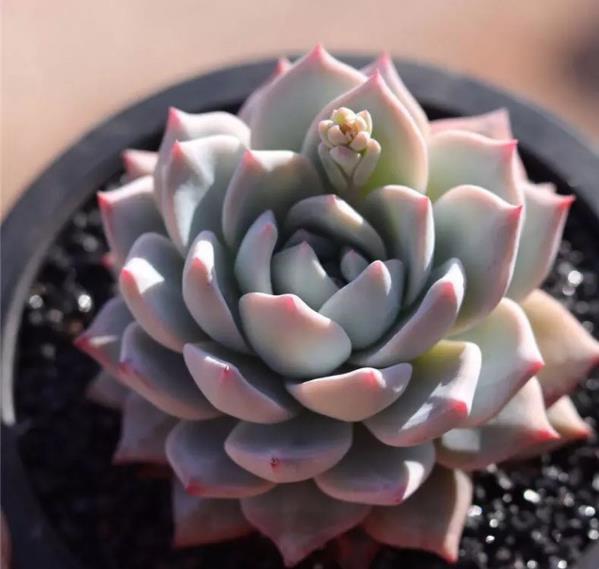
How exactly is river sand used when mixing soil for growing flowers? River sand is a medium commonly used by flower lovers, especially for succulents. Many people believe that succulents grow in deserts. I already talked about this in a previous article: most succulents do not grow in deserts.
First, when growing succulents, what everyone pays the most attention to is generally soil breathability. This is also the biggest shortcoming of river sand and the misunderstanding people have when using river sand to grow succulents. When river sand particles are smaller than 2 mm, after watering, due to the surface tension of water, its breathability is almost the same as that of garden soil. This is especially true for fine sand. Sand with a particle size of 0.25-0.35 mm is usually called fine sand. Needless to say, this kind of sand definitely cannot be used as a flower-growing medium; even a small amount will clog the gaps in the soil. After river sand dries completely, it will become severely compacted. If peat or coconut coir is used, this situation absolutely will not occur. Obviously, pure river sand is inferior to peat, coconut coir, and even ordinary garden soil in many respects.
Next is the issue of nutrients. Sand itself is composed of various minerals and rock-like substances. Its main component is quartz stone (but quartz is not equal to silicon dioxide; material with a silicon dioxide content above 98.5% is called quartz stone, and it must be distinguished from silica stone). River sand is very common and found everywhere, but the composition of river sand varies somewhat from place to place, though generally the differences are not great. River sand is very infertile, lacking humus and many fertilizers needed by plants. Growing flowers in pure river sand will not necessarily kill them, but it will undoubtedly cause slow growth and have a considerable impact on the plants. Although, under the conditions satisfying the first point, it can be used to grow succulents and other flowers, and coarse river sand is cheap, common, and decent in all aspects, making it a very good succulent-growing medium, it is absolutely not recommended to use pure river sand to grow succulents and flowers.
Let me talk about the other functions and precautions of river sand. If we go to the riverbank ourselves to collect river sand, the particles we find are generally both large and small. It is recommended to screen out particles that are too large and too small. Most of this kind of sand we get comes from construction sites, and most of it at construction sites is fine sand. Be sure to use it with caution! For succulent soil mixes, particles with a diameter of about 3-6 mm are usually used. For other flowers, the particles can be slightly smaller. For top dressing, as long as it is larger than 2 mm to ensure breathability, it is fine; a little larger does not matter.
Finally, some flower lovers believe that river sand top dressing has an insecticidal effect. Let me clarify first: it does have an insect-preventing effect, but it is not insecticidal. What you also need to know is that this can indeed effectively prevent insects such as fungus gnats, mole crickets, white grubs, and cutworms from laying eggs on the soil surface and, after hatching, harming plants or burrowing into the soil to overwinter. However, most of these insects do not harm succulents and flowers. They mostly feed on vegetables and can only harm plants grown in the ground. If the soil itself already has insects, then it is of little use. Also, if diatomite or volcanic rock is used, the insect-preventing effect is definitely better than that of river sand. Even more incredible is that insects staying on diatomite will lose about 10% of their body fluids and die. This is an insecticidal effect that river sand is far from being able to achieve.
This is a gathering place for succulent lovers, sharing succulent care tips. Welcome to follow and exchange ideas.