Don't Rush to Behead Leggy Succulents - They Actually Have 5 Benefits, Including Preventing Black Rot and Boosting Side Shoots
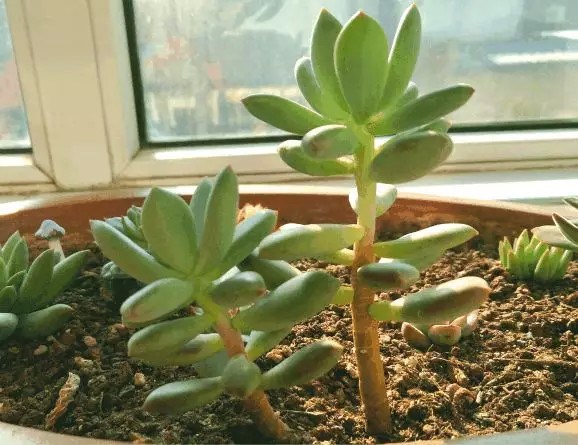
When caring for succulents, growers least want them to become leggy. Once a plump, cute, compact succulent turns into a tall, spindly specimen, its looks plummet several times over! But a leggy succulent is not entirely without merit. Today, Huahua will walk you through the benefits of leggy succulents!
Improved ventilation helps them get through summer!
After a succulent becomes leggy, the leaves at the base of the stem become sparse, making it less prone to dead or rotting leaves. This improves ventilation at the base and helps prevent black rot and mushy rot in succulents.
Black rot is easier to spot, preventing it from spreading!
After a succulent becomes leggy, the stem grows very long and the spacing between leaves increases. This way, if black rot appears, it can be detected and dealt with promptly, preventing it from spreading.
It easily forms an old succulent stump, sending its value soaring!
Legginess in succulents is irreversible and cannot be restored to its previous state. However, in a leggy succulent, the stem gradually dries out and becomes woody, thus forming an old succulent stump.
More water stored in the stem boosts drought resistance!
The main cause of legginess in succulents is a lack of light, which reduces water evaporation. The water that the leaves cannot absorb is all stored in the stem, which instead strengthens the succulent's ability to resist drought.
It promotes side shoot growth and rapid pot-filling!
After a succulent becomes leggy, the spacing between leaves increases, which is more conducive to side shoot growth. As the legginess progresses, the side shoots gradually grow into independent branches. Before long, the succulent will fill its pot!
However, if you really don't like a leggy succulent, you can behead it to bring it back to peak appearance!
How do you behead a leggy succulent?
1. Today, Huahua will use a leggy Ruby Slippers as an example to explain how to behead and handle a leggy succulent.
2. Count 2 layers of leaves from the bottom, and use a sterilized knife to cut it across the middle. To avoid damaging the leaves, you can remove some of the leaves before beheading.
3. After beheading, be sure to apply some carbendazim powder to the cut, otherwise it can easily develop black rot. After applying it, place the succulent in a cool, ventilated spot for care.
4. Use the removed leaves for leaf propagation. Lay the leaves flat on the surface of the soil and place them in a cool, ventilated spot. They will root in a few days.
5. Find a mineral water bottle, fill it with clean water, and place the beheaded top of the succulent at the bottle opening to encourage rooting.
6. Once the roots have grown, you can pot up the beheaded top for care.
7. Summer temperatures are relatively hot and humid, and in about half a month the mother succulent will grow many small side shoots!
That's all for today's little tips about leggy succulents.