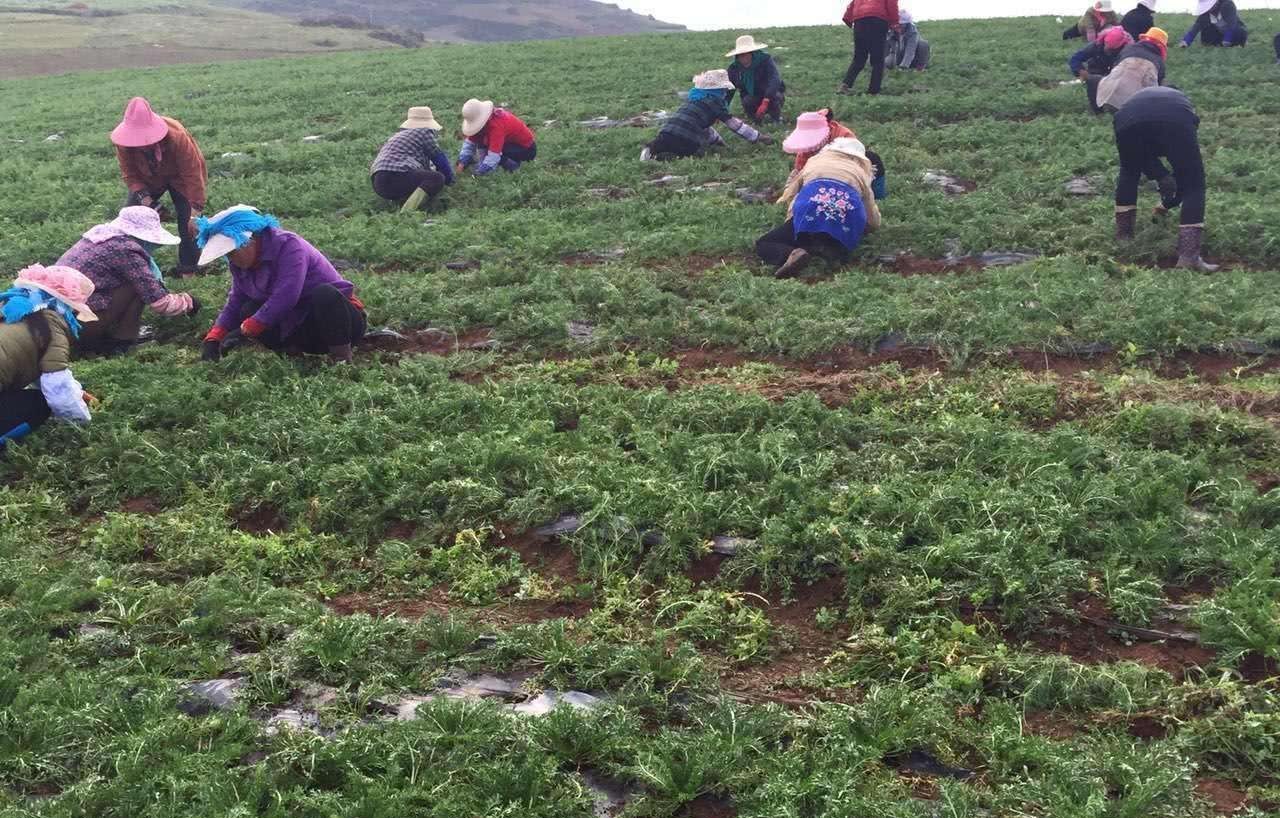
Peruvian ginseng once sold for sky-high prices, but now nobody wants it, and it rots in the fields as pig feed.
In today's world of rapidly advancing technology, in what is called the "fast-food era," everything demands speed. One person is expected to do the work of several, and one day is stretched to do the work of two. With mental energy and physical stamina excessively depleted, the body is already on the verge of collapse. The age at which various serious diseases strike is getting lower and lower, so health preservation has become a fashionable trend. Young people are like this, and middle-aged and elderly people, who are on the last train of life, show even more clearly their anxiety about and craving for life.
It is precisely for this reason that many "flash-in-the-pan" miracle drugs and supplements have been born. When they arrive, they sweep the world like a storm. Because their functions are exaggerated and hyped, the truth cannot be hidden forever, and they fall from heaven to hell, creating an awkward scene of utter ruin. Today's protagonist is - maca.
The reason maca became popular is first that it satisfied a necessary condition: "things are precious when they are rare." The places where it can grow are truly few. It must be high in altitude, have sufficient sunlight, have a large temperature difference between day and night, and also has requirements for soil pH, and so on. It is mainly found in the Andes Mountains of South America and the Yulong Snow Mountain area of Lijiang, Yunnan, China.
This has led to the scarcity of maca and made it a product that people scramble to compete for and chase. The appearance of maca, which grew up in a frozen world, is also easy to identify. Its leaves are elliptical, and the main edible part, the root and stem, resembles a small radish. Because of these characteristics, it also has the title of "South American ginseng."
Speaking of its popularity, everyone must have heard at one time about maca's "ten great magical effects." As for exactly what those ten are, the editor will not go into detail. But even ordinary people like the editor could not escape the eye-catching effect of the ten great effects. Among them, the most commonly recognized one should be that it can tonify the kidney and boost yang.
But was the real effect a slap in the face? After looking at these ten, one finds that aside from tonifying the kidney, what is said is merely things like strengthening the body and relieving stress. There is nothing so mysterious about it at all. But as merchants added exaggeration upon exaggeration, the price rose along with it, and it once sold for the sky-high price of several thousand per jin.
It is said that when things reach an extreme, they reverse. Once an event exceeds a critical point, it will collapse. Who could have imagined that maca, once a money tree, would actually be reduced to pig feed? When the tree falls, the monkeys scatter. Under the influence of the maca craze at the time, many farmer friends invested their entire fortunes, and in the end suffered the fate of losing everything. Harsh advice grates on the ear; this kind of foolish following of trends is truly inadvisable.
Actually, to be fair, what consumers bought was mostly a kind of belief, a kind of worship of vitality. In front of it, reason was probably clouded as well. "Water can carry a boat, but it can also overturn it." When the "miracle drug maca," born from human desire, came down from the altar, in the end all that remained was it and the merchants' mess.