Garlic oversupply is unlikely to recover in the short term, so planting this autumn requires caution
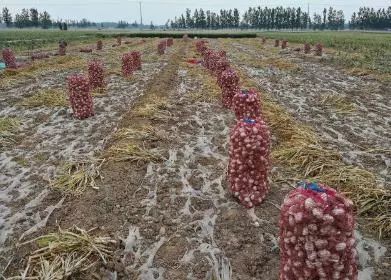
Summary: Garlic is severely oversupplied, and it will be difficult to restore its former glory in the short term, so garlic planting this autumn requires caution!
For farmers who planted garlic this year, the losses have been truly devastating. A few days ago, Science Xingnong calculated the situation for farmers who invested in garlic planting this year, and from the general picture, the losses were commonly around 1300 yuan. Faced with this situation, now is not the time for reckless, blind expansion of planting; what is needed is wise analysis and appropriate, rational planning to lose less and earn more.
Previously, I saw a netizen say that when he saw the market downturn in August last year, he decisively chose to exit garlic planting and cleared out all the garlic seed from more than 50 mu he had on hand. This year's garlic market facts proved how wise and brilliant his choice was at the time. A correct decision cannot be separated from calm-headed analysis at the time, and that is still true today.
In the garlic industry, there has long been a saying that it rises for one year and stays low for two, which is actually not just a coincidence. If it is always a coincidence, then this kind of coincidence has a certain inevitability, which is what we commonly call the calculation cycle. The root cause, to a large extent, still comes from information asymmetry.
On the one hand, farmers and market information are asymmetric. This directly leads farmers to follow the trend when planting. At this time, farmers see profit, but they ignore market risks. The asymmetry between market demand and farmers' planting volume leads to annual changes in market supply.
On the other hand, it comes from the information asymmetry between market demand and market supply, and this asymmetry is reflected in fluctuations in local garlic prices. The quantity on the market demand side is generally relatively limited, but local market demand has great uncertainty, thus causing localized oversupply or supply shortages of garlic in our country.
The above two factors are both factors in garlic market fluctuations, and because of the information asymmetry on the farmers' side, they lead to price fluctuations between market years. Taking last year as an example, in fact, the manifestation of garlic oversupply was already quite obvious, but this year's drop in garlic prices was so large that it was also beyond my expectations.
Media reports said that when this year's new garlic came to market, old garlic had still not been cleared out. This already counts as severe oversupply. And this year, unsold garlic has already appeared on the market. From the market supply side, this year's garlic will probably be difficult to sell off even by next year. In other words, this situation of oversupply will also continue into next year.
Therefore, Science Xingnong believes that while some garlic farmers still insist on planting garlic this year, the overall garlic supply next year will gradually improve somewhat after July or August of next year, but prices will still remain near the cost level. If garlic farmers expect to turn things around, that is probably still unrealistic.