Why are bonsai so expensive? Once you see these shapes, you will understand
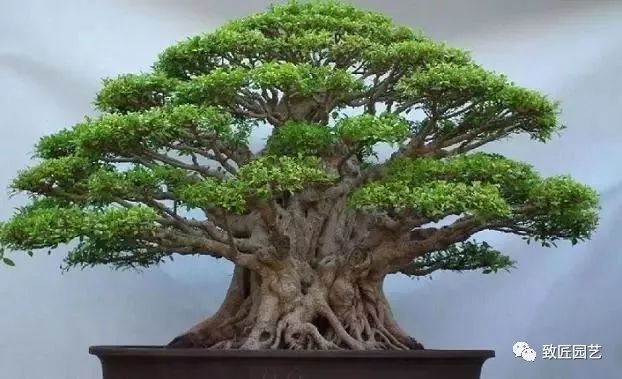
Bonsai worth tens of thousands, hundreds of thousands, or even millions are expensive because of the tree species, the age, and most importantly, the shaping. Bonsai shapes can be described as ever-changing, with each school having its own strengths. Let the editor take you to see the bizarre and varied shapes of bonsai.
1 Formal upright style bonsai
The formal upright style is the most common in bonsai. Its advantage is that the trunk stands upright, like a soldier standing at attention, full of masculine energy. Its drawback is that it is rather monotonous and rigid, lacking movement and spirit. Commonly used tree species include Japanese white pine, orange jessamine, golden larch, Chinese elm, zelkova, Buddhist pine, and kapok.
2 Curved trunk style bonsai
In the curved trunk style, the trunk winds and twists from the roots to the top of the canopy, with the trunk like a writhing dragon, combining strength and suppleness, full of lively interest. Generally, species with more pliable character, such as Japanese white pine, serissa, and elm, are more suitable. Shaping 2-3 year old young trees is even simpler. Common tree species include Japanese white pine, Chinese juniper, Buddhist pine, savin juniper, and flowering quince.
3 Slanting trunk style bonsai
In slanting trunk style bonsai, the trunk leans to one side, increasing the sense of movement of the bonsai, with sparse shadows slanting across, elegant and unrestrained, very much possessing an antique and understated air. Common tree species include Japanese white pine, Buddhist pine, Chinese elm, Fujian tea, flowering quince, fragrant olive, Chinese plum, and boxwood.
4 Waterside style bonsai
The trunk (body of the trunk) leans to one side, at an angle greater than that of the slanting trunk style, but the trunk does not lie across the pot surface. The branches droop beyond the pot, but the degree of drooping does not exceed the pot surface line, just like the posture of approaching water or playing in water.
Common tree species for the waterside style include black pine, Buddhist pine, Chinese plum, boxwood, Chinese elm, tamarisk, Chinese juniper, creeping juniper, and Japanese white pine.
5 Horizontal trunk style bonsai
In the horizontal trunk style, the trunk leans to one side to a horizontal or near-horizontal state, so that the body of the trunk lies flat
on the pot surface, as if blown down by wind in a deep mountain wilderness, like a Buddhist arhat sleeping on the ground or a rolling horse leaping on its hooves, with a unique charm and a style all its own. Common tree species include Chinese elm, Chinese plum, orange jessamine, creeping juniper, and goji.
6 Cliff style
It bends and droops to a relatively large extent beyond the pot, like a sea-exploring dragon on a cliff. If the tip of the tree droops no lower than the bottom of the pot, it is called a small cliff; if the tip droops lower than the bottom of the pot, it is called a large cliff. Common tree species include Chinese juniper, black pine, Japanese white pine, Chinese elm, Chinese plum, Fujian tea, Buddhist pine, creeping juniper, serissa, acacia, mountain orange, and boxwood.
7 Double trunk style
Double trunk style bonsai is one of the common tree bonsai styles that people love. Relatively speaking, the single trunk style is more abstract and monotonous in its "scene," while the double trunk style, because the two trees reference and contrast with each other, turns monotony into liveliness, and its "scene" is richer in interest and more intuitive than that of a single trunk tree.
8 Forest style
Multiple plants are grown together in one pot, using artistic techniques to make them form a primitive great forest, or a quiet and elegant scenic forest, and other such pictures. It is best to choose tree species with fine branches and dense leaves, or those that have been shaped, such as porcupine wood, Chinese elm, Fujian tea, serissa, pomegranate, Japanese maple, red maple, Japanese white pine, golden larch, and tamarisk.
9 Split trunk style
The trunk (body of the trunk) is split from the center into two halves or multiple sections, each with roots, and planted separately, thus forming a split trunk style bonsai. The split trunk style is mostly used for tree stumps whose trunks are relatively thick, long, and straight, and not suitable for curved shaping.
10 Root-on-rock style
The tree roots cling to mountain rocks, growing along crevices or through holes, just like old trees growing naturally on mountain cliffs, with the posture of "dragon claws gripping stone," antique and picturesque. The trunk forms are diverse, either straight, slanting, or curved. Common tree species include trident maple, Japanese white pine, maple, papaya flowering quince, black pine, Chinese juniper, Chinese elm, and fish-scale boxwood.
11 Exposed root style
When potting or repotting, or by using other methods, the upper part of the root system is gradually raised above the soil surface, revealing the main and lateral roots shaped like a coiled dragon or eagle claws. It mainly displays the beautiful form of the roots, like a coiled dragon or suspended eagle claws.
12 Deadwood style
The deadwood style, also called the withered peak style, has a withered and decayed trunk, with bark mottled and falling off, revealing eroded, hollowed, and pierced xylem. It reflects the state of a withered tree meeting spring, full of vitality.
Wonderful content