Dianthus superbus is a Dianthus species with fringed petals
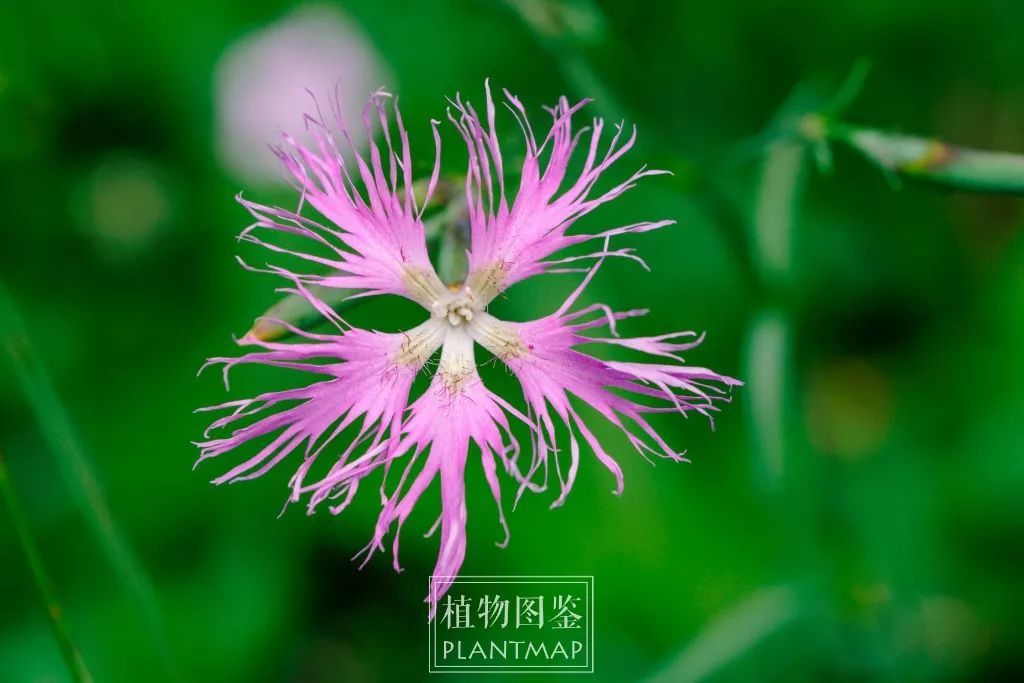
In summer and autumn, this flower, Dianthus superbus (qú mài), can be seen on high mountains in many provinces.
[Dianthus superbus] Caryophyllaceae >> Dianthus
Dianthus superbus is widely distributed. For example, it can be found on several high mountains in Zhejiang, such as the summits of Dongbai Mountain and Baishanzu, and it also grows on the meadows of mountain peaks around Beijing. It can also be seen in the Northwest, North China, and Southwest.
In general, Dianthus superbus prefers to grow on subalpine meadows at an altitude of 1,000 m. Therefore, if you want to see wild Dianthus superbus, you often cannot avoid trekking over mountains and wading across streams. However, with the development of China's landscaping and floriculture industries, Dianthus superbus has gradually come down from the high mountains and appeared in landscaping and flower shops.
Dianthus superbus in a vase, from "Jiachen Album and Watercolor Album. Mimura Chikusei"
Dianthus superbus in horticulture
Dianthus superbus is a plant in the Caryophyllaceae family and Dianthus genus. Compared with ordinary Dianthus flowers, the flower diameter of Dianthus superbus is more than twice as large, and the petals also appear fringed. It has 5 petals, and the petals are pink-purple, especially long, reaching 4 to 5 cm. The base of the petals is white; in the middle section the pink-purple begins to deepen, with short fine hairs; the ends of the petals split into finely shredded fringe, making the whole petal look like a peacock splendidly spreading its tail.
The newly opened flowers of Dianthus superbus are the most beautiful, with plump petals and slightly curved fringe, and the whole flower looks extremely spirited, like a bright and beautiful woman. But Dianthus superbus flowers age too easily. After the flower shrivels, the fringe hangs scattered and drooping. Or they are toyed with by insects and rain and become battered and broken.
Besides the petals, the calyx of Dianthus superbus is also different from that of ordinary Dianthus. The calyx of common Dianthus plants is leaf-like and spreading, while the bracts of Dianthus superbus do not spread and are scale-like. If you can push aside the densely packed wild grass of the meadow, you can discover that Dianthus superbus is also a tall beauty, with the whole plant reaching more than half a meter in height and slender leaves.
Except for Dianthus superbus and Dianthus longicalyx, plants in the Dianthus genus are all called XX Dianthus. So how did the name "Dianthus superbus" come about?
According to the textual research in "Notes on the Interpretation of Plant Names," plant names often use variant characters, and "Qu" may be such a case. The author suspects that Qu is the same as Qu, so Dianthus superbus is Qu wheat.[1] "Qu" has the meaning of "can be used for brewing wine." Searching for Dianthus superbus wine, some "health" medicinal liquors in China include it. Some Japanese brewing companies use Dianthus superbus flowers to make "flower yeast" for brewing Japanese sake.
Another possibility is that "Dianthus superbus" refers to its young seedlings in spring that resemble wheat seedlings.
[1] Xia Weiying. Notes on the Interpretation of Plant Names. Agriculture Press, 1990. Page 194
Author: Jiang Mouren
Images: Jiang Mouren
This work is licensed under the (CC BY-NC-ND 4.0) license
Please retain the above statement when reposting