Can you pronounce more than 5 of these plant names? Let's learn something new together
A name is a label, the beginning of understanding something, and the same goes for understanding plants. A name not only saves a whole series of descriptions of a plant, but also lets you revisit that plant over and over again when you link the name with its morphological features and so on.
It is often said that Chinese culture is broad and profound, and Chinese character culture is naturally no exception. We take many plant names for granted but actually mispronounce them; some plant names contain polyphonic characters, and we are confused about which sound to read; and some plant names are written in complicated, rare and uncommon characters. Today, let us turn our attention to these plant names that we do not know or often mispronounce~
Pits we have fallen into
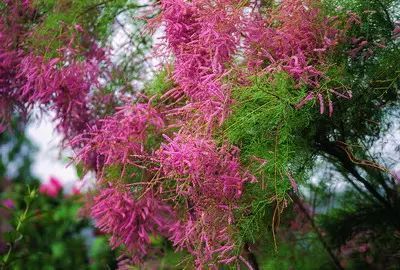
[chēng liǔ]
Tamarix chinensis
Tamarix chinensis
This tamarisk is really beautiful!
[bì lì]
Ficus pumila
Ficus pumila
Do you know how to make jelly from the fruit of Ficus pumila?
[cù jiāng cǎo]
Oxalis
Oxalis corniculata
This oxalis is not as pretty as the one with red flowers!
[yè gàn]
Belamcanda chinensis
Belamcanda chinensis
You must not say she [shè] gan [gān]~
Rare characters
[xī xiān]
Siegesbeckia orientalis
Sigesbeckia orientalis
If it were not for this plant, I probably would never have known these two characters in my life. It really is not pretty, no wonder Linnaeus gave it a Latin scientific name using the name of his mortal enemy;
Carl von Linnaeus, Swedish biologist, born in Smaland, Sweden. Founder of binomial nomenclature for animals and plants. He loved flowers from childhood. He traveled through various European countries, visited famous botanists, and collected a large number of plant specimens. He was the first to propose the species classification method of kingdom, phylum, class, order, family, genus, and species, which is still used by people today.
[zèng]
Patrinia villosa
Patrinia villosa
It is likely that the ancients would have recognized the name of this plant, because zeng is a kind of ancient earthenware vessel for steaming rice;
[qū]
Gnaphalium affine
Gnaphalium japonicum
One saying is that qu is a surname, changed from the Ju clan, but in fact it is ji uqu, now simplified as ji uqu. The ancients used the yellow of ji uqu to describe the flower color of chrysanthemums, and that is how today's ju came about;
[kǔ zhī]
Physalis angulata
Physalis angulata
Personally, I feel that no matter how I look at this character, I still cannot write it from memory. Many times, it gets written as "ku zhi";
[péng léi]
Rubus
Rubus hirsutus
The genus Rubus is already hard enough to distinguish, why are there still such hard-to-read characters? Too hard, really too hard;
[jǔ ruò]
Tacca
Tacca leontopetaloides
The flowers of the entire genus Tacca look like tiger whiskers. Juruo is also another name for the genus Amorphophallus. And then there is also a plant in the Piperaceae family, genus Piper, called jiaju. One stone, three birds;
[xiè]
Allium macrostemon
Allium macrostemon
You say it is good for a hard-to-recognize plant to have an easy-to-recognize alias, but this fellow's alias is just the opposite, even harder to recognize - jiao [jiào] tou;
[tuó wú]
Ligularia przewalskii
Ligularia przewalskii
I kept wondering why the Asteraceae family has so many hard-to-recognize plant names. Later I thought, after all, the Asteraceae family has so many species and genera, and probability theory put an end to that line of thinking;
[jí cài]
Houttuynia cordata
Celtis sinensis
Jicai is fish mint, zhe'ergen. In the Flora, it is recorded under the name jicai;
[máng]
Geraniaceae
[guàn]
Geranium
Geranium wilfordii
Polyphonic characters
[qiào]
Fagaceae
Fagaceae
The fruits of Fagaceae plants have a cupule appendage, like the chestnut of the genus Castanea in the Fagaceae family shown above, that outer layer, and it is read qiào, not ké. You might as well think of the golden cicada shedding its shell;
[suō]
Cyperaceae
Cyperaceae
Probably few people notice that the character suo is a polyphonic character. Besides the [shā] we are used to, there is also the pronunciation [suō]. The picture above shows Cyperus alternifolius of the genus Cyperus in the Cyperaceae family;
[zhú]
Atractylodes macrocephala
Atractylodes macrocephala
Baizhu is a very common traditional Chinese medicine, and its pronunciation is also willfully not shù;
[jì]
Shepherd's purse
Capsella bursa-pastoris
Needless to say, everyone knows shepherd's purse, right;
[bí qi]
Water chestnut
Eleocharis dulcis
Here it is read qi again, because the edible part resembles a horse's hoof, so it is also called mati;
[lián qiáo]
Forsythia
Forsythia suspensa
I say this meekly, but there should be many people who read lianqiao as lian [qiào];
[pāo]
Paulownia kawakamii
Paulownia elongata
The wood of plants in the genus Paulownia is bulging and loose, so reading it [pāo] is only too correct;
[qián]
Nettle
Urtica fissa
Nettle in the genus Urtica of the Urticaceae family is all read [qián], while urticaria is read [xún];
[shā]
Chinese fir
Cunninghamia lanceolata
It is simply willful to the extreme. Taxodiaceae, dawn redwood, pond cypress, and bald cypress are all read [shān], yet Chinese fir in the genus Cunninghamia is read [shā];
[pò]
Hackberry
Celtis sinensis
[pǔ] shu, wrong! [piáo] shu, even more wrong! It should be [pò] shu, not po shu;
Brain-hole memory method
[qí]
Osmunda japonica
Osmunda japonica
Hello everyone, I am not the Deng Ziqi who can sing!
[suō luó]
Alsophila spinulosa
Alsophila spinulosa
Hello everyone, I am not the Thoreau who wrote Walden!
[luò xīn fù ]
Astilbe
Astilbe chinensis
Hello everyone, I am not the jorogumo that can weave webs!
[ kǔ liàn ]
Melia azedarach
Melia azedarach
Hello everyone, please do not love me bitterly, my flowers are very fragrant!