What are the common pests and diseases of roses? A detailed guide to prevention and control methods
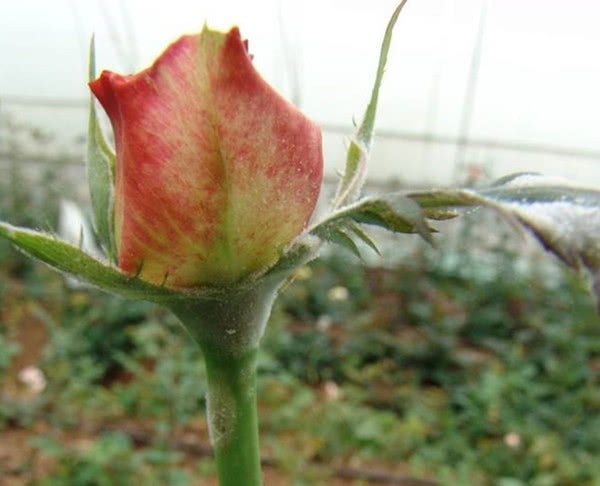
Roses originated in China and were introduced abroad as early as 200 years ago. Through long-term crossbreeding and selection by European and American horticulturists, modern roses have developed to more than 20,000 varieties. Roses are cold-resistant and highly adaptable, suitable for both ground planting and container growing, so they are widely cultivated around the world. Here is an introduction to several pests and diseases that occur on roses and their prevention and control methods.
1. Powdery mildew
Symptoms: It first starts from the middle and upper parts, occurring on leaves, flower buds and young shoots. In the early stage, chlorotic yellow spots appear on the leaves, gradually expand, and white powdery mildew spots appear, followed by a layer of white powdery substance. In severe cases, the entire surface is covered with a powdery white layer. After young leaves are infected, they curl, wrinkle, thicken, and sometimes turn purplish red. When petioles and young shoots are infected, they swell, bend on the underside, and young leaves fail to unfurl. On old leaves, round or irregular powdery white spots appear, but the leaves do not become distorted.
Prevention and control methods: Spray both the upper and lower surfaces of the plants with 50% Cuibei dry suspension concentrate at 3000 times dilution and 25% tebuconazole emulsifiable concentrate at 3000 times dilution.
2. Gray mold
Symptoms: The pathogen is Botrytis cinerea. This pathogenic fungus infects the flowers, flower buds and young stems of roses, and the lesions mainly occur on the flowers. At first, they are irregular water-soaked small spots, slightly sunken, and later turn brown and rot. On buds, irregular water-soaked small spots also appear, and the lesions can expand to the entire bud, eventually causing the whole bud to soften and rot. After diseased buds wither, they hang on or near the diseased tissue. In a warm and humid environment, a large amount of gray mold layer can be produced on the diseased parts.
Prevention and control methods: In autumn, it is not advisable to use dead branches and fallen leaves to mulch the roots, so as to avoid excessive moisture at the base of the stems, which favors the survival of the pathogen. When cultivating in a greenhouse, attention should be paid to ventilation and light transmission, avoiding excessively high humidity; avoid overhead watering, do not apply excessive nitrogen fertilizer, and do not plant too densely. Remove infected diseased flowers. For diseased buds, they should be cut off together with several centimeters of the stem below the bud and destroyed.
3. Downy mildew
Symptoms: It occurs on leaves, new shoots and flowers. In the early stage, irregular light green markings appear on the leaves, then expand and turn yellowish brown and dark purple, and finally grayish brown, with darker edges, gradually expanding and spreading to healthy tissue without obvious boundaries. In humid air, sparse grayish white downy mildew layers can be seen on the underside of diseased leaves. Leaves tend to fall off. Deformation occurs at axillary buds and pedicels, and lesions appear. In severe cases, cracks appear at the base of new shoots and the tissue dies downward along the cut. Some lesions are purplish red with a grayish white center. When new shoots and flowers are infected, the lesions are similar to those on diseased leaves, slightly sunken. In severe cases, leaves wilt and fall off, and new shoots rot and die.
Prevention and control methods: Reducing nighttime humidity is the key to prevention and control. For chemical control, alternate the use of polyoxin, metalaxyl and triethylphosphonate aluminum smoke agents every 2-7 days, or spray with 70% thiophanate-methyl wettable powder at 1000 times dilution.
4. Black spot
Symptoms: The pathogen is Diplocarpon rosae. This pathogenic fungus mainly infects rose leaves and can also damage petioles, young shoots and other parts. In the early stage of the disease, small brown spots first appear on the upper surface of the leaves, gradually expanding into nearly round or irregular lesions with a diameter of 4 to 12 mm, blackish purple, with radial edges and yellow halos. In the later stage, the central tissue of the lesions turns grayish white, with many small black dots on it. Under a magnifying glass, small black blister-like granules can be seen, which are the acervuli of the pathogen. The lesions connect with each other, causing the leaves to turn yellow and fall off (some rose varieties do not drop diseased leaves). Black streaky spots, slightly sunken, are produced on young branches and pedicels. In severe cases, all the leaves on the middle and lower parts of the plant fall off, leaving only a few leaves at the top.
Prevention and control methods: In late autumn, thoroughly remove dead branches and fallen leaves, and in combination with winter pruning, cut off diseased branches and destroy them. During the dormant period, spray 2000 times sodium pentachlorophenate aqueous solution or 1% equal-amount Bordeaux mixture to kill the overwintering inoculum on diseased residues.