How to grow orchids? Strong air and ample light are needed for a full bloom
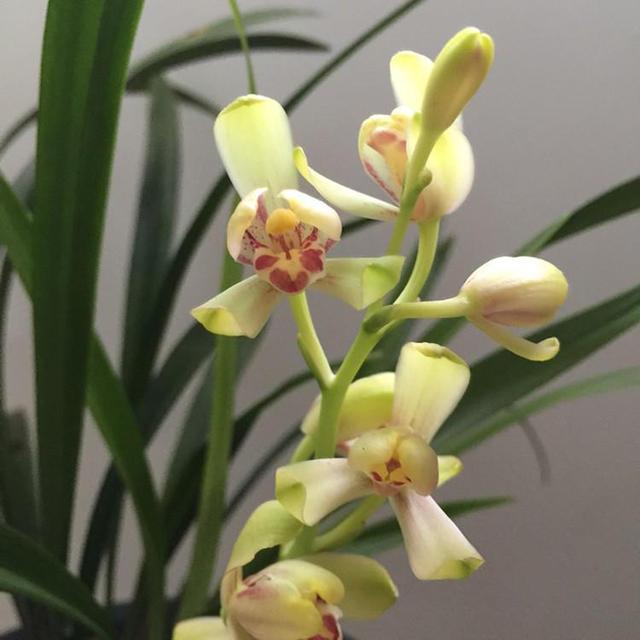
"Air" to an orchid is like "air" to a person; when air is insufficient, a person weakens, and "ventilation" is a matter of survival for orchid plants. In addition, light is equally very important for orchid growth, so if you want orchids to bloom in full clusters, you need to achieve strong "air" and ample light.
1. How to achieve strong "air"?
Orchid plants grow on high mountains, where mountain breezes blow and it is cool and pleasant, the ground is loose and airy, and from the roots to the leaf surfaces everything is spread out and comfortable; life is in an extremely favorable environment, so how could they fail to grow vigorously? But if they are moved into a flowerpot, things are different.
Therefore, so-called strong "air" means orchids need "ventilation." Ventilation also has two meanings. One refers to ventilation inside the pot. This mainly concerns the preparation of the growing medium, which is to solve the ventilation problem inside the pot. If the inside of the pot is not ventilated, orchid roots cannot move. So when growing orchids, it is recommended to use a special orchid growing medium to achieve the effect of ventilation inside the pot.
The second is site ventilation, meaning the surroundings should be open and bright to facilitate air circulation, and it should not be narrow and closed in; moreover, it should be on a raised platform, a bit higher. In cities, these conditions for growing orchids are relatively poor, so an exhaust fan should be installed.
In addition, when caring for orchids normally, in order to ensure normal orchid growth, nutrients need to be supplied to the orchids in a timely manner. It is recommended that flower growers use a special organic liquid fertilizer for orchids, diluted 500 times, and water the roots once every 10-15 days, which can achieve the effect of promoting flowering, strengthening roots, and growing leaves.
2. How to achieve ample light?
Orchids have relatively special requirements for light. They do not need strong direct light, but prefer morning sun; they do not like patchy light, but prefer scattered light. The so-called secluded orchid refers to orchid plants growing in deep mountain valleys, which do not receive strong light all day long.
Therefore, suitable light is an indispensable condition for orchid plant growth, development, seedling production, and flowering. If the light is too strong, orchid leaves easily turn yellow and may even be scorched. If the light is too weak, orchid leaves are tender and lack strength, the seedling production rate is also low, and they do not bloom easily.
Generally speaking, orchids can accept sunlight before 11 a.m. in summer and autumn. Spring and winter sunlight is very precious, and orchids can accept it all day. Some orchid growers in cities like to use artificial combined light, but the effect is not good; it is recommended to choose a place with good natural lighting conditions instead. If it is summer, appropriate shading is needed, and water should also be sprinkled frequently.
In order to receive morning sun, when planting orchids, flower growers should orient them toward the east or southeast. If it is a rooftop, there must be ecology all around, and some vines or deciduous broadleaf trees can be planted. With that method of regulating light relying only on shade nets, over a long time the orchid leaves will also show a withered and yellow state.