3 kinds of oddly shaped flowers that bloom more than 300 days a year, easier to grow than pothos and prettier too
As people's living standards rise, more and more people have taken up growing flowers. A pot of flowers at home can cultivate character, nourish the mind, beautify the room and purify the air - truly a case of many benefits in one. Many people keep a pot or two of spider plants and pothos at home; foliage plants are easy to grow and superb at purifying the air, but after a while they can become visually tiring. With that in mind, today I'm sharing with fellow flower lovers: 3 kinds of "oddly shaped" flowers, "distinctive" and beautiful, that can bloom more than 300 days a year and are even easier to grow than pothos!
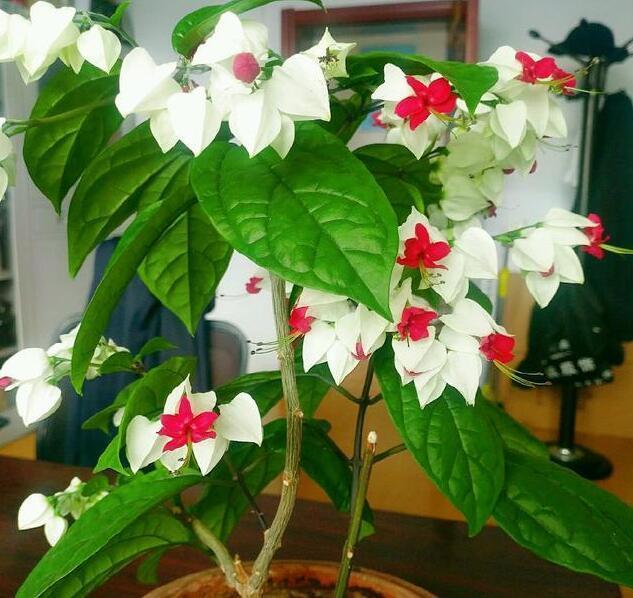
1. Bleeding Heart Vine (Clerodendrum thomsoniae)
Bleeding Heart Vine, an evergreen shrub of the Verbenaceae family, is a woody plant, not herbaceous. Its flowers are very unusual: when they first open, the white bracts are prism-shaped, much like the pagoda candy we ate as children, and then the red flower buds slowly extend from the split at the tip, shaped like spitting pearls - hence the name. The whole process is full of interest, and the red-and-white blooms are very beautiful too
It blooms in summer, autumn and spring. Bleeding Heart Vine is a top-grade potted flower.
Care instructions:
Place it on a south-facing balcony, one meter away from the window, where it gets sunlight. Water thoroughly once the potting soil has dried out completely, and fertilize once a quarter. It thrives in these conditions and blooms continuously; the only problem is that the balcony is too small, so it needs frequent pruning, otherwise it grows extremely fast.
During growth, if yellowing of the leaves is noticed, spray with 0.2% ferrous sulfate solution 2~3 times, and the leaves will gradually turn from yellow back to green.
2. Small-leaf Goldfish Vine
Small-leaf Goldfish Vine is a plant with small, nearly ovate, opposite leaves and tiny flowers that almost overlap. When it is not in bloom, its leaves hang down like a green ribbon, which is very beautiful in itself; once it flowers, it looks like little fish swimming in green water, especially lovely.
It actually belongs to the same family as the goldfish plant, and its ornamental value is excellent, though it is currently a niche flower. If a friend of yours grows this plant, you can take some cuttings after warm spring arrives to propagate it; if you want more flowers, give it plenty of phosphorus and potassium fertilizer in spring to encourage blooming.
3. Hoyas - Hoya carnosa 'Compacta' (Hindu Rope)
'Compacta' is a distinctly individual variety within the vast hoya family. Its flowers have a pink base with water-red petals, crystal clear and delicately jade-like, so beautiful they look like artificial flowers, and one can never get enough of them. Not only are the flowers outstanding, its leaves are very beautiful too: the leaves are thick and fleshy, as big as an adult's fist, plump and round, utterly adorable - truly a variety with both beautiful flowers and foliage.
Hoyas cannot take direct sun exposure or insufficient light, nor temperatures outside 10°C-38°C. It is best to grow them indoors at a closed south-facing window position, and the window must provide plenty of scattered light. Occasional ventilation is needed, and there should be a trellis for them to climb and grow on.
If you want your hoya to bloom abundantly and beautifully, besides sufficient phosphorus fertilizer, keep it away from air-conditioned rooms, let it experience natural temperature changes within a suitable temperature range, and pinch back the tips appropriately - but do not damage the flower stems of the hoya, as those are where next year's flowers will come from.
Do not water too much: in spring and autumn water once every two weeks, in summer once a week, and in winter once a quarter is enough.
That is all for today's sharing