Only by growing lithops this way will they split into doubles? You surely didn't know this
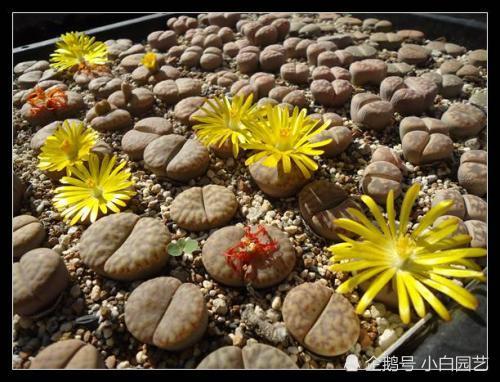
Lithops is a succulent native to southern and southwestern Africa, generally living in crevices of rock beds, also known as "living stones." Although lithops has strong vitality, making it split into doubles is also a very difficult and lucky matter. Follow along with the editor below to learn how to grow lithops so they split into doubles, as well as the points to note during lithops cultivation.
Introduction to lithops
Lithops, a perennial small succulent plant of the genus Lithops in the family Aizoaceae, has a very short stem. The modified leaves are thick and fleshy. 3-4 year old lithops bloom in autumn from the middle gap between opposite leaves, with yellow, white, pink and other colored flowers, mostly opening in the afternoon, closing at dusk, and opening again the next afternoon; a single flower can bloom for 3-7 days. When blooming, the flower almost covers the entire plant. After the flowers fade, they bear fruit, from which very tiny seeds can be harvested.
How to grow lithops so they split into doubles?
Soil:
The principle of the soil is: permeable, breathable, moisture-retaining. In fact, this is the same as for many plants, especially succulents, and for lithops it must be strictly followed. Permeable, breathable, moisture-retaining means the plant is kept long-term in an environment that is either too dry or too wet. It seems contradictory, but in fact you only need to layer the potting soil to achieve the goal.
The soil for lithops can roughly be divided into three layers:
(1) Bottom layer soil
Use a granular medium with good water retention; akadama soil is generally recommended, and if unavailable it can barely be used as a substitute. The purpose of using this type of medium is that the bottom of the pot must not accumulate water, yet it needs to provide water vapor to guide the roots downward and supply an appropriate amount of water to the dry middle layer soil. Special note: the particle size of the soil must suit the pot used; if the pot is shallower with a smaller diameter, small particle size soil should be used, and conversely a deeper pot with a larger diameter should use larger particle size soil.
(2) Middle layer soil
The role of the middle layer soil is to provide a small amount of water and nutrients without accumulating water; in other words, water retention must not be too good, otherwise roots easily rot during dormancy, but it must still maintain a certain degree of humidity. To achieve this, the soil should be mixed with water before use, then left to stand to produce granular structure , and be careful not to press too firmly when filling it into the pot. Regarding the soil layer ratio, appropriate adjustments should be made according to the local climate and watering and fertilizing habits
(3) Top layer soil
The main role of the top layer soil is to support the lithops, or for decoration. This layer of soil had best not absorb or retain water, and the soil layer thickness depends on the plant's habits. Generally speaking, lithops in their native habitat "shrink" into the soil during dormancy, exposing only the top of the leaves. However, since the cultivation environment is not necessarily as harsh as the native habitat, and in addition to viewing needs, how much of the plant is exposed can be determined by this layer. In the cold winter of the north, this layer can even be used as an insulation layer to protect the plant from frostbite.
Breathability of the pot
Breathable pots are usually also the type that makes potting soil dry easily; generally, using small unglazed pots or clay pots makes it less likely for roots to rot from excessive moisture. Using highly ornamental purple clay pots, Han clay pots, etc., these pots can also prevent the potting soil from becoming too dry, and are recommended. In addition, note the ventilation and drainage function of the drainage hole at the bottom of the flower pot; if the hole is too small, it should be enlarged. Between the bottom of the pot and the potting soil there should be breathable and drainage material to prevent the potting soil from escaping, such as broken pot pieces, broken tiles, clods of soil, etc.
Points to note in lithops cultivation:
1. Lithops does not have very high soil requirements; ordinary flower soil will do, but the soil needs to maintain smooth drainage;
2. Because it comes from the African savanna, lithops is accustomed to arid and hot climates, so during care you must maintain sufficient temperature, especially in winter it is best to keep it at 50-55 degrees, so you need to give them a specially made small greenhouse
3. Lithops will "shed its skin," that is, the old leaves will wither and new leaves will grow out. At this time you must not water them, because their most comfortable air humidity is around 30%.
Today's introduction on how to grow lithops so they split into doubles ends here! After reading, have you gained something from it!