Most succulents can be propagated from leaf cuttings; master the method and fill your balcony
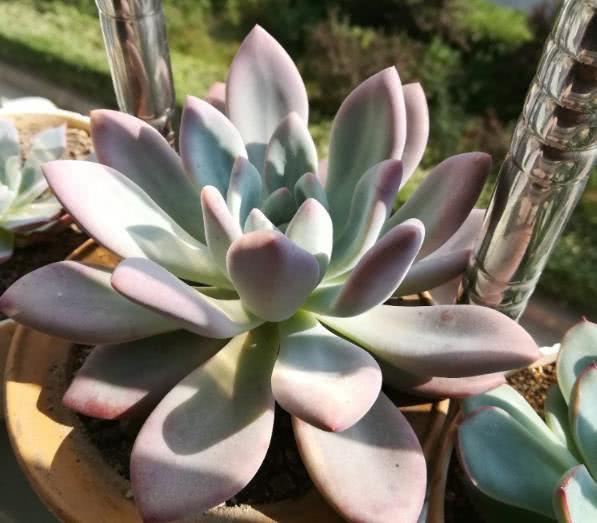
Most succulents can be propagated from leaf cuttings. Some varieties of succulents can be propagated through stem cuttings, beheading, or division. Leaf cuttings for succulents need to meet three main conditions: temperature, humidity, and light. Leaf cuttings are a highly successful method of succulent propagation, simple and effective, and they can even produce multi-headed succulents. During the growing season, you can casually do leaf cuttings and they will still root and sprout smoothly, and the small succulent seedlings from leaf cuttings and sprouting have no special requirements for pots. A leaf casually tossed into a pot might just give you a surprise and grow into a small succulent!
Actually, for leaf cuttings, as long as the growth point is intact, they can be propagated. If the leaf has a wound but the growth point is still there, we can apply some fungicide to the wound to minimize the possibility of the succulent turning to mush. In summer, wounded leaves are more likely to turn to mush. After applying the fungicide to the wound, let it dry in a cool place, and then you can do the leaf cutting.
Leaf cuttings can be said to be the simplest and most convenient propagation method for succulents. The steps for succulent leaf cuttings are also very simple. First, prepare the soil. In winter, when temperatures are lower, mix some plant ash into the soil, which can both keep it warm and increase soil fertility. Then select healthy leaves and let them dry in a dry place for about two days to dry out their wounds. Then you can lay the leaves flat on the soil. What you need to do next is wait patiently, waiting for the succulents to take root and sprout, then repot and fill the pot.
To have the leaves sprout smoothly, you need to ensure the environment has some light. Leaf cuttings cannot have direct sunlight, but a lack of light also has a certain impact on leaf cutting sprouting, so you can place them indoors in a bright spot with scattered light. If they do not sprout for a long time, we can repeatedly pull off the roots that have grown, or use a needle to prick the growth point of the mother leaf, which has a certain positive effect. As long as the mother leaf has no problems like turning to mush or shriveling, there is hope for sprouting.
Temperature has a certain effect on leaf cuttings, so gardeners with heating or air conditioning in winter can do leaf cuttings with peace of mind. We can also create a small greenhouse environment for leaf cuttings. Enclosed cultivation of leaf cuttings can maintain the humidity and temperature of the environment, but ventilation must be maintained, and watering should also be moderate. Humidity is the key to making succulents root. If the air humidity is high, the succulent leaves can sprout while drying their wounds. If the air is not humid enough, then when mixing soil, use more river sand and vermiculite, which retain water well and help maintain moist soil. During the leaf cutting process, you can avoid the succulent leaves and spray water on the soil surface to maintain humidity.
When the growth point of a succulent leaf turns red, that is a sign of sprouting. If the succulent never sprouts, you can stimulate the growth point of the leaf by pricking it with a needle or pulling off the roots that have grown from the leaf cutting. There are many ways to do succulent leaf cuttings, such as laying flat or inserting at an angle, or inserting them into a drink bottle. When temperature and humidity are insufficient, you can try using a drink bottle. Generally speaking, when the climate conditions are very good, laying the succulent leaves flat for leaf cuttings works well.
This is a gathering place for succulent enthusiasts, sharing succulent care tips. Welcome to follow and exchange ideas.