What does seed-grown succulent mean? It is very different from leaf-cutting propagation
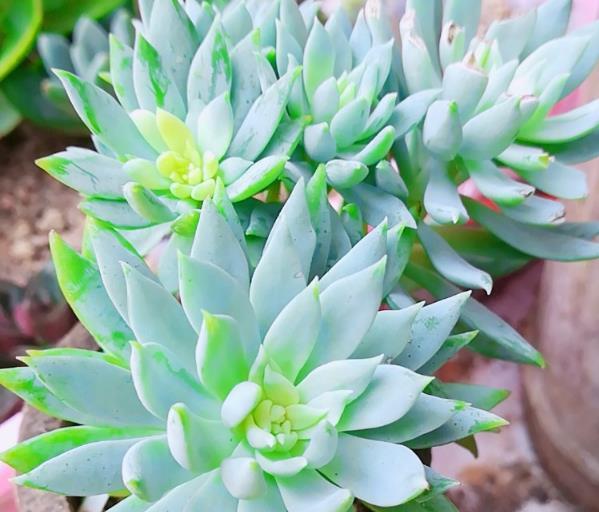
Seed-grown succulents refer to succulent seedlings propagated directly from seed. This includes sown seedlings, wild seed-grown seedlings, and transplanted seedlings obtained by transplanting the above two types. Seed-grown seedlings are seedlings obtained through sexual reproduction, different from asexually propagated leaf-cutting seedlings, cuttings, grafted seedlings, etc. Tissue culture is a seedling-raising method; tissue-cultured seedlings are young plants under tissue culture conditions, which can be obtained from culturing plant stem segments or from seed germination. Seed-grown seedlings are seedlings obtained through seed germination. So, if seeds are sown directly under tissue culture, what is obtained is a tissue-cultured seedling, which is also a seed-grown seedling.
Succulent sowing is generally carried out in autumn in October, and the method is exactly the same as sowing Aizoaceae (mesembs). Before sowing, you need to prepare seeds, sowing soil, a pot, plastic wrap, and carbendazim. Cover the drainage holes of the pot with mesh, put the sowing soil into the pot, shake it slightly, and level the soil firmly. Do not fill it full; leave a 3CM space at the top. Scatter the seeds into the soil. I usually pinch and scatter them by hand, or you can fold a piece of paper and gently scatter them in; just try to scatter them evenly. Seal it with plastic wrap, and remember to always leave 1-2 small gaps for ventilation, without closing them. Then place it in a spot with scattered light, and absolutely avoid direct sunlight.
Besides seed propagation, succulents can also be propagated by leaf cuttings, stem cuttings, pinching, and other methods. Succulent leaf propagation is an interesting thing. Almost everyone who has come into contact with succulents has more or less done this kind of thing. It is interesting and magical, and leaf-cutting seedlings are also especially easy to develop nice coloration, especially when a certain amount of light is maintained. Some flower enthusiasts have asked, why do the leaves of leaf cuttings turn black in two days? When the leaves of leaf cuttings turn black or turn to mush in two days, generally speaking there are only two reasons. One is that the leaf itself already has a problem. For example, the plant itself has a disease that has already manifested, such as black rot, black spot disease, leaves turning to mush, and so on. At this time, the leaf that is broken off may look normal, but in fact it is "on duty while sick," and in two days it turns to mush or turns black.
Another reason is that the succulent leaf itself had no problem, but it became contaminated. A freshly broken-off leaf has a wound, and it is very easy for it to become infected. If the wound, that is, the position of the leaf base growth point, has not dried, and it is directly placed on the soil surface to contact water or other pathogens, it is also possible for it to turn to mush and develop black rot, especially in a stuffy and humid environment. Therefore, after the leaf for leaf cutting is broken off, it is best to let it dry in a ventilated place for three or four days to a week, and then place it on the soil surface for leaf cutting; or after breaking off the leaf and placing it on the soil surface, the soil surface should not be too moist, the growth point should not come into contact with water, and during leaf cutting do not expose it to strong sunlight.
A freshly broken-off succulent leaf, because of the wound caused by tearing, is prone to pathogen infection. In serious cases, the leaf may turn to mush and turn black; in mild cases, the growth point may be damaged and the leaf cutting may fail to produce seedlings. It is just like human skin: when it is intact, there is no problem, but if the skin is broken and not treated, even if it is only exposed to air, it may become inflamed and form pus. Letting a freshly torn-off leaf dry for a few days is equivalent to letting the wound heal. Not drying it and directly placing it on the soil surface and watering is like letting your own wound directly contact a source of contamination. Therefore, after a leaf is broken off, it is usually dried in a cool, ventilated place for three or four days to a week, and then laid flat on the soil surface for leaf cutting. The drying method is also very simple: just hold it in a plate or box and place it in a cool, ventilated place.
For succulent leaf propagation, can you water the leaves? During succulent leaf propagation, when the potting soil is dry, watering it, or occasionally spraying it, can increase the humidity around the leaves and stimulate them to root. But sometimes it is generally advised not to get water on the leaves when watering or spraying, so as to avoid infection and turning to mush. Logically there is nothing wrong with this, but the risk is exaggerated, just as getting rained on may cause a cold, but most of the time it actually will not, especially when you only get a little rain and your body is healthy. Occasionally watering and spraying is fine, but if the environment is stuffy and hot and the potting soil is moist for a long time (which favors fungal and bacterial reproduction), the risk of something happening to the leaves will also become relatively greater.
This is a gathering place for succulent lovers, sharing succulent care tips. You are welcome to follow and exchange ideas.