Red smartweed dug up from the countryside and planted in my own yard looks stunningly beautiful
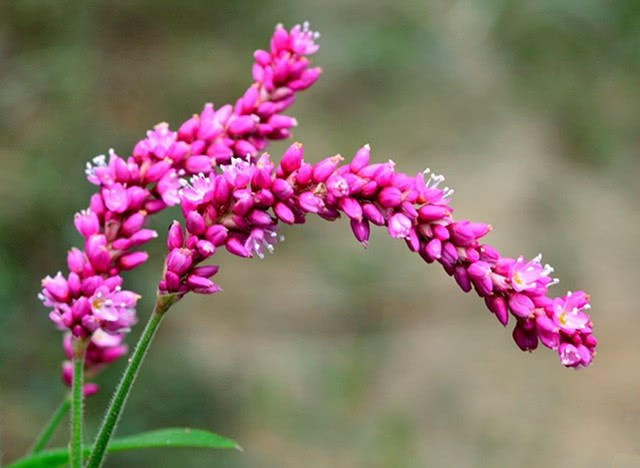
Red smartweed is also known as hongliao, water flower seed, Oriental smartweed, and dog's tail flower. Red smartweed grows quickly, tall and lush, with green leaves and red flowers, and can self-seed and multiply. Its tall, loose and free-spirited branches and leaves make it a garden ornamental plant full of wild charm, and it is also often used as material for flower arranging.
Red smartweed likes plenty of sunlight, likes water, is cold-tolerant, drought-tolerant, poor-soil-tolerant, highly adaptable, with few pests and diseases, and strong stress resistance. It is not demanding about soil, but grows best in deep, fertile soil, making it a good plant for low-maintenance villa gardens. Red smartweed is suitable for planting in private garden courtyards, corners, watersides or shallow-water areas, and is an excellent aquatic and terrestrial plant for flowers and foliage in private garden design.
The story of red smartweed
Stories about red smartweed have circulated in our country, teaching people to serve the country loyally and honor their parents. The Eastern Han Dynasty work Wu Yue Chun Qiu by Zhao Ye records a story. The State of Yue was destroyed by the State of Wu, and the King of Yue vowed revenge. He knew this could not be achieved in a single day, so he "pondered bitterly and labored his mind, day and night, and when lying down he used smartweed to sting himself." This is another version of sleeping on brushwood and tasting gall. After the King of Yue abdicated and went into seclusion, he still endured hardship and ate simply, never forgetting the shame of his destroyed state and his resolve for revenge, and eventually defeated the State of Wu.
During the Han Dynasty, Emperor Jing of Han, Liu Qi, enfeoffed his son Liu Fa as the Dingwang of Changsha. According to legend, because the Dingwang missed his deceased mother, he built a tall terrace in Changsha in hopes of gazing toward his mother's grave from afar. At the same time, he also opened a smartweed garden in his palace to show that he did not forget his mother. Later generations called that terrace the Dingwang Terrace, which still stands east of Changsha County in Hunan, but the smartweed garden can no longer be found.
Red smartweed culture
Red smartweed has been loved by people since ancient times, and writers through the ages have written poems praising red smartweed flowers.
"Smartweed Flowers" -- Wen Tong of the Song Dynasty
Red fragrance in the night dew is clear, emerald stems greet the late evening.
After the rain, the setting sun dries, autumn's look fills the rail and pavilion.
In the first line of this poem, the red smartweed flowers pass through the night, with clear dew sparkling, and the glistening dewdrops set off the brightness of the flower color even more. In the second line, green branches and green leaves are shrouded in the evening mist of the west window. In the third and fourth lines, after the rain, the setting sun appears, with yellow as the main tone: the sky is yellow, the earth is yellow, and the grass and trees are all yellow.
"Smartweed Flowers" -- Zheng Gu of the Tang Dynasty
Clusters upon clusters, again and again lingering, year after year brushing the spreading stream.
Uneven, accompanying yellow chrysanthemums, coldly passing the Mid-Autumn Festival.
At evening it carries the urgent chirping of insects, in cold it hides the autumn of roosting egrets.
The old stream cannot be returned to, so I rely on a staff to tie up the fishing boat.
In the first couplet of this poem, the flower spikes of smartweed cluster together and its branches and leaves droop and brush, brushing the stream as they grow, year after year without end. The second couplet describes the relationship between smartweed and other plants. "Uneven" means irregular, with smartweed flowers long and short, growing in clumps in the wild suburbs, blooming alongside wild chrysanthemums, and coldly spending the Mid-Autumn Festival. The third couplet describes the relationship between smartweed and insects and birds. Among the flowers are insects and birds; in the evening the autumn insects chirp urgently, and in the cold the roosting birds fret, and being accompanied by restless insects and birds makes the loneliness of smartweed even more apparent. The fourth couplet describes how smartweed stirs feelings of longing to return home. A smartweed shoal is wild, cold and lonely, naturally not comparable to a hometown stream. Because returning home is hard, one can only rely on a fishing boat to roam the rivers and mountains.
"Water Smartweed" -- Liu Kezhuang of the Song Dynasty
Parted red interspersed with white on the sandbar at evening, bowing to wind and saluting rain in the autumn of the Yangtze and Han.
See who can endure the clear frost and leave? Yet I resent that reed flowers turn white first.
In the first and second lines of this poem, on an autumn dusk, on the sandbar where the Yangtze River and Han River meet, smartweed grows in clumps, with red interspersed. In autumn wind and autumn rain, the flowers sway and branches dance, and the smartweed bows and salutes. "See who can endure the clear frost and leave?" asks which one has strong cold resistance and can withstand the clear frost; that one is the strong one. "Yet I resent that reed flowers turn white first." Reed flowers have poor cold resistance; once the "clear frost" falls, they turn white, and thus the poem praises smartweed.
Red smartweed delicacies
According to ancient books, in the pre-Qin era people used smartweed in food and drink, and there was a custom of using smartweed in thick soup. Kou Zongbi's Zongshi Yanyi of the Song Dynasty records the practice in early spring of processing smartweed seeds into smartweed sprouts as a dish: "Smartweed fruit is the seed of water smartweed, which is in the lower grade of the herb section. What is called water smartweed uses the stem, while what is called smartweed fruit uses the seed. In early spring, use a gourd vessel filled with water to soak them, hang it high over a fire, keep it warm day and night, and then red sprouts grow; take them as a vegetable to prepare the five-spice platter." The "five-spice platter" is a combination of five kinds of tender vegetables eaten with spring pancakes.
The tender leaves of red smartweed are edible, and the whole plant is used as medicine. Every 100 grams of red smartweed contains 3.5 mg of carotene, 72 mg of vitamin C, and various minerals. The tender leaves can be blanched in boiling water, soaked and washed clean in water, then mixed with seasonings and eaten cold, or washed and steamed before eating.