Feed a little sesame to your clivia - an old flower grower's tip makes leaves and flowers shoot up nonstop and grow like weeds
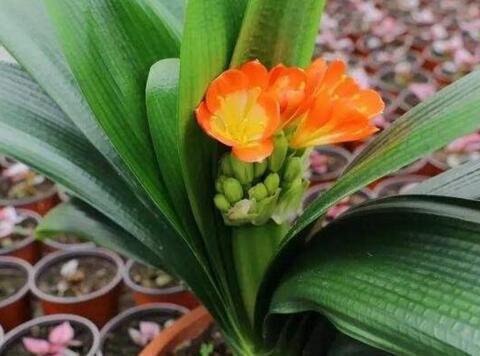
As people's living standards improve, more and more people have fallen in love with growing flowers - it cultivates the mind, refreshes the spirit, and purifies the air, a good thing that achieves several goals at once. And the clivia (Clivia miniata), such an elegant and beautiful flower, has naturally become many people's new favorite. Flower lover Aunt Zhang is especially fond of clivias. In her words, even when a clivia does not bloom, its fan-like leaves alone are beautiful. Because she loves them, Aunt Zhang raises her clivias with particular care, and because of that care, her clivias are raised to be very beautiful - not only are the leaves like fans, but the flowers bloom beautifully too. Whenever the flowering season comes, Aunt Zhang's clivias shoot up flowers nonstop, which is especially delightful. So how does Aunt Zhang do it?
Come and see how flower lover Aunt Zhang uses one jin of "sesame" to raise clivias until they grow like "weeds", with leaves and flowers "shooting" nonstop!
Why can sesame be used to grow clivias? This begins with the habits of the clivia. The roots of the clivia are fleshy roots, suitable for growing in loose, fertile, water-permeable, well-aerated soil. So the growing medium should be a loose, fertile neutral or slightly acidic humus soil. The growing soil can be mixed from 55% humus soil, 20% clean sand, and 15% fine furnace ash, with relative humidity preferably around 40%.
Such potting soil is loose and airy but lacks nutrients, so we can add another 5% sesame and 5% bone meal.
Of course, raw sesame cannot be used directly to grow clivias. Flower lovers can first put the sesame in a pan and roast it until cooked, let it cool, crush it, and mix it into the potting soil, and it can then be used directly to grow clivias.
For the bone meal, we can collect the bones left over from eating pork ribs at home, soak them in clean water for about 10 hours, remove the salt, then simmer them for 30 minutes, let them cool, sun-dry them, and crush them.
When potting up the clivia, we also need to place crushed stones at the bottom of the pot, which further improves the aeration and water permeability of the clivia's pot bottom, suitable for the breathing of the clivia's roots.
With loose, airy, and nutrient-rich soil, the clivia has the strength to grow. But if you want the clivia to grow well, other aspects of care must not be neglected!
1. How to water a clivia?
The principle of watering is: do not water if not dry, and water thoroughly when you do. The practice of giving just a tiny splash at a time, like a dragonfly skimming the water, is extremely harmful. The "dry" mentioned here does not mean completely dry with no water, but that the water content in the soil has become relatively low - that is the time to water.
People who often grow orchids usually tap the flower pot with their fingers, judging the water content in the soil by the sound produced by the tapping.
If the tapping produces a dull sound, it means the water content in the soil is relatively high and there is no need to water; conversely, if the sound is crisp, it means the water content in the soil is relatively low and you should water immediately.
Another point we should note is that clivias need less water during the seedling stage and more water during the flowering stage - be sure not to mix them up~
2. Light
The clivia is a mid-day-length plant. Although it cannot lack sunlight in daily life, it cannot be exposed to blazing sun. The most suitable light condition is half shade and half sun. Build a shade shed for the clivia, preferably with perforated shading material, which can both block sunlight and still give the clivia sunlight exposure.
In addition, if there is tree shade or a grape trellis or the like, placing the clivia under the tree shade or grape trellis is even more perfect~
Summer precautions:
1. In summer, foliar top-dressing is commonly used, spraying the leaf surface with 0.1% monopotassium phosphate or superphosphate, etc. However, since clivias often enter a dormant period in summer, fertilizing should still be done with caution. In addition, foliar top-dressing can be carried out in all four seasons.
2. In summer, be sure to cut off excess flower scapes. The normal flowering season of the clivia is from New Year's Day to the Spring Festival period. Flower scapes emerging in summer cannot produce good flowers, and if they are not cut off in time, they will consume nutrients and affect normal growth and flowering in winter and spring.
That is all for today's sharing