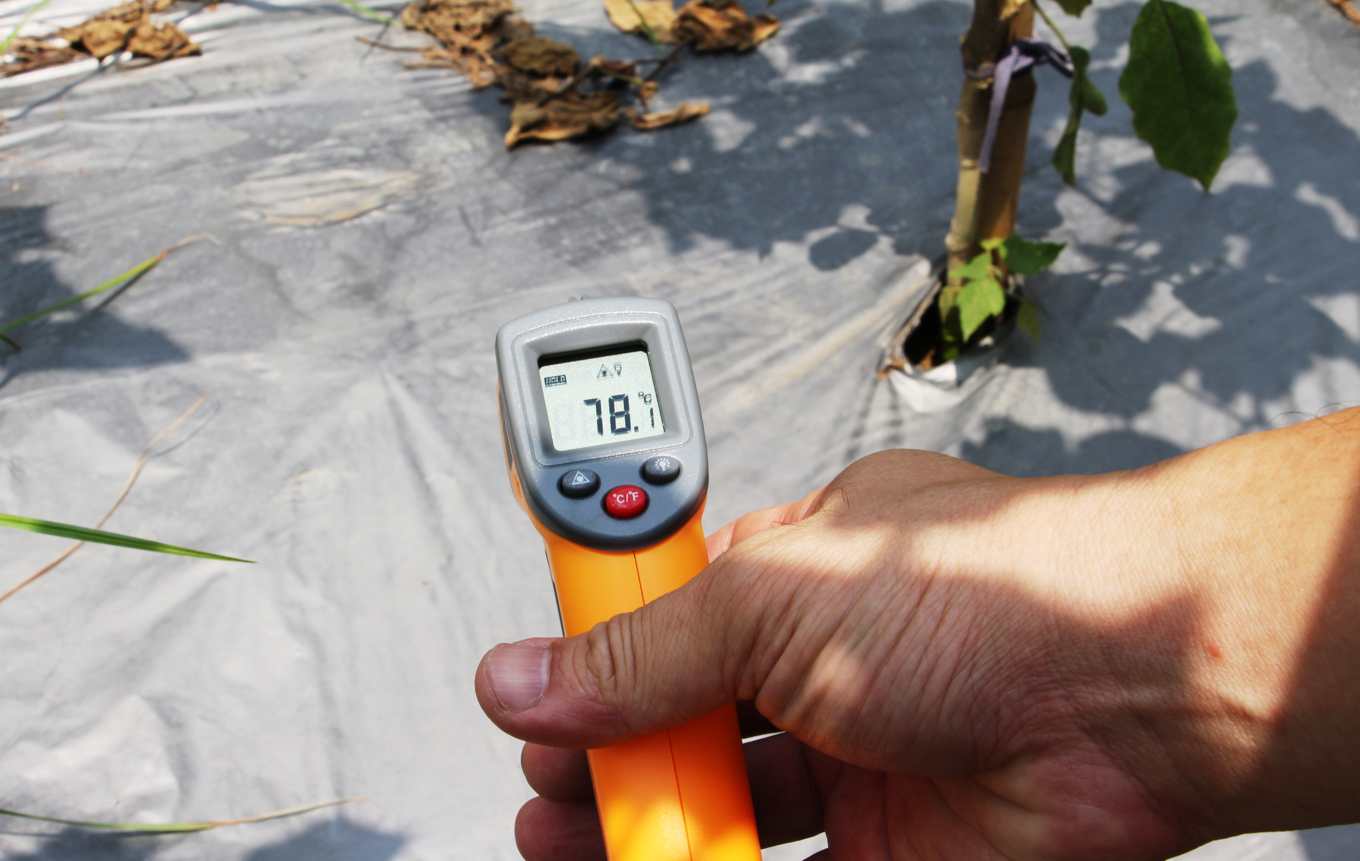
Plastic mulch sheeting in the field measured 78 degrees Celsius, plant roots tend to rise to the surface and suffer scald damage and fertilizer burn
Silver-black plastic mulch sheeting can often be seen in fields, with each bed completely covered to prevent weeds from spreading; for farmers this is a convenient and cheap practice. However, when actually tested in the field, at midday the plastic sheeting temperature reached as high as 78 degrees Celsius. The non-breathable plastic sheeting clings tightly to the soil, not only causing plant roots to rise to the surface, but also easily causing fibrous root burn and excessively high soil temperatures.
Orchard brought back from the brink - the secret lies in foliar feeding and manual weeding
"This farmer originally said that without spraying herbicide it just wouldn't work, and she also wanted to lay plastic sheeting in the field; at one point I wanted to give up helping her." When Chen Xingzong arrived at the third field, he pointed out that this field had originally been in terrible condition and the farmer was about to give up, but unexpectedly Chen Xingzong gave suggestions and she continued with foliar feeding and fruit thinning. "This orchard has been saved, and it even has the most beautiful root system of all the fields seen today."
However, Chen Xingzong also stated that part of the reason is that each orchard is at a different growth stage. Because this orchard is still at an early growth stage, it does not need to expend energy on fruit and can focus on developing its root system, so naturally the roots are relatively healthy.
If plastic sheeting must be laid, PET bottles should be placed underneath along with manual weeding and foliar feeding
Earlier this year there was not much rain, so roots rose to the surface, and heat scald damage was not severe; instead, because of the lack of rain, roots grew downward searching for water and anchored themselves, so root scald damage was minimal. In addition, even though plastic sheeting was laid in all the fields, the roots were in different conditions, because each field's soil, crop growth stage and herbicide management methods were all different.
Chen Xingzong stated that, for example, soil is divided into clayey soil and sandy soil. Clayey soil is finer and tends to retain moisture, so its temperature rises more slowly; sandy soil easily loses moisture and, relative to clayey soil, more readily reaches temperatures that harm crops after sunlight exposure. When sandy soil is combined with plastic sheeting, once sunlight raises the temperature, the crop is like having a fever; the roots and rhizosphere microorganisms are damaged, and the crop easily wilts and ages.
Although laying plastic sheeting has many disadvantages, farmers' habits are hard to change. Chen Xingzong also suggested that at the very least PET bottles should be placed under the plastic sheeting, along with foliar feeding and manual weeding.