Detailed Explanation of Open-Field Watermelon Cultivation with Plastic Film Mulching
I. Soil Selection and Crop Rotation
1. Soil selection: Choose sandy soil with good aeration and large soil porosity. In early spring, soil temperature rises quickly, which can promote seedling growth. A large diurnal temperature difference is beneficial for plant growth and development and for the accumulation of sugars in the fruit. Clay soil can be improved, for example by applying more organic fertilizer, mushroom residue, plant ash, etc.
2. Crop rotation: Watermelon is most intolerant of continuous cropping. After continuous cropping, Fusarium wilt is likely to occur. The rotation period is generally about 6—7 years. The previous crop is mostly wheat, corn, cotton, etc., and the following crop is generally vegetables, such as Chinese cabbage, radish, spinach, etc.
3. Intercropping and relay cropping are often done with wheat, barley, rapeseed, peanut, etc., and can also be intercropped with young orchards and cotton.
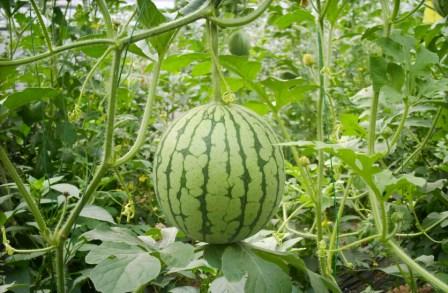
Watermelon Cultivation Technology
II. Land Preparation and Application of Base Fertilizer
First, deeply plow and sun the soil, then apply base fertilizer. Most commonly used is decomposed pig manure or barnyard manure, at a rate of about 3000 kg-4000 kg per mu, plus 20 kg of formula fertilizer (N:P:K=15:8:27), mixed evenly with a small amount of carbendazim and insecticide, then broadcast. Finally, form ridges with a ridge spacing of 2.5—3 m and a ridge height of 30 cm. Each ridge is divided into two rows, made into a turtle-back shape, with a row spacing of 30 cm, a row height of 20 cm, and a row width of 30 cm.
III. Seedling Raising
1. Variety selection: Choose mid-to-late maturing, disease-resistant, high-quality, high-yielding watermelon varieties, such as: Kangbing Qilu Wang, Dongbei Long, Xinong No. 8, etc.
2. Preparation of nutrient soil: Based on 12 sq m of seedbed required per mu, 1000 nutrient pots are needed. Use about 150 kg of farmyard manure (mixed with a small amount of plant ash), add about 350 kg of clean garden soil (ratio 3:7, total nutrient soil 500 kg), then add about 5 kg of formula fertilizer, and disinfect with 65% mancozeb powder (about 20 kg). Mix all thoroughly, cover with plastic film for 2—3 days, then remove it. After the medicinal smell has dissipated, it is ready for use.
3. Build a seedling-raising cold frame with a small arched shed on top. The cold frame is 1.2 m wide, and the length is calculated as 10 m per mu. Electric heating wires can be laid at the bottom of the cold frame, then the nutrient soil is put into nutrient pots, which are arranged neatly and tightly in the seedbed.
4. Sowing: A. Sowing period: The seedling age of watermelon is generally about 30 days, and the sowing time is determined by the planting time. In the Xi'an area, planting time is generally in mid-April, so the appropriate sowing time should be around March 10. B. Sowing rate: about 200 g per mu. C. Seed treatment: Select seeds carefully, sun them for 2 days, put the seeds into 55°C warm water and stir continuously for 15 minutes, soak for 4—6 hours after cooling, wrap them in disinfected wet cloth and place in a container, and germinate at 25—30°C (or use body temperature for germination). Wash the seeds once every other day, they sprout after 3 days, and sow after 70% of the seeds have broken white. D. Sowing method: The day before sowing, water the seedbed thoroughly at one time (be careful not to wash away the nutrient soil), and preheat so that the soil temperature reaches 28—30°C, then place the seeds with the radicle facing down into the nutrient pots, 1 seed per pot (2 seeds for those that have not sprouted), cover with about 1 cm of nutrient soil, cover with plastic film, and secure the small arched shed.
5. Seedling stage management
A. Use high-temperature seedling raising, that is, control the soil temperature at 28—30°C before emergence. After emergence (about 70%), lower the soil temperature in time, controlling it at 22—25°C during the day and 18—20°C at night. Gradually lower the temperature 7—10 days before transplanting to harden the seedlings, so that the soil temperature of the seedling pots is close to the soil temperature at planting (about 15°C).
B. Water and fertilizer management in the seedbed: Besides temperature, the focus of seedbed management is humidity control, that is, reduce seedbed humidity as much as possible and reduce the number of waterings as much as possible. In principle, water after the surface of the nutrient pot soil is dry and whitish, and at the same time pay attention to ventilation. After emergence is uniform, spray propamocarb once to prevent damping-off and seedling blight.
IV. Open-Field Direct Seeding
1. Sowing method: Use the direct seeding method after germination. First dig sowing holes in the watermelon rows according to plant spacing, then water the holes, at least one large bowl of water per hole. After the water seeps down, use a watermelon shovel to open a sowing furrow about 1.5—2 cm deep. When sowing, place the seed sprout tip downward against the ridge of the sowing furrow, sow 2—3 seeds per hole, cover with fine soil about 1—1.5 cm, and cover with plastic film.
2. Releasing seedlings: Cut an opening in the plastic film at the emergence point so that the seedling is exposed outside the film. After releasing the seedlings, seal the opening in the film tightly with soil.
V. Planting:
1. Planting density: Plant 2 rows per ridge, with a row spacing of 30 cm and a plant spacing of 60—65 cm, planting about 700 plants per mu.
2. Planting method: The two rows are staggered using triangular planting. Dig holes according to a plant spacing of 60—65 cm, water each hole sufficiently for planting, then place the seedlings in, taking care to keep the nutrient soil block intact. After transplanting, cover with plastic film. When covering with plastic film, be careful to expose the seedlings and firm the soil around the seedlings with fine soil.
VI. Pruning, Vine Pressing, and Selecting and Keeping Young Fruit:
1. Three-vine pruning: In addition to the main vine, keep one side vine on each side near nodes 7—8 of the main vine, for a total of three vines. Before fruit set, remove excess side branches in time. Except for the branches that protect the seedlings and the side branches at the fruit-setting node, all other side branches and side buds should be removed. After fruit set, the frequency of removal should be reduced or stopped.
2. Vine pressing: After the watermelon vine elongates, take soil blocks from between the rows, flatten one side, and press them onto the internodes of the stems and vines, generally once every 3—4 nodes. Note that the two rows on each ridge should be pressed separately to both sides, leaving the middle as a working row.
3. Selecting and keeping young fruit: The young fruit from the 2nd or 3rd female flower around node 15 of the main vine is more suitable. Keep 1 fruit per plant first, and only select and keep second-crop fruit when the first-crop fruit is close to maturity. After keeping the fruit, combine fruit retention with artificial pollination. Do not pinch the tip before the fruit is firmly set. Pay attention to pruning and removing side branches and side buds. When the fruit is firmly set and about the size of an egg, pinch the tip to control growth. When vigorous growth prevents fruit set, the stems and vines are often pinched and injured to control excessive growth.
VII. Topdressing and Watering
1. Topdressing: Control the amount of nitrogen fertilizer used, and restrict the use of chlorine-containing fertilizers and their compound fertilizers. Apply topdressing twice with water during the fruit-setting stage and the fruit expansion stage respectively, using about 10 kg of formula fertilizer each time. Foliar fertilizer can be added in the earlier stage. Topdressing should be combined with watering, and each time applied between the two rows on the ridge to facilitate full absorption.
2. Watering: Generally, do not water much before fruit set. In cases of extreme drought or when needed, water lightly. After fruit set, water the first time when the young fruit is the size of an egg. Most often, irrigate fully in the watermelon furrow, as evenly as possible, generally once a week. After 2—3 waterings, stop watering when the fruit is close to maturity.