How are the standards and characteristics of free-range chickens defined?
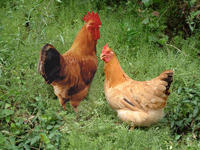
Free-range chicken image
A: As people pay more and more attention to the quality of life and their own health, they increasingly pursue natural foods, so in recent years a trend of eatingfree-range chickenshas sprung up in both urban and rural areas across our country, and this is also an objective requirement of social progress.
Conceptually speaking, what most farmer friends call free-range chickens is not a specific breed, but a general term for a type of chicken.
Free-range chickens refer to those raised by farming households themselves, kept under free-range or semi-free-range conditions, mainly feeding themselves on corn, grains, insects and green grass, with relatively extensive management and a relatively small output of products; because nutrients are deposited and stored in the chicken's body for a relatively long time, the quality of the chicken products produced is relatively good. Some friends also call free-range chickens native chickens, farmhouse chickens, etc. Overall, the names used among the public and among practitioners are rather confusing.
In order to unify the standards for free-range chickens, the animal husbandry and veterinary administrative departments of various regions and the provincial quality and technical supervision bureaus have successively introduced some local standards. For example, the Hebei Provincial Animal Husbandry and Veterinary Bureau proposed it, and Professor Huang Renlu of Hebei Agricultural University led the drafting of the Hebei local standard for free-range chickens, which was issued by the Hebei Provincial Quality and Technical Supervision Bureau in 2005. It is a local recommended standard, and the standard number is: DB13/T686-2005.
The standard is defined as follows:Appearance characteristics of free-range chickensPart
First, the head characteristics of free-range chickens: the head and face are relatively small, with delicate features, that is, giving people a petite impression;
Second is the characteristic of the comb. Most comb types are single comb (the so-called single comb is a serrated single fleshy comb), some are pea comb (composed of three smaller single combs, with the middle leaf higher) and strawberry comb (the whole body from the base of the beak to the middle of the top of the comb, small and low, with no comb tail, and the surface protruding like a strawberry), and very few have comb feathers;
The third characteristic is the beak of the free-range chicken. The beak is short and thin, mostly bluish-gray and flesh-colored, with very few being black or yellow;
The fourth characteristic is the shank, that is, the lower leg. The lower leg is slender, mostly bluish-gray or flesh-colored;
The fifth characteristic is the earlobe, which is red or white, with red accounting for the majority;
The sixth characteristic is the feathers. The rooster's feathers are reddish-brown, and the feathers on the tail and wings are black with a glossy sheen. Most hens are partridge-colored, mainly yellow partridge and brown partridge, with a small number being speckled and variegated.
In terms of body shape characteristics, free-range chickens are generally relatively small and slender, with a well-proportioned body structure, tight feathers, small bones and a sturdy constitution. For adult chickens, the body length is 21.8 cm for roosters and 18.1 cm for hens, the body weight is 1.21-2.1 kg for roosters and between 0.95-1.6 kg for hens, the average age at first laying is 150 days, the average annual egg production is about 150 eggs, and the maximum egg weight is 54 g. This characteristic is also relatively familiar to everyone and quite obvious, so many people mistakenly think that small eggs are free-range eggs, which is actually inaccurate.